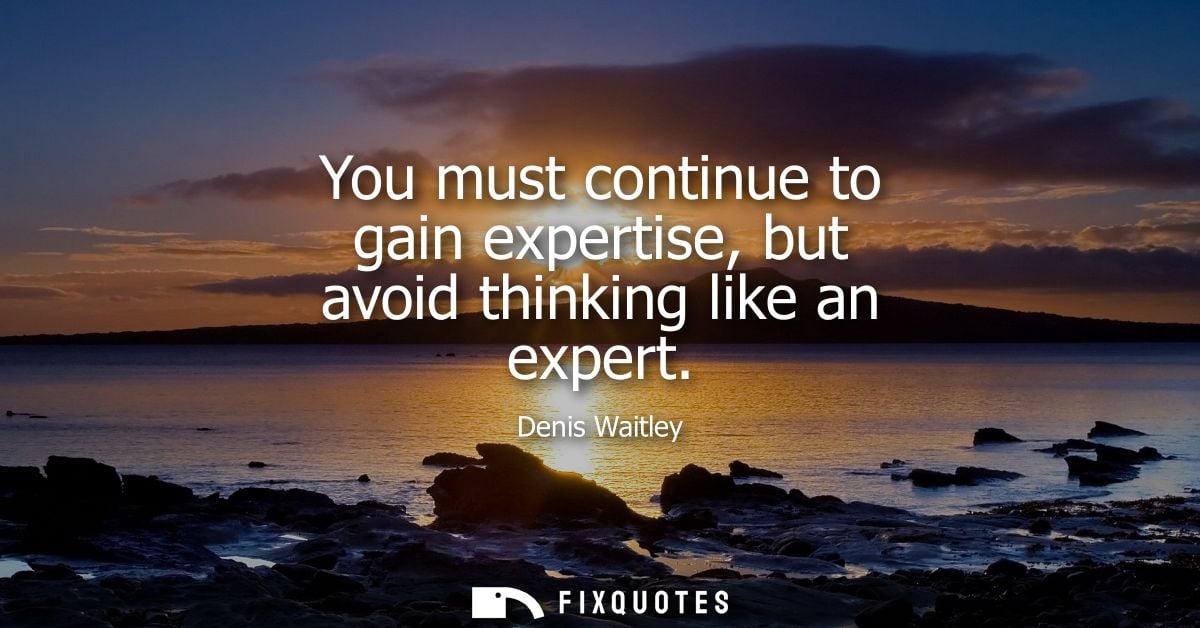
"You must continue to gain expertise, but avoid thinking like an expert"
About this Quote
Waitley’s line is a self-help-era paradox designed to slip past your defenses: become highly skilled, then refuse the psychological perks that often come with skill. “Gain expertise” flatters the striver; “avoid thinking like an expert” yanks the ladder out from under the ego. The hook is that it treats expertise not as a badge but as a risk factor.
The specific intent is practical, almost managerial. He’s arguing for competence without calcification: keep sharpening your tools, but don’t let your tools decide what you’re capable of seeing. “Thinking like an expert” is shorthand for a cluster of habits that look like confidence and often function like blindness: premature certainty, reliance on familiar frameworks, and the quiet dismissal of outlier information. In workplaces, that’s the veteran who stops listening; in creative fields, it’s the craftsperson who can’t tolerate messy drafts; in politics, it’s the technocrat who mistakes models for reality.
The subtext is also a cultural critique of credential worship. Waitley came up in the late-20th-century American success-literature ecosystem, where “lifelong learning” became a moral virtue and “expert” became both an aspiration and a punchline. His sentence tries to reconcile those tensions by separating mastery from mentality. Expertise is necessary for judgment; “expert thinking” is the temptation to outsource curiosity to your résumé.
It works because it reframes humility as a performance advantage, not a character trait: stay teachable, stay porous, stay dangerous to your own assumptions.
The specific intent is practical, almost managerial. He’s arguing for competence without calcification: keep sharpening your tools, but don’t let your tools decide what you’re capable of seeing. “Thinking like an expert” is shorthand for a cluster of habits that look like confidence and often function like blindness: premature certainty, reliance on familiar frameworks, and the quiet dismissal of outlier information. In workplaces, that’s the veteran who stops listening; in creative fields, it’s the craftsperson who can’t tolerate messy drafts; in politics, it’s the technocrat who mistakes models for reality.
The subtext is also a cultural critique of credential worship. Waitley came up in the late-20th-century American success-literature ecosystem, where “lifelong learning” became a moral virtue and “expert” became both an aspiration and a punchline. His sentence tries to reconcile those tensions by separating mastery from mentality. Expertise is necessary for judgment; “expert thinking” is the temptation to outsource curiosity to your résumé.
It works because it reframes humility as a performance advantage, not a character trait: stay teachable, stay porous, stay dangerous to your own assumptions.
Quote Details
| Topic | Learning |
|---|---|
| Source | Help us find the source |
| Cite |
Citation Formats
APA Style (7th ed.)
Waitley, Denis. (2026, January 18). You must continue to gain expertise, but avoid thinking like an expert. FixQuotes. https://fixquotes.com/quotes/you-must-continue-to-gain-expertise-but-avoid-6384/
Chicago Style
Waitley, Denis. "You must continue to gain expertise, but avoid thinking like an expert." FixQuotes. January 18, 2026. https://fixquotes.com/quotes/you-must-continue-to-gain-expertise-but-avoid-6384/.
MLA Style (9th ed.)
"You must continue to gain expertise, but avoid thinking like an expert." FixQuotes, 18 Jan. 2026, https://fixquotes.com/quotes/you-must-continue-to-gain-expertise-but-avoid-6384/. Accessed 27 Mar. 2026.
More Quotes by Denis
Add to List