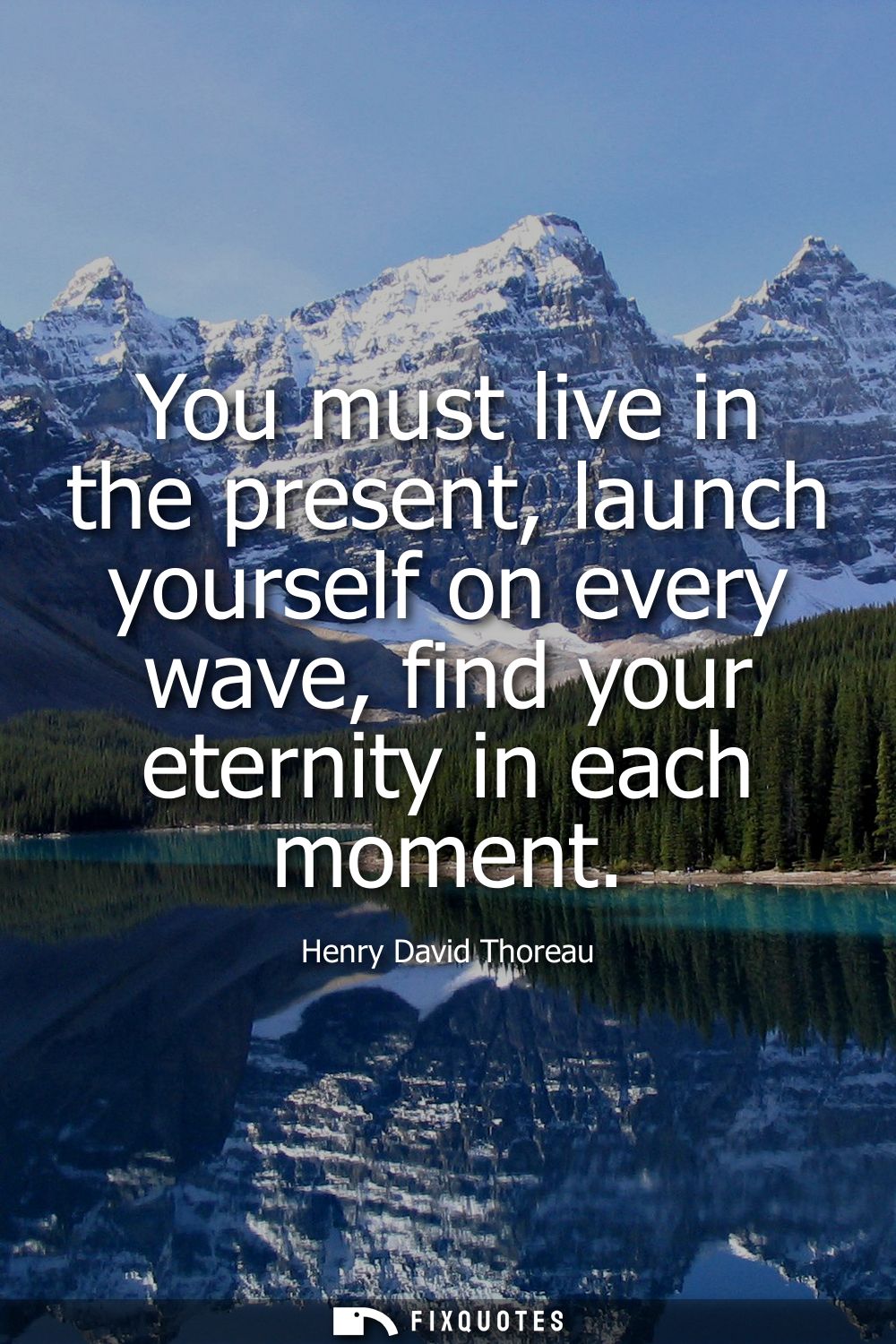
"You must live in the present, launch yourself on every wave, find your eternity in each moment"
About this Quote
Thoreau doesn’t offer mindfulness as a scented candle; he offers it as a dare. “You must live in the present” lands with the force of a command, not a suggestion, and the next clause turns that command into kinetic imagery: “launch yourself on every wave.” It’s a line that borrows from the body, from risk, from weather. The present isn’t a calm pond to contemplate; it’s surf, and you’re expected to commit.
The subtext is a rejection of the era’s prized virtues: industriousness, long-term accumulation, the quiet moral prestige of planning. In mid-19th-century America, time was being disciplined by factories, railroads, and a tightening Protestant work ethic that treated the future as the proper destination of a life. Thoreau, the patron saint of deliberate living, pushes back by insisting that meaning isn’t deferred. “Find your eternity in each moment” is less mysticism than insurgency: it relocates the infinite from churches and afterlives into the ordinary now.
What makes the sentence work is its paradox: eternity, by definition, should be the opposite of a moment. Thoreau collapses that opposition on purpose. If eternity can be found “in each moment,” then the future loses its tyrannical leverage over the present. He’s not telling you to stop thinking ahead; he’s warning that a life organized around later is a life quietly forfeited. The line’s intensity is the point: it’s trying to snap you out of postponement, to make presence feel like action, not retreat.
The subtext is a rejection of the era’s prized virtues: industriousness, long-term accumulation, the quiet moral prestige of planning. In mid-19th-century America, time was being disciplined by factories, railroads, and a tightening Protestant work ethic that treated the future as the proper destination of a life. Thoreau, the patron saint of deliberate living, pushes back by insisting that meaning isn’t deferred. “Find your eternity in each moment” is less mysticism than insurgency: it relocates the infinite from churches and afterlives into the ordinary now.
What makes the sentence work is its paradox: eternity, by definition, should be the opposite of a moment. Thoreau collapses that opposition on purpose. If eternity can be found “in each moment,” then the future loses its tyrannical leverage over the present. He’s not telling you to stop thinking ahead; he’s warning that a life organized around later is a life quietly forfeited. The line’s intensity is the point: it’s trying to snap you out of postponement, to make presence feel like action, not retreat.
Quote Details
| Topic | Live in the Moment |
|---|
More Quotes by Henry
Add to List