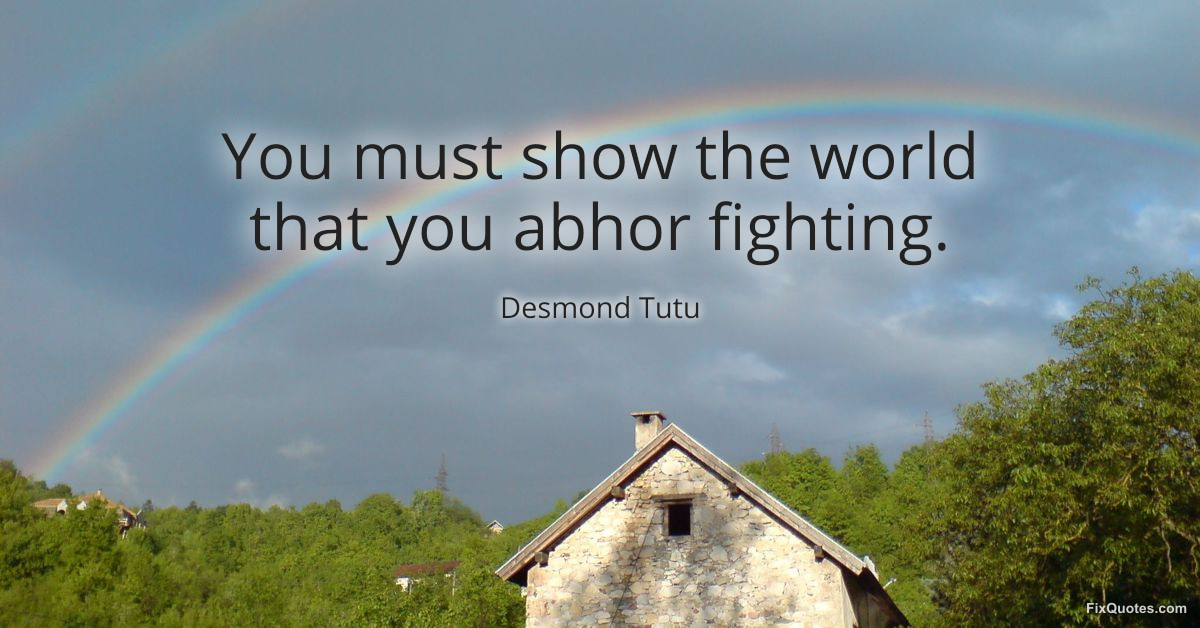
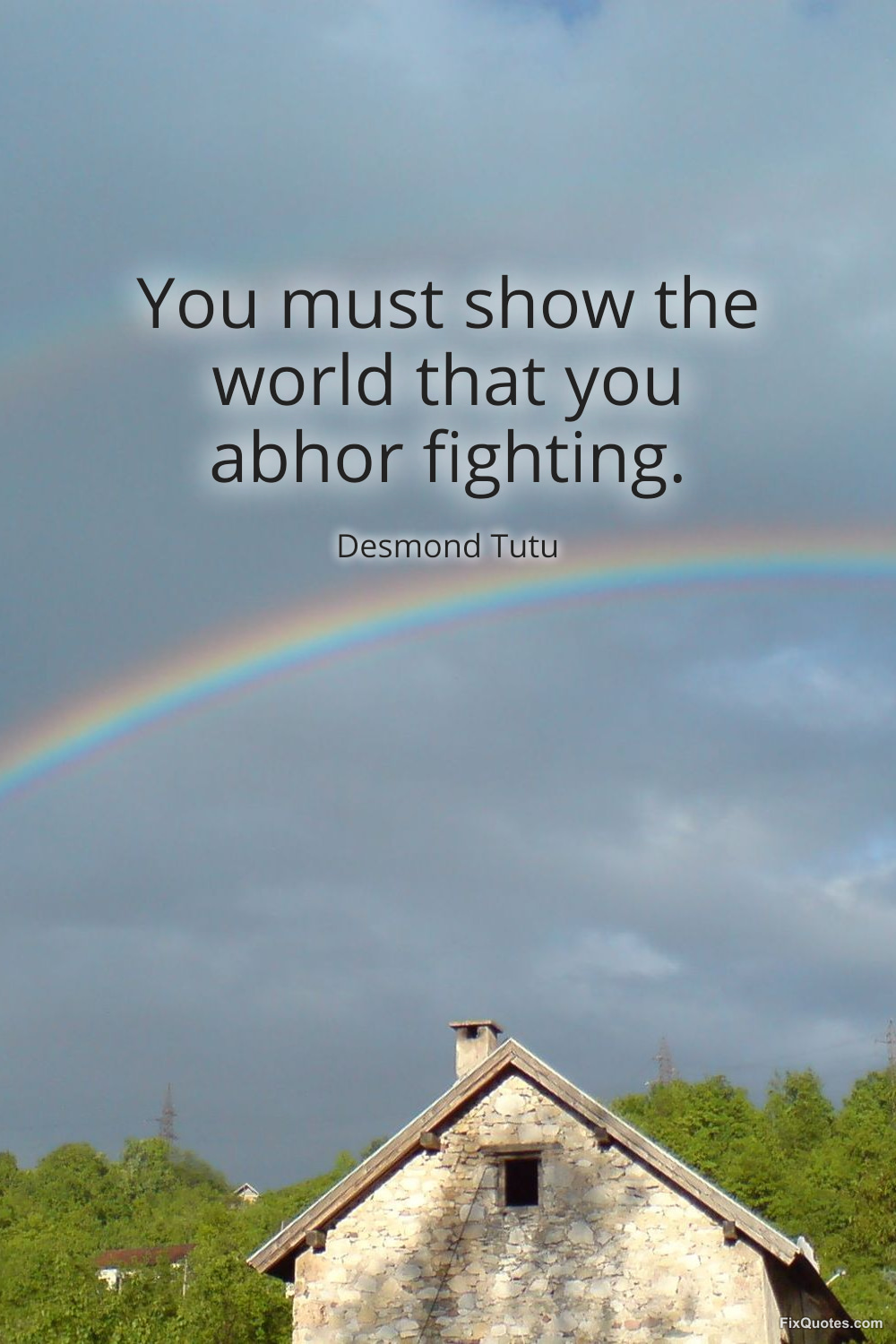
"You must show the world that you abhor fighting"
About this Quote
Tutu’s line is deceptively simple, almost parental in its phrasing, but it’s really a strategic command. “You must” doesn’t leave room for private virtue; it demands public theater. For Tutu, moral opposition to violence isn’t a personal lifestyle choice, it’s a social instrument. If abhorrence stays internal, it changes nothing. If it’s made visible, it becomes contagious, a standard others are pressured to meet.
The key word is “show.” He’s talking about performance, yes, but not hypocrisy. In apartheid South Africa, where the state’s violence was bureaucratic and “legal,” nonviolence needed its own kind of spectacle: marches, prayers, funerals turned into rallies, truth spoken into microphones that the regime couldn’t fully control. Public abhorrence becomes a form of protection too. It creates witnesses. It raises the reputational cost of brutality. It narrows the state’s ability to pretend it’s merely “maintaining order.”
There’s subtext aimed at activists tempted by righteous retaliation. Tutu isn’t naive about anger; he’s wary of what violence does to a movement’s legitimacy and to its participants’ inner lives. “Abhor” is stronger than “avoid.” He’s asking for disgust, not just restraint, because he knows how quickly “necessary force” becomes habit, then identity.
As a leader shaped by Christian theology and political realism, Tutu frames nonviolence as both ethical stance and tactical leverage: the refusal to mirror your oppressor, broadcast loud enough that the world can’t look away.
The key word is “show.” He’s talking about performance, yes, but not hypocrisy. In apartheid South Africa, where the state’s violence was bureaucratic and “legal,” nonviolence needed its own kind of spectacle: marches, prayers, funerals turned into rallies, truth spoken into microphones that the regime couldn’t fully control. Public abhorrence becomes a form of protection too. It creates witnesses. It raises the reputational cost of brutality. It narrows the state’s ability to pretend it’s merely “maintaining order.”
There’s subtext aimed at activists tempted by righteous retaliation. Tutu isn’t naive about anger; he’s wary of what violence does to a movement’s legitimacy and to its participants’ inner lives. “Abhor” is stronger than “avoid.” He’s asking for disgust, not just restraint, because he knows how quickly “necessary force” becomes habit, then identity.
As a leader shaped by Christian theology and political realism, Tutu frames nonviolence as both ethical stance and tactical leverage: the refusal to mirror your oppressor, broadcast loud enough that the world can’t look away.
Quote Details
| Topic | Peace |
|---|---|
| Source | Help us find the source |
| Cite |
Citation Formats
APA Style (7th ed.)
Tutu, Desmond. (2026, January 18). You must show the world that you abhor fighting. FixQuotes. https://fixquotes.com/quotes/you-must-show-the-world-that-you-abhor-fighting-6400/
Chicago Style
Tutu, Desmond. "You must show the world that you abhor fighting." FixQuotes. January 18, 2026. https://fixquotes.com/quotes/you-must-show-the-world-that-you-abhor-fighting-6400/.
MLA Style (9th ed.)
"You must show the world that you abhor fighting." FixQuotes, 18 Jan. 2026, https://fixquotes.com/quotes/you-must-show-the-world-that-you-abhor-fighting-6400/. Accessed 3 Apr. 2026.
More Quotes by Desmond
Add to List