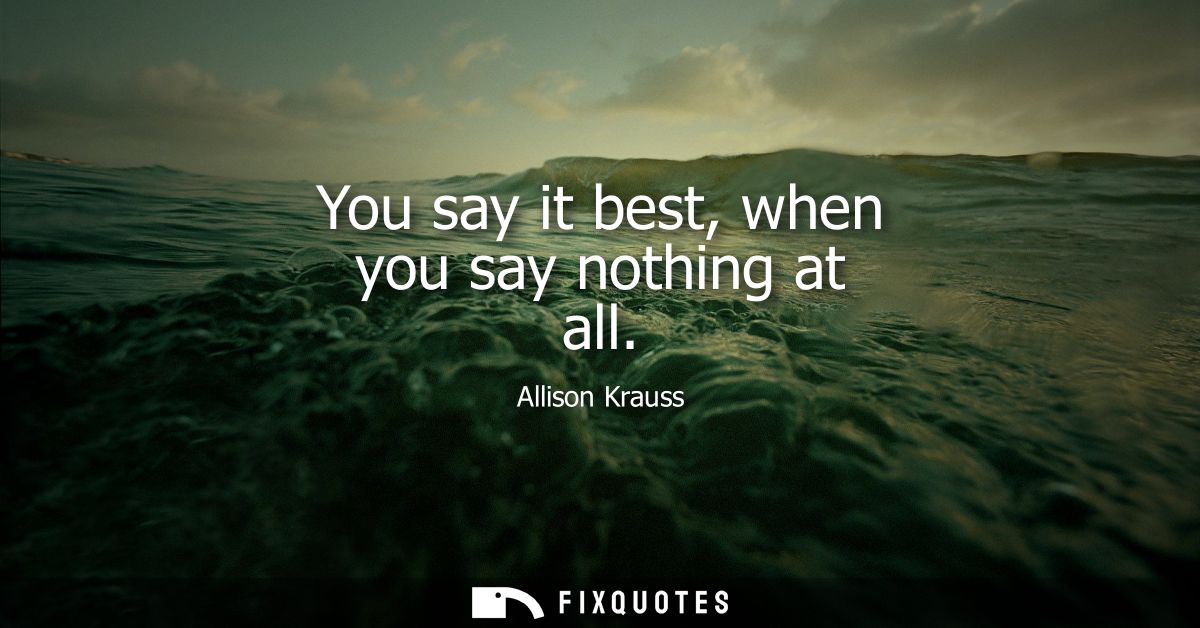
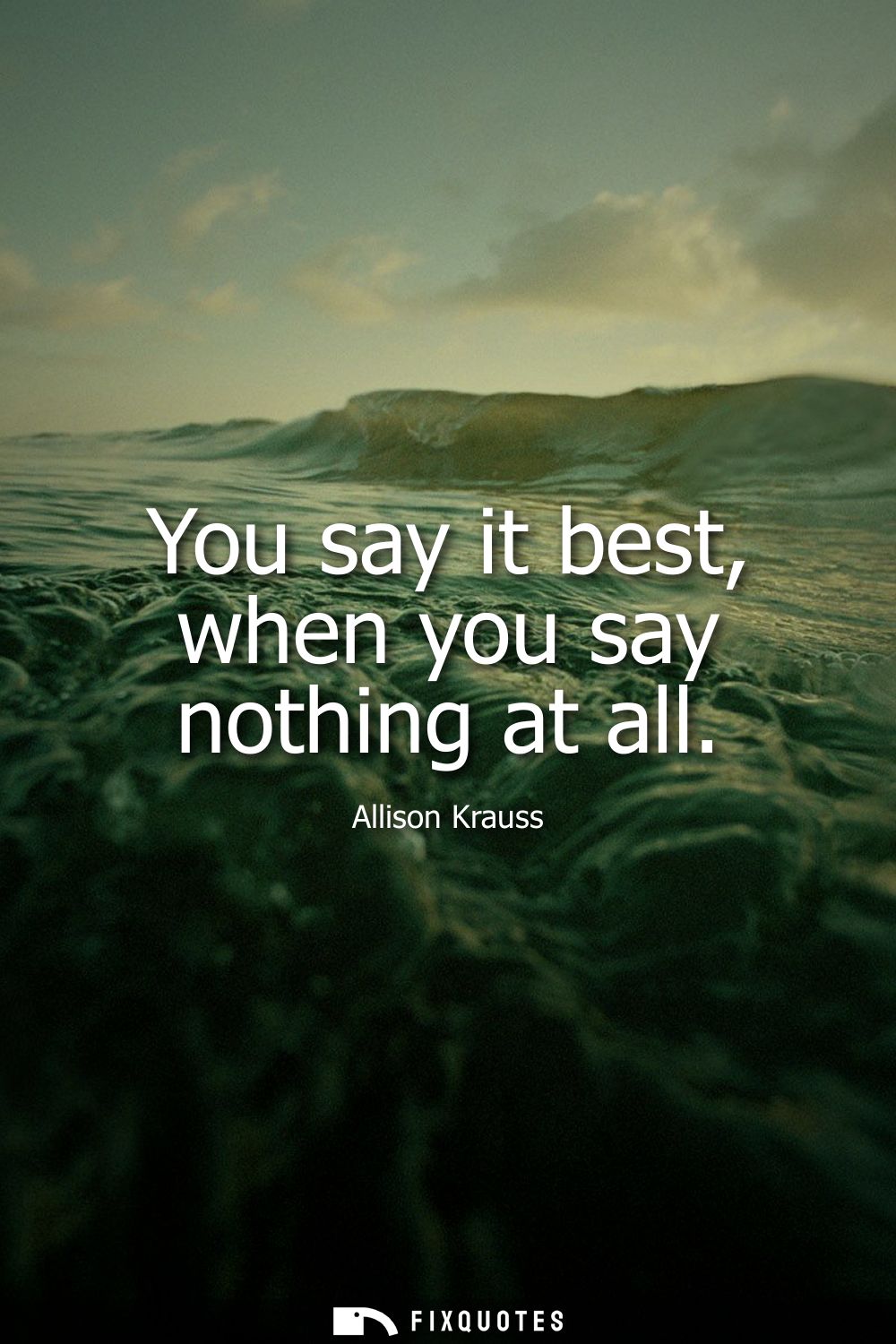
"You say it best when you say nothing at all"
About this Quote
A love line that doubles as a truce. "You say it best, when you say nothing at all" romanticizes silence, but it also quietly sets terms: stop trying to talk your way out of what your face, your hands, your habits already reveal. In Alison Krauss's world, where restraint is a kind of virtuosity, the sentiment lands because it feels earned. Bluegrass and country have always prized the unsaid - ache conveyed through a held note, a pause, a voice that refuses melodrama. The lyric borrows that aesthetic: less explanation, more evidence.
The intent is reassuring on the surface. It tells a partner, I don't need speeches; I can read you. That is intimate, even flattering. The subtext is sharper: words are suspect. They can be performative, defensive, weaponized. Silence, here, becomes a proof of authenticity, the opposite of spin. It's a small rebuke to over-talking, to the nervous modern impulse to narrate every feeling in real time.
Context matters: the line arrives in a song built on gentle observation - "the smile on your face", "the touch of your hand". Communication is relocated from language to behavior. That shift is why it works culturally: it validates an emotional literacy many people feel but struggle to justify. Still, there's an edge. If silence is "best", who gets to decide what it means? The lyric sells quiet as devotion, but it also hints at the power dynamics of interpretation: one person speaks, the other gets edited.
The intent is reassuring on the surface. It tells a partner, I don't need speeches; I can read you. That is intimate, even flattering. The subtext is sharper: words are suspect. They can be performative, defensive, weaponized. Silence, here, becomes a proof of authenticity, the opposite of spin. It's a small rebuke to over-talking, to the nervous modern impulse to narrate every feeling in real time.
Context matters: the line arrives in a song built on gentle observation - "the smile on your face", "the touch of your hand". Communication is relocated from language to behavior. That shift is why it works culturally: it validates an emotional literacy many people feel but struggle to justify. Still, there's an edge. If silence is "best", who gets to decide what it means? The lyric sells quiet as devotion, but it also hints at the power dynamics of interpretation: one person speaks, the other gets edited.
Quote Details
| Topic | Romantic |
|---|---|
| Source | Verified source: When You Say Nothing at All (Alison Krauss & Union Station, 1994)
Evidence:
Song: "When You Say Nothing at All" by Alison Krauss & Union Station |
| Cite |
Citation Formats
APA Style (7th ed.)
Krauss, Allison. (2026, March 13). You say it best when you say nothing at all. FixQuotes. https://fixquotes.com/quotes/you-say-it-best-when-you-say-nothing-at-all-131970/
Chicago Style
Krauss, Allison. "You say it best when you say nothing at all." FixQuotes. March 13, 2026. https://fixquotes.com/quotes/you-say-it-best-when-you-say-nothing-at-all-131970/.
MLA Style (9th ed.)
"You say it best when you say nothing at all." FixQuotes, 13 Mar. 2026, https://fixquotes.com/quotes/you-say-it-best-when-you-say-nothing-at-all-131970/. Accessed 28 Mar. 2026.
More Quotes by Allison
Add to List