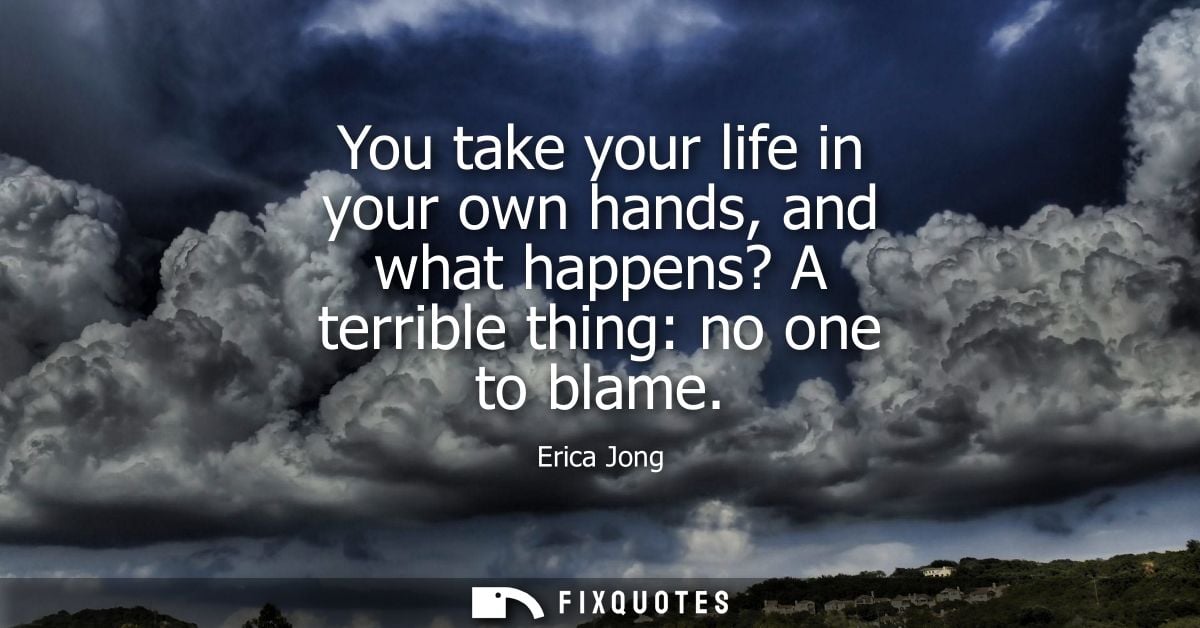
"You take your life in your own hands, and what happens? A terrible thing: no one to blame"
About this Quote
Jong, a novelist identified with second-wave feminism and the confessional candor of the 1970s, knew exactly what kind of liberation narrative her era was selling: break free, claim your desires, author your destiny. The subtext is that emancipation is emotionally expensive. Patriarchy can be a cage, but it can also function as an explanation. When you step outside it, you gain agency and lose the story that your pain is someone else's fault. That loss is "terrible" because blame is not just resentment; it's a form of meaning-making.
The wit works because it refuses sanctimony. Jong doesn't moralize responsibility as character-building; she frames it as a kind of existential prank. The sentence structure mirrors the trap: a familiar setup, a breezy "and what happens?", then the cold click of the door closing. It's a novelistic insight posed as a joke: adulthood isn't heroic self-mastery; it's living with choices you can't outsource.
Quote Details
| Topic | Free Will & Fate |
|---|---|
| Source | Fear of Flying (novel), Erica Jong, 1973. |
| Cite |
Citation Formats
APA Style (7th ed.)
Jong, Erica. (2026, January 17). You take your life in your own hands, and what happens? A terrible thing: no one to blame. FixQuotes. https://fixquotes.com/quotes/you-take-your-life-in-your-own-hands-and-what-58714/
Chicago Style
Jong, Erica. "You take your life in your own hands, and what happens? A terrible thing: no one to blame." FixQuotes. January 17, 2026. https://fixquotes.com/quotes/you-take-your-life-in-your-own-hands-and-what-58714/.
MLA Style (9th ed.)
"You take your life in your own hands, and what happens? A terrible thing: no one to blame." FixQuotes, 17 Jan. 2026, https://fixquotes.com/quotes/you-take-your-life-in-your-own-hands-and-what-58714/. Accessed 22 Mar. 2026.