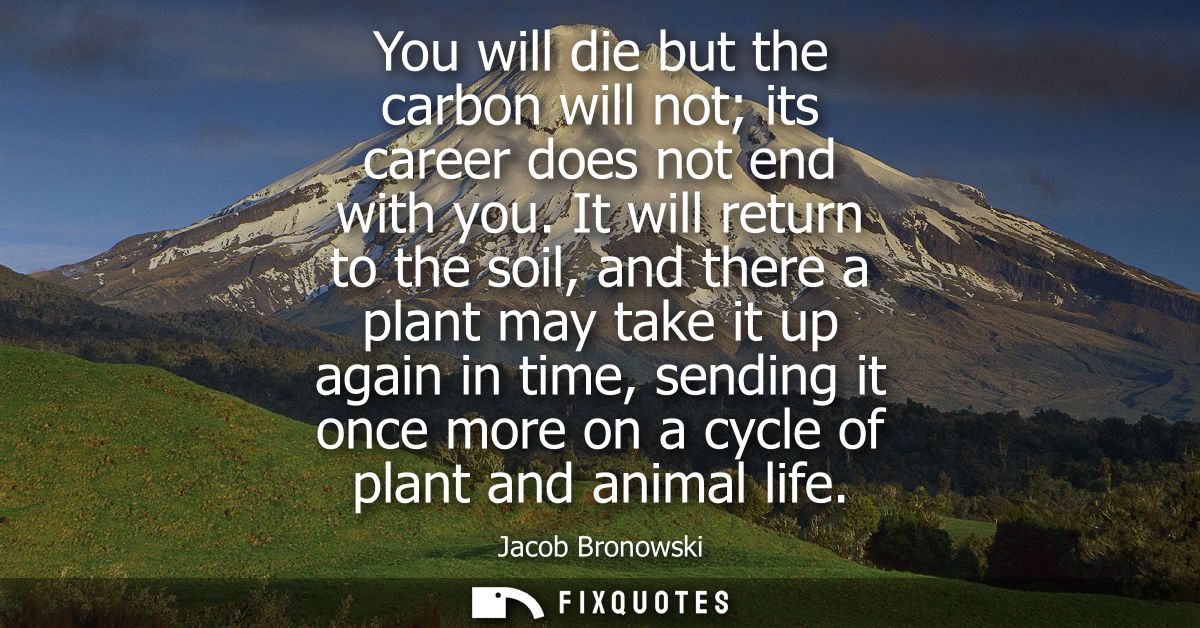
"You will die but the carbon will not; its career does not end with you. It will return to the soil, and there a plant may take it up again in time, sending it once more on a cycle of plant and animal life"
About this Quote
As a scientist who spent his career translating big ideas for public life, Bronowski is also making an ethical move. Carbon is both intimate (your cells) and impersonal (a basic element cycling through everything). By foregrounding it, he nudges the reader away from exceptionalism. You are not a final chapter; you’re a temporary arrangement. The subtext is anti-possessive: the body isn’t property to cling to, and life isn’t a story with a neat ending, but a process that keeps reusing the same raw materials.
The context matters. Writing in a century that saw industrial war, nuclear anxiety, and the growing authority of scientific explanation, Bronowski often argued for a humane, non-mystical awe. This passage fits that project: a corrective to both despair and sentimental spirituality. It’s also quietly ecological. The image of carbon returning to soil and becoming plant again turns death into a fact of metabolism, not a scandal - and reminds us that the cycle only works if the soil, the plants, and the world that receives us are not destroyed.
Quote Details
| Topic | Mortality |
|---|---|
| Source | Help us find the source |
| Cite |
Citation Formats
APA Style (7th ed.)
Bronowski, Jacob. (2026, January 18). You will die but the carbon will not; its career does not end with you. It will return to the soil, and there a plant may take it up again in time, sending it once more on a cycle of plant and animal life. FixQuotes. https://fixquotes.com/quotes/you-will-die-but-the-carbon-will-not-its-career-18041/
Chicago Style
Bronowski, Jacob. "You will die but the carbon will not; its career does not end with you. It will return to the soil, and there a plant may take it up again in time, sending it once more on a cycle of plant and animal life." FixQuotes. January 18, 2026. https://fixquotes.com/quotes/you-will-die-but-the-carbon-will-not-its-career-18041/.
MLA Style (9th ed.)
"You will die but the carbon will not; its career does not end with you. It will return to the soil, and there a plant may take it up again in time, sending it once more on a cycle of plant and animal life." FixQuotes, 18 Jan. 2026, https://fixquotes.com/quotes/you-will-die-but-the-carbon-will-not-its-career-18041/. Accessed 27 Mar. 2026.