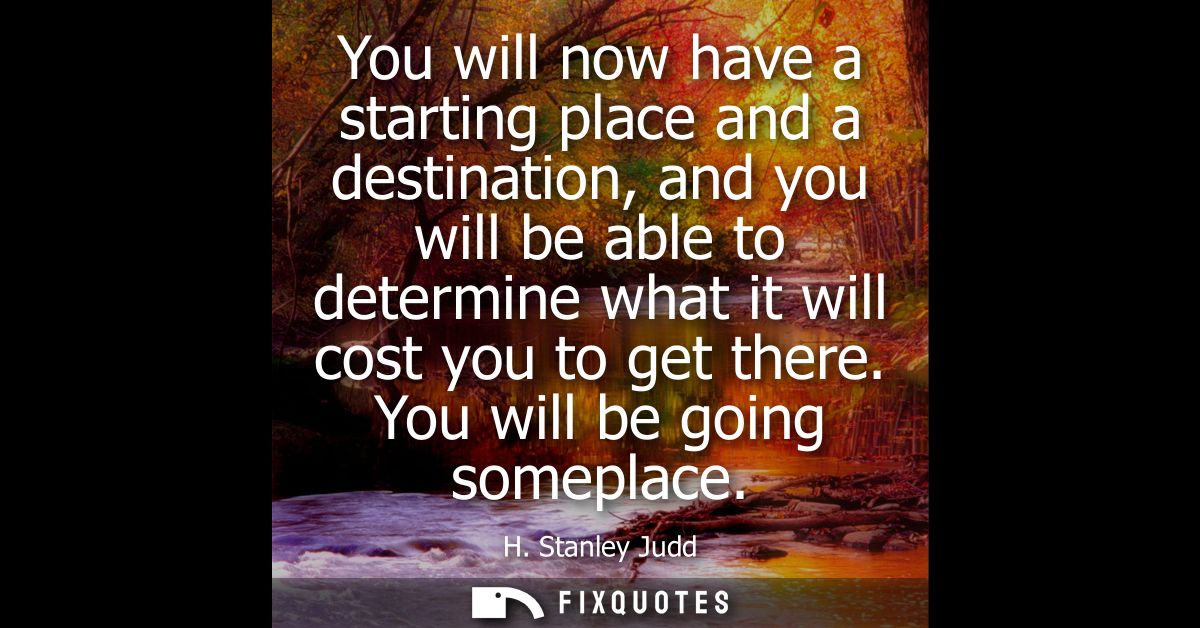
"You will now have a starting place and a destination, and you will be able to determine what it will cost you to get there. You will be going someplace"
About this Quote
A promise of motion disguised as bookkeeping: Judd turns self-improvement into itinerary. The sentence marches you from “starting place” to “destination” with the clean inevitability of a train schedule, then slips in the real hook: cost. Not money, exactly, but the kind of price people prefer to keep vague - time, comfort, pride, the pleasure of drifting. By naming cost as knowable, Judd flatters the reader with agency while quietly warning that progress is never free, and that ignorance of the price tag is its own excuse.
The rhetoric works because it’s procedural, almost bureaucratic. “Determine,” “cost,” “get there” - verbs of calculation, not inspiration. That tone matters. Judd isn’t selling a dream; he’s selling a method, an early-20th-century confidence that life can be engineered with the right plan. In an era of efficiency movements, uplift literature, and the emerging gospel of goal-setting, this reads like a moral upgrade to industrial management: take inventory of yourself, chart the route, accept the expenditure.
The final line, “You will be going someplace,” lands like a rebuke to complacency. It’s both reassurance and indictment. Reassurance: direction is possible. Indictment: if you’re “not going someplace,” you’re choosing stagnation. The subtext is that aimlessness is not neutral; it’s a decision with its own hidden costs. Judd’s intent is less to motivate with emotion than to corner you with clarity: define the trip, and you lose the right to pretend the fare is a surprise.
The rhetoric works because it’s procedural, almost bureaucratic. “Determine,” “cost,” “get there” - verbs of calculation, not inspiration. That tone matters. Judd isn’t selling a dream; he’s selling a method, an early-20th-century confidence that life can be engineered with the right plan. In an era of efficiency movements, uplift literature, and the emerging gospel of goal-setting, this reads like a moral upgrade to industrial management: take inventory of yourself, chart the route, accept the expenditure.
The final line, “You will be going someplace,” lands like a rebuke to complacency. It’s both reassurance and indictment. Reassurance: direction is possible. Indictment: if you’re “not going someplace,” you’re choosing stagnation. The subtext is that aimlessness is not neutral; it’s a decision with its own hidden costs. Judd’s intent is less to motivate with emotion than to corner you with clarity: define the trip, and you lose the right to pretend the fare is a surprise.
Quote Details
| Topic | Goal Setting |
|---|---|
| Source | Help us find the source |
More Quotes by Stanley Judd
Add to List