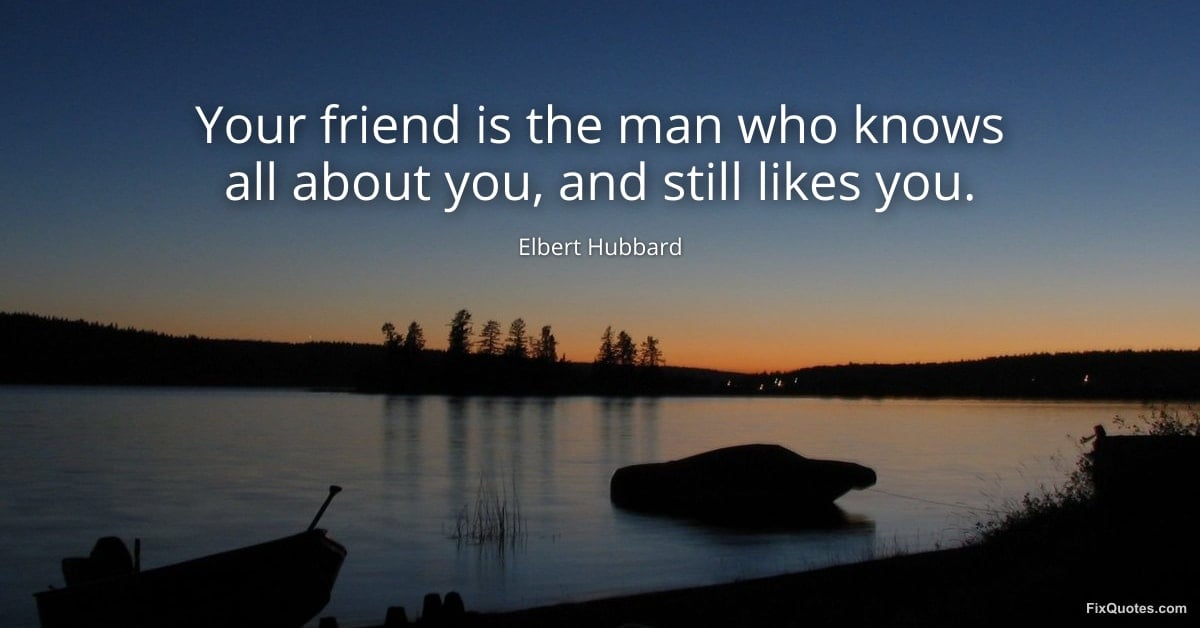
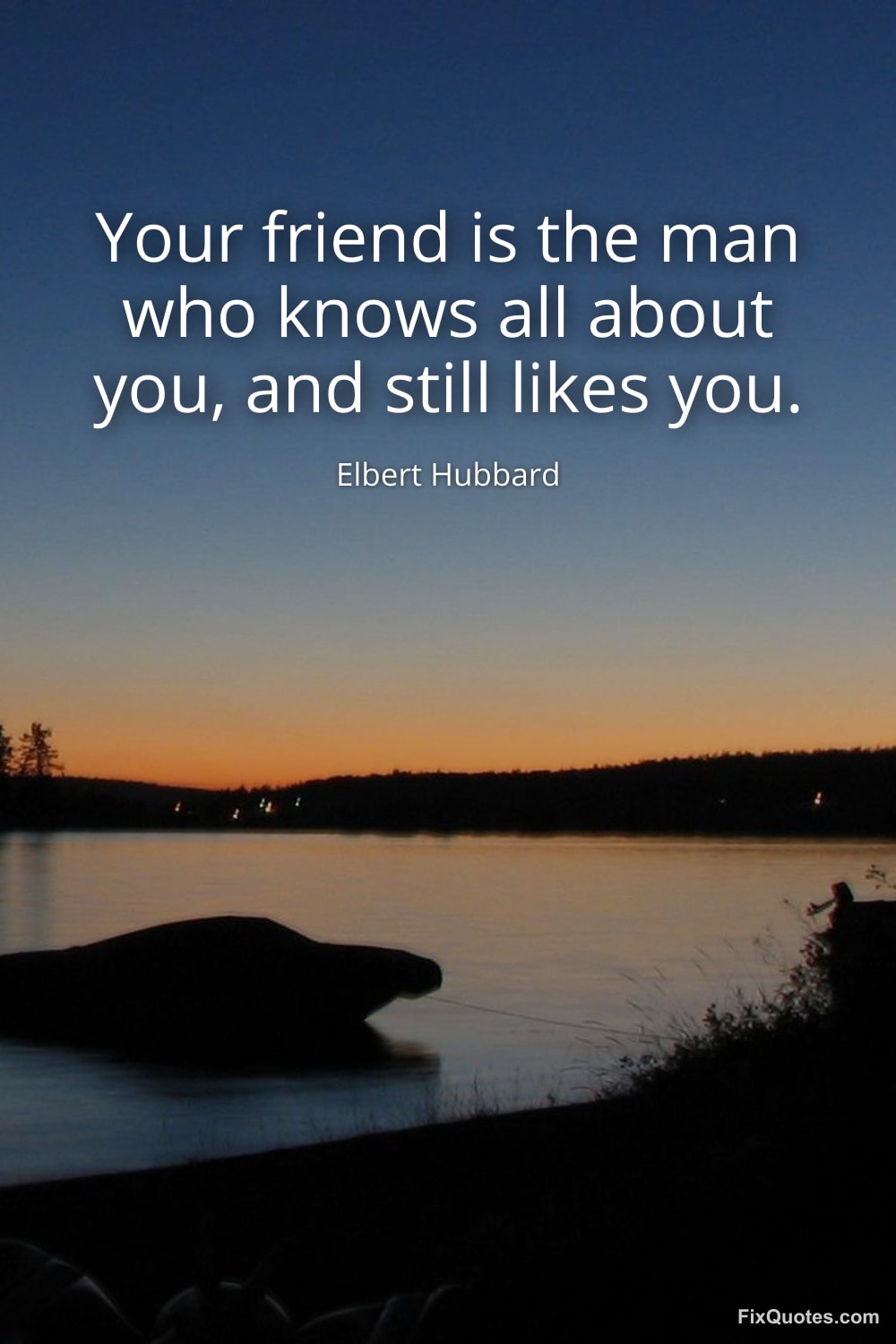
"Your friend is the man who knows all about you, and still likes you"
About this Quote
Friendship, Hubbard suggests, isn’t built on curated likability; it’s built on the radical act of staying. The line lands because it frames intimacy as a test of endurance: not whether someone can admire you, but whether they can metabolize the unflattering parts - your pettiness, your bad patterns, the stories you’d rather edit out - and remain warmly in your corner. “Knows all about you” is doing heavy work here. It implies time, proximity, and a level of attention that most relationships never reach. This isn’t the casual friendliness of shared taste; it’s the sustained exposure of shared history.
The twist is the last clause: “and still likes you.” Hubbard chooses “likes,” not “loves,” and that’s the quietly cynical, modern-feeling move. Love can be duty, romance, or abstraction; “like” is elective. It’s the everyday vote, cast repeatedly, to enjoy your company. The sentence also smuggles in a standard: real friendship isn’t proved when you’re impressive, but when you’re merely yourself, stripped of performance.
Context matters. Hubbard, a self-made American writer and entrepreneur in the late 19th and early 20th century, specialized in aphorisms that fit the era’s appetite for moral clarity and practical psychology. In a culture selling self-improvement and reputations, he offers a counter-metric: the person who sees behind the sales pitch and doesn’t walk away. It’s both comforting and bracing, because it implies most people don’t qualify - and that’s precisely why the ones who do feel priceless.
The twist is the last clause: “and still likes you.” Hubbard chooses “likes,” not “loves,” and that’s the quietly cynical, modern-feeling move. Love can be duty, romance, or abstraction; “like” is elective. It’s the everyday vote, cast repeatedly, to enjoy your company. The sentence also smuggles in a standard: real friendship isn’t proved when you’re impressive, but when you’re merely yourself, stripped of performance.
Context matters. Hubbard, a self-made American writer and entrepreneur in the late 19th and early 20th century, specialized in aphorisms that fit the era’s appetite for moral clarity and practical psychology. In a culture selling self-improvement and reputations, he offers a counter-metric: the person who sees behind the sales pitch and doesn’t walk away. It’s both comforting and bracing, because it implies most people don’t qualify - and that’s precisely why the ones who do feel priceless.
Quote Details
| Topic | Best Friend |
|---|---|
| Source | Help us find the source |
| Cite |
Citation Formats
APA Style (7th ed.)
Hubbard, Elbert. (2026, January 15). Your friend is the man who knows all about you, and still likes you. FixQuotes. https://fixquotes.com/quotes/your-friend-is-the-man-who-knows-all-about-you-35525/
Chicago Style
Hubbard, Elbert. "Your friend is the man who knows all about you, and still likes you." FixQuotes. January 15, 2026. https://fixquotes.com/quotes/your-friend-is-the-man-who-knows-all-about-you-35525/.
MLA Style (9th ed.)
"Your friend is the man who knows all about you, and still likes you." FixQuotes, 15 Jan. 2026, https://fixquotes.com/quotes/your-friend-is-the-man-who-knows-all-about-you-35525/. Accessed 3 Apr. 2026.
More Quotes by Elbert
Add to List