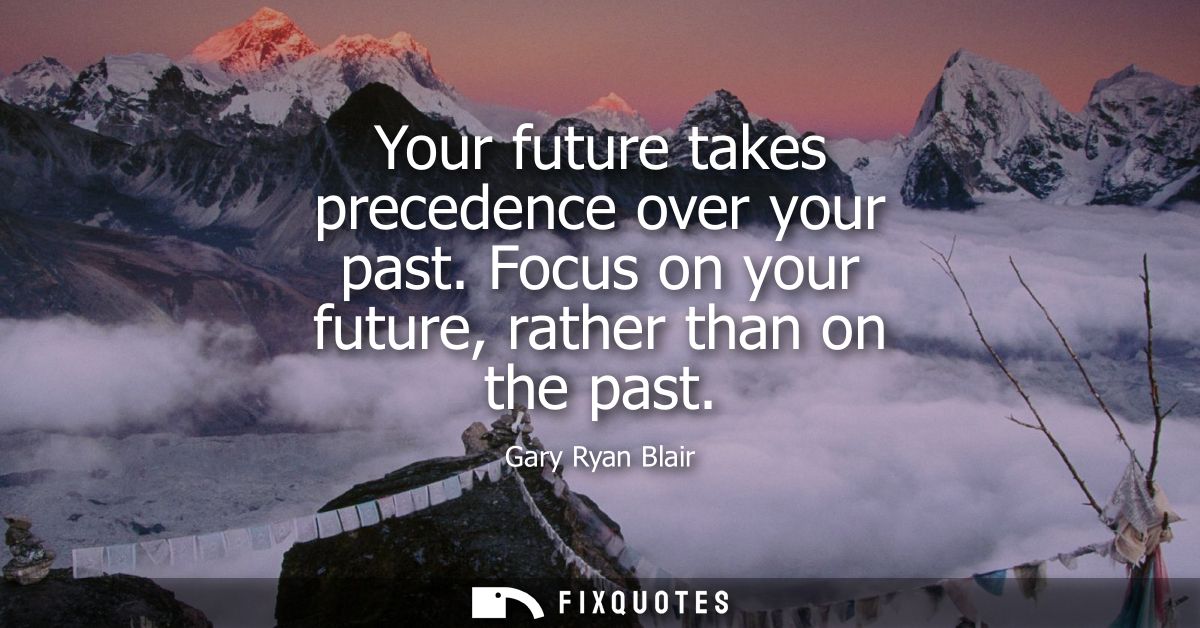
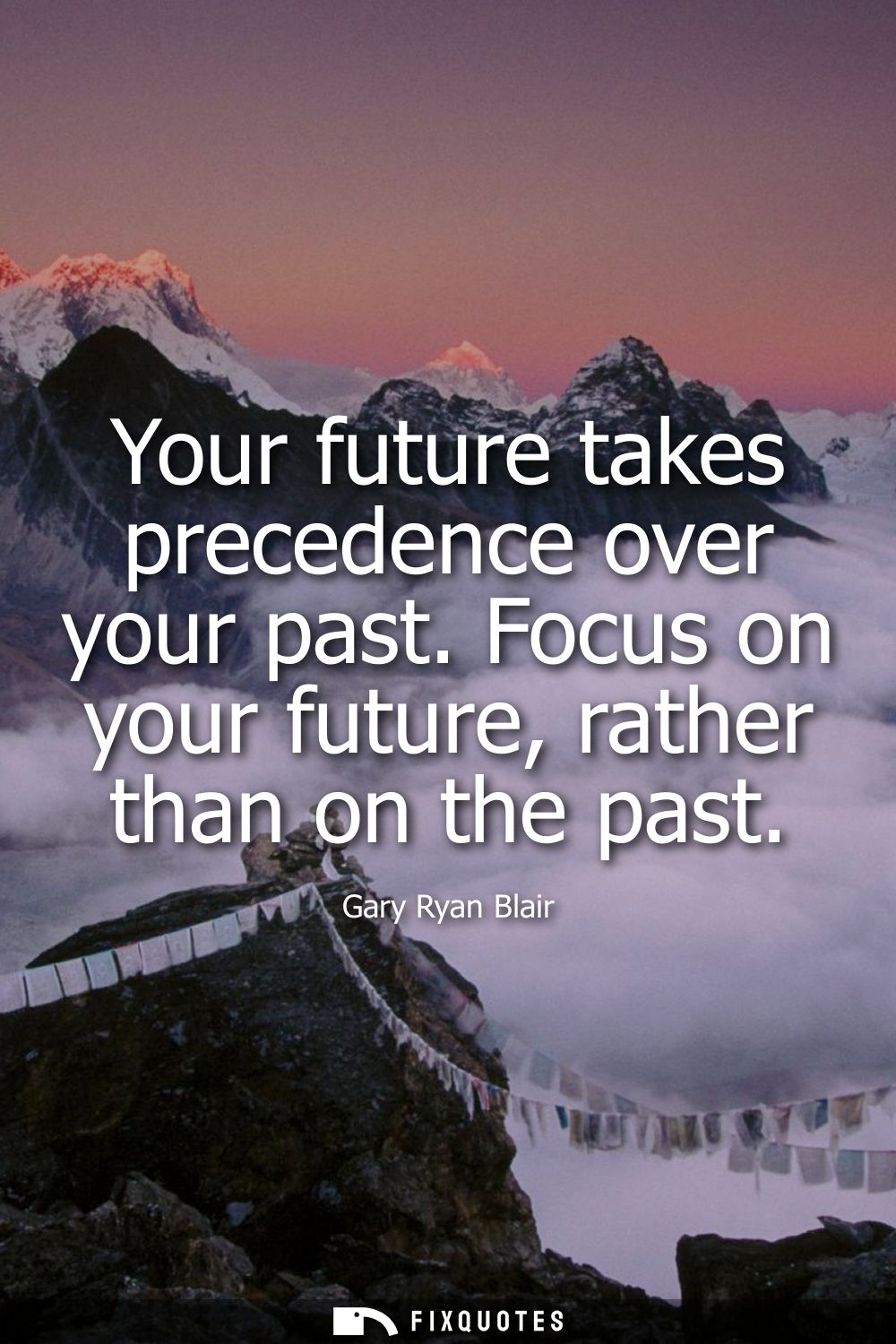
"Your future takes precedence over your past. Focus on your future, rather than on the past"
About this Quote
Gary Ryan Blair distills a principle of performance psychology: give the future priority over the past. Precedence is a decision about where to invest attention, energy, and time. The past is fixed data; the future is the realm of agency. As a goals strategist known for the 100 Day Challenge and a relentless focus on execution, Blair is urging a shift from postmortems to proactive design.
The line counters two common traps. One is the sunk cost fallacy, the urge to keep paying for yesterday’s choices because we already invested in them. The other is rumination, a looping replay of missteps that masquerades as vigilance but stalls action. By elevating the future, you privilege feedforward over feedback: rather than obsessing over what went wrong, you translate a distilled lesson into a specific next move. Identity becomes a verb, not a verdict. You are not what happened; you are what you plan, practice, and persist in doing next.
This stance does not erase the past; it edits it. Learn the lesson, keep the wisdom, discard the weight. An athlete studies the loss, then trains to close the gap. An entrepreneur conducts a postmortem, then pivots the model. A student notes the study habits that failed, then schedules new routines and implements cues and precommitments. The scoreboard that matters is the one you can still change.
Focusing on the future also clarifies controllables. You cannot rewrite yesterday, but you can set a goal, define a time horizon, design your environment, and script implementation intentions for critical moments. Attention is a finite resource; allocate it where it compounds. Hope is not a strategy, but strategy is a form of disciplined hope. By letting the future take precedence, you align decisions with the outcomes you want rather than the stories you fear, and you give yourself permission to move with purpose instead of being managed by memory.
The line counters two common traps. One is the sunk cost fallacy, the urge to keep paying for yesterday’s choices because we already invested in them. The other is rumination, a looping replay of missteps that masquerades as vigilance but stalls action. By elevating the future, you privilege feedforward over feedback: rather than obsessing over what went wrong, you translate a distilled lesson into a specific next move. Identity becomes a verb, not a verdict. You are not what happened; you are what you plan, practice, and persist in doing next.
This stance does not erase the past; it edits it. Learn the lesson, keep the wisdom, discard the weight. An athlete studies the loss, then trains to close the gap. An entrepreneur conducts a postmortem, then pivots the model. A student notes the study habits that failed, then schedules new routines and implements cues and precommitments. The scoreboard that matters is the one you can still change.
Focusing on the future also clarifies controllables. You cannot rewrite yesterday, but you can set a goal, define a time horizon, design your environment, and script implementation intentions for critical moments. Attention is a finite resource; allocate it where it compounds. Hope is not a strategy, but strategy is a form of disciplined hope. By letting the future take precedence, you align decisions with the outcomes you want rather than the stories you fear, and you give yourself permission to move with purpose instead of being managed by memory.
Quote Details
| Topic | Moving On |
|---|
More Quotes by Gary
Add to List