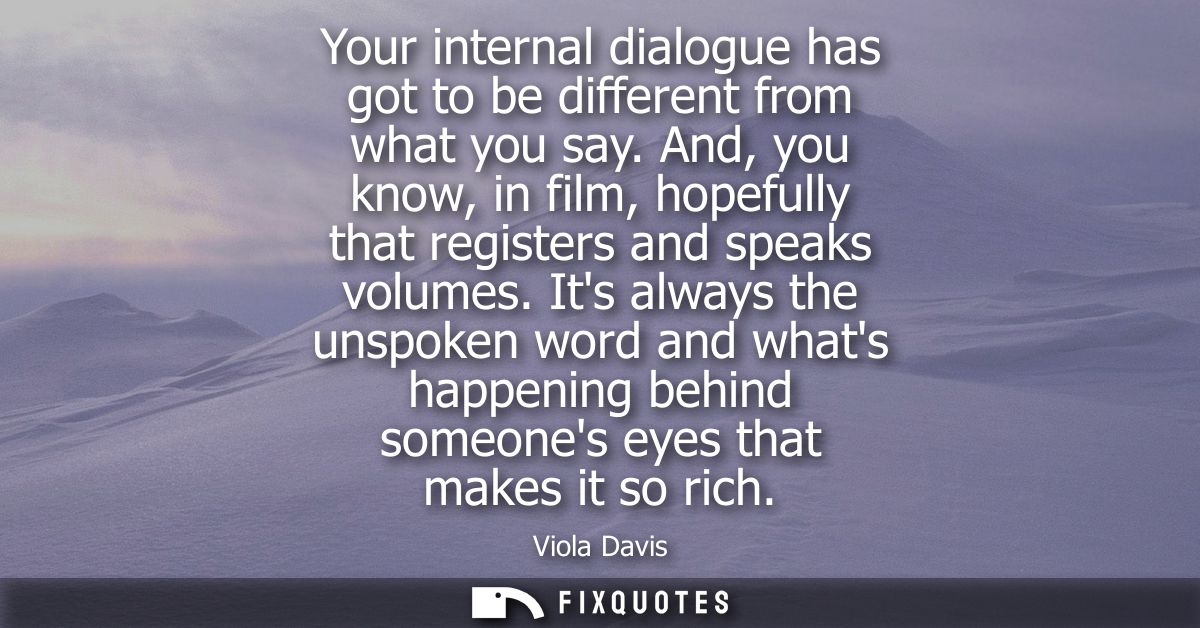
"Your internal dialogue has got to be different from what you say. And, you know, in film, hopefully that registers and speaks volumes. It's always the unspoken word and what's happening behind someone's eyes that makes it so rich"
About this Quote
Acting, Viola Davis reminds us, is basically a two-track system: the sentence you deliver and the quieter, messier sentence you refuse to. Her point cuts against the lazy idea that screen performance is just “say the line with feeling.” Film is a close-up medium; it feeds on contradiction. When a character’s words and inner monologue match too neatly, the scene goes flat, like a captioned emotion. When they clash, we lean in, because we recognize the social truth: most of us narrate one story out loud and another in our heads.
The intent here is craft-forward but also political in a subtle way. Davis has built a career on characters who survive by managing perception - women who can’t afford transparency, whose lives are shaped by power, race, class, and gender expectations. “Different from what you say” isn’t just technique; it’s lived realism. It’s how people move through institutions, relationships, danger. Subtext becomes survival.
And she’s naming what the camera uniquely rewards: micro-decisions. A fraction of a pause, a breath held too long, a blink that doesn’t quite land - these are readable in a way stage acting can’t always depend on. “Behind someone’s eyes” is literal and metaphorical: the audience is invited to do investigative work, to sense the private weather under the public forecast.
That’s why it “speaks volumes.” The unspoken isn’t emptiness; it’s compression. Film turns withheld thought into narrative pressure, and Davis is arguing for performances that trust viewers to feel that pressure without being spoon-fed the explanation.
The intent here is craft-forward but also political in a subtle way. Davis has built a career on characters who survive by managing perception - women who can’t afford transparency, whose lives are shaped by power, race, class, and gender expectations. “Different from what you say” isn’t just technique; it’s lived realism. It’s how people move through institutions, relationships, danger. Subtext becomes survival.
And she’s naming what the camera uniquely rewards: micro-decisions. A fraction of a pause, a breath held too long, a blink that doesn’t quite land - these are readable in a way stage acting can’t always depend on. “Behind someone’s eyes” is literal and metaphorical: the audience is invited to do investigative work, to sense the private weather under the public forecast.
That’s why it “speaks volumes.” The unspoken isn’t emptiness; it’s compression. Film turns withheld thought into narrative pressure, and Davis is arguing for performances that trust viewers to feel that pressure without being spoon-fed the explanation.
Quote Details
| Topic | Movie |
|---|
More Quotes by Viola
Add to List