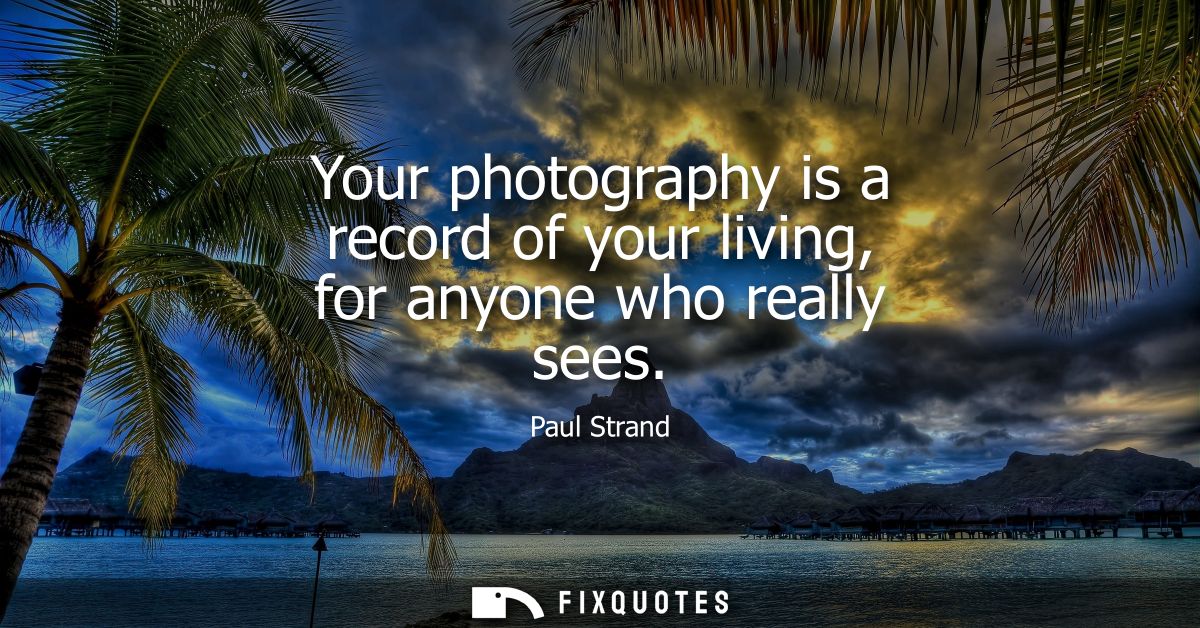
"Your photography is a record of your living, for anyone who really sees"
About this Quote
The kicker is the last clause: “for anyone who really sees.” Strand draws a sharp line between consumption and perception. Most viewers skim images the way they scroll a feed: collecting vibes, confirming assumptions, moving on. “Really sees” demands a slower literacy, an attention to composition, choice, and omission. What’s centered? What’s cropped out? Who gets to look, and who gets looked at? Strand’s work - portraits, city scenes, objects with a kind of moral clarity - was built on the belief that formal decisions are ethical decisions.
Context matters here. Strand came up when photography was fighting for legitimacy against painting and against its own reputation as mere mechanical reproduction. His sentence is an argument for authorship: the photographer is not a technician but a witness. The subtext lands especially hard today, when “authentic” images are mass-produced, filtered, and algorithmically rewarded. Strand’s challenge is bracing: your photos will outlive your explanations, and the people who can truly read them will know how you lived.
Quote Details
| Topic | Art |
|---|---|
| Source | Help us find the source |
| Cite |
Citation Formats
APA Style (7th ed.)
Strand, Paul. (2026, January 16). Your photography is a record of your living, for anyone who really sees. FixQuotes. https://fixquotes.com/quotes/your-photography-is-a-record-of-your-living-for-126926/
Chicago Style
Strand, Paul. "Your photography is a record of your living, for anyone who really sees." FixQuotes. January 16, 2026. https://fixquotes.com/quotes/your-photography-is-a-record-of-your-living-for-126926/.
MLA Style (9th ed.)
"Your photography is a record of your living, for anyone who really sees." FixQuotes, 16 Jan. 2026, https://fixquotes.com/quotes/your-photography-is-a-record-of-your-living-for-126926/. Accessed 12 Feb. 2026.