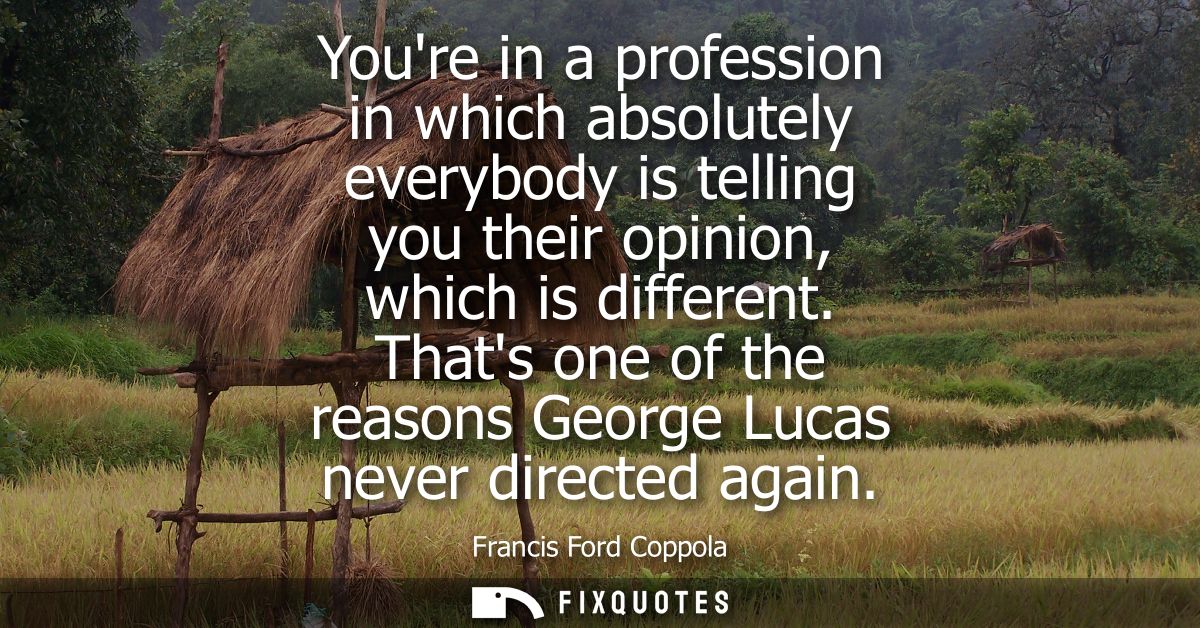
"You're in a profession in which absolutely everybody is telling you their opinion, which is different. That's one of the reasons George Lucas never directed again"
About this Quote
Dropping George Lucas as the example is doing a lot of work. Lucas is the modern myth of the filmmaker who built a universe, then stepped away from the specific ordeal Coppola is describing. After Star Wars, Lucas didn’t stop creating; he shifted power. He built infrastructure (Industrial Light & Magic, Skywalker Sound), produced, wrote, engineered a system where he could control outcomes without standing in the daily crossfire of on-set adjudication. Coppola’s subtext: the most rational response to nonstop second-guessing is to redesign your career so you don’t have to absorb it.
There’s also a sly self-portrait here. Coppola, who fought studios and nearly broke himself making films like Apocalypse Now, is speaking as a veteran of that war. The intent isn’t gossip about Lucas; it’s a thesis about authorship under capitalism: the director is treated as both visionary and service worker, expected to have a singular voice while accommodating everyone else’s. The quote lands because it frames “notes” not as feedback, but as a structural pressure that can permanently reroute an artist’s life.
Quote Details
| Topic | Movie |
|---|---|
| Source | Help us find the source |
| Cite |
Citation Formats
APA Style (7th ed.)
Coppola, Francis Ford. (2026, January 18). You're in a profession in which absolutely everybody is telling you their opinion, which is different. That's one of the reasons George Lucas never directed again. FixQuotes. https://fixquotes.com/quotes/youre-in-a-profession-in-which-absolutely-13401/
Chicago Style
Coppola, Francis Ford. "You're in a profession in which absolutely everybody is telling you their opinion, which is different. That's one of the reasons George Lucas never directed again." FixQuotes. January 18, 2026. https://fixquotes.com/quotes/youre-in-a-profession-in-which-absolutely-13401/.
MLA Style (9th ed.)
"You're in a profession in which absolutely everybody is telling you their opinion, which is different. That's one of the reasons George Lucas never directed again." FixQuotes, 18 Jan. 2026, https://fixquotes.com/quotes/youre-in-a-profession-in-which-absolutely-13401/. Accessed 28 Mar. 2026.