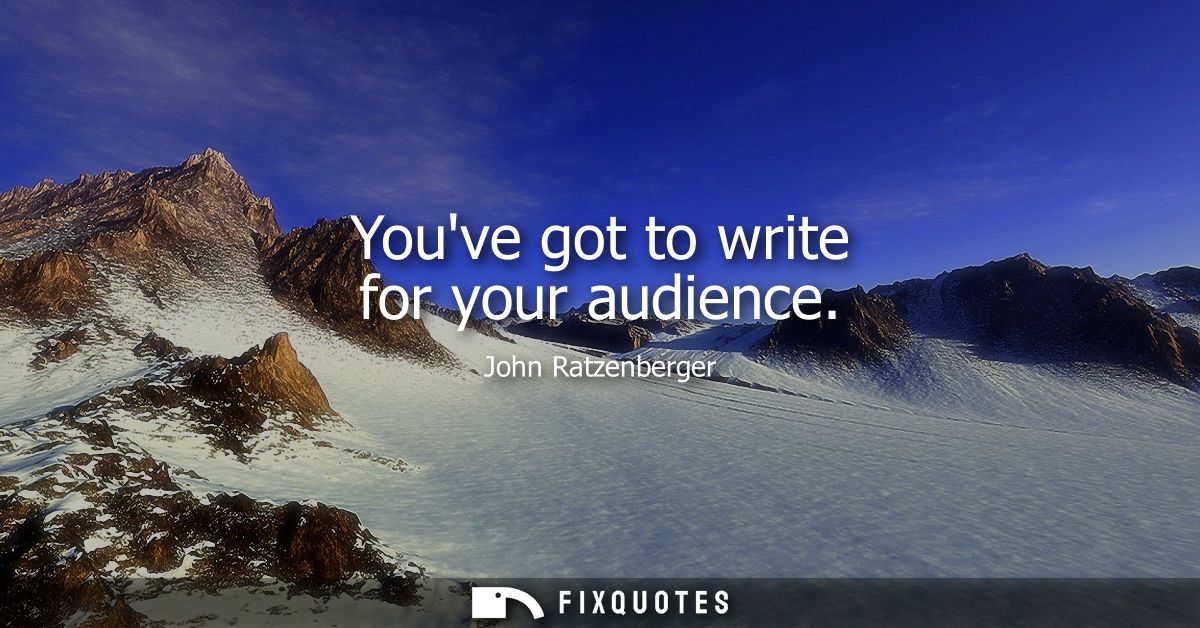
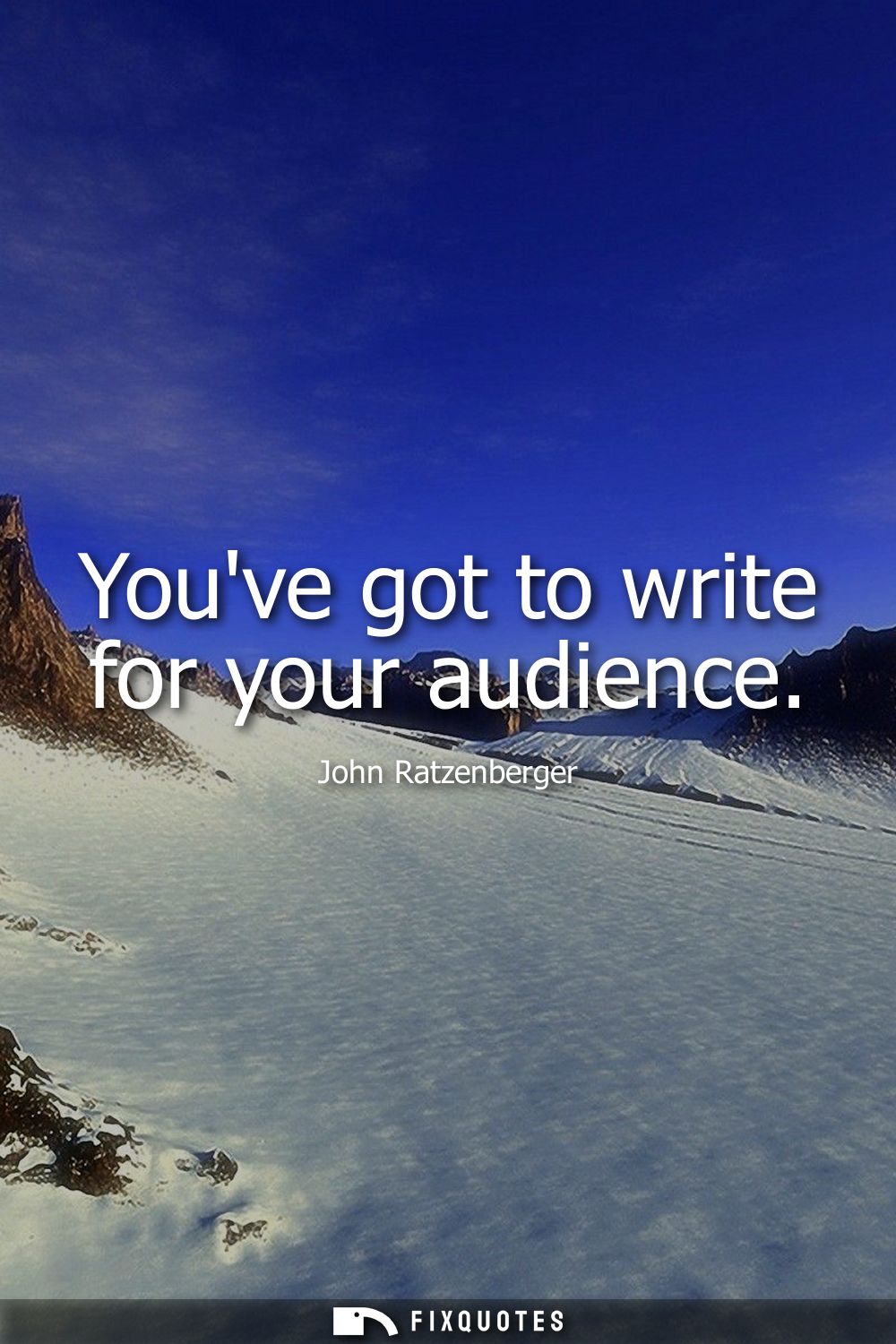
"You've got to write for your audience"
About this Quote
There is a quietly radical humility in Ratzenberger's blunt mandate: the work is not about you. Coming from an actor best known for playing the dependable everyman (from Cheers to Pixar’s long-running roster of blue-collar voices), it lands less like a writing seminar platitude and more like a survival tip from someone who’s spent decades watching what actually connects.
The intent is practical, almost blue-collar in its ethic: craft is service. “Write” here isn’t precious literary self-expression; it’s communication under real conditions - time limits, network notes, studio expectations, the rhythms of comedy, the attention span of a family audience. Ratzenberger’s career has lived inside systems where clarity and timing beat private genius. The line doubles as advice to writers and as a reminder to performers: you’re translating a script into a room’s reactions, not auditioning your inner monologue.
The subtext is a gentle critique of prestige posturing. “Your audience” implies accountability: you can’t blame people for “not getting it” if you never tried to meet them where they are. It’s also a warning about misreading who’s listening. Write for the wrong audience - or for an imaginary, cooler one - and you’ll feel it immediately in comedy, where dead air is an honest review.
Contextually, it fits a late-20th-century entertainment truth: mass culture is a negotiation between taste and accessibility. Ratzenberger isn’t saying pander; he’s saying translate. The smartest work doesn’t dilute its point - it engineers a path for someone else to reach it.
The intent is practical, almost blue-collar in its ethic: craft is service. “Write” here isn’t precious literary self-expression; it’s communication under real conditions - time limits, network notes, studio expectations, the rhythms of comedy, the attention span of a family audience. Ratzenberger’s career has lived inside systems where clarity and timing beat private genius. The line doubles as advice to writers and as a reminder to performers: you’re translating a script into a room’s reactions, not auditioning your inner monologue.
The subtext is a gentle critique of prestige posturing. “Your audience” implies accountability: you can’t blame people for “not getting it” if you never tried to meet them where they are. It’s also a warning about misreading who’s listening. Write for the wrong audience - or for an imaginary, cooler one - and you’ll feel it immediately in comedy, where dead air is an honest review.
Contextually, it fits a late-20th-century entertainment truth: mass culture is a negotiation between taste and accessibility. Ratzenberger isn’t saying pander; he’s saying translate. The smartest work doesn’t dilute its point - it engineers a path for someone else to reach it.
Quote Details
| Topic | Writing |
|---|---|
| Source | Help us find the source |
| Cite |
Citation Formats
APA Style (7th ed.)
Ratzenberger, John. (2026, January 15). You've got to write for your audience. FixQuotes. https://fixquotes.com/quotes/youve-got-to-write-for-your-audience-143136/
Chicago Style
Ratzenberger, John. "You've got to write for your audience." FixQuotes. January 15, 2026. https://fixquotes.com/quotes/youve-got-to-write-for-your-audience-143136/.
MLA Style (9th ed.)
"You've got to write for your audience." FixQuotes, 15 Jan. 2026, https://fixquotes.com/quotes/youve-got-to-write-for-your-audience-143136/. Accessed 28 Mar. 2026.
More Quotes by John
Add to List