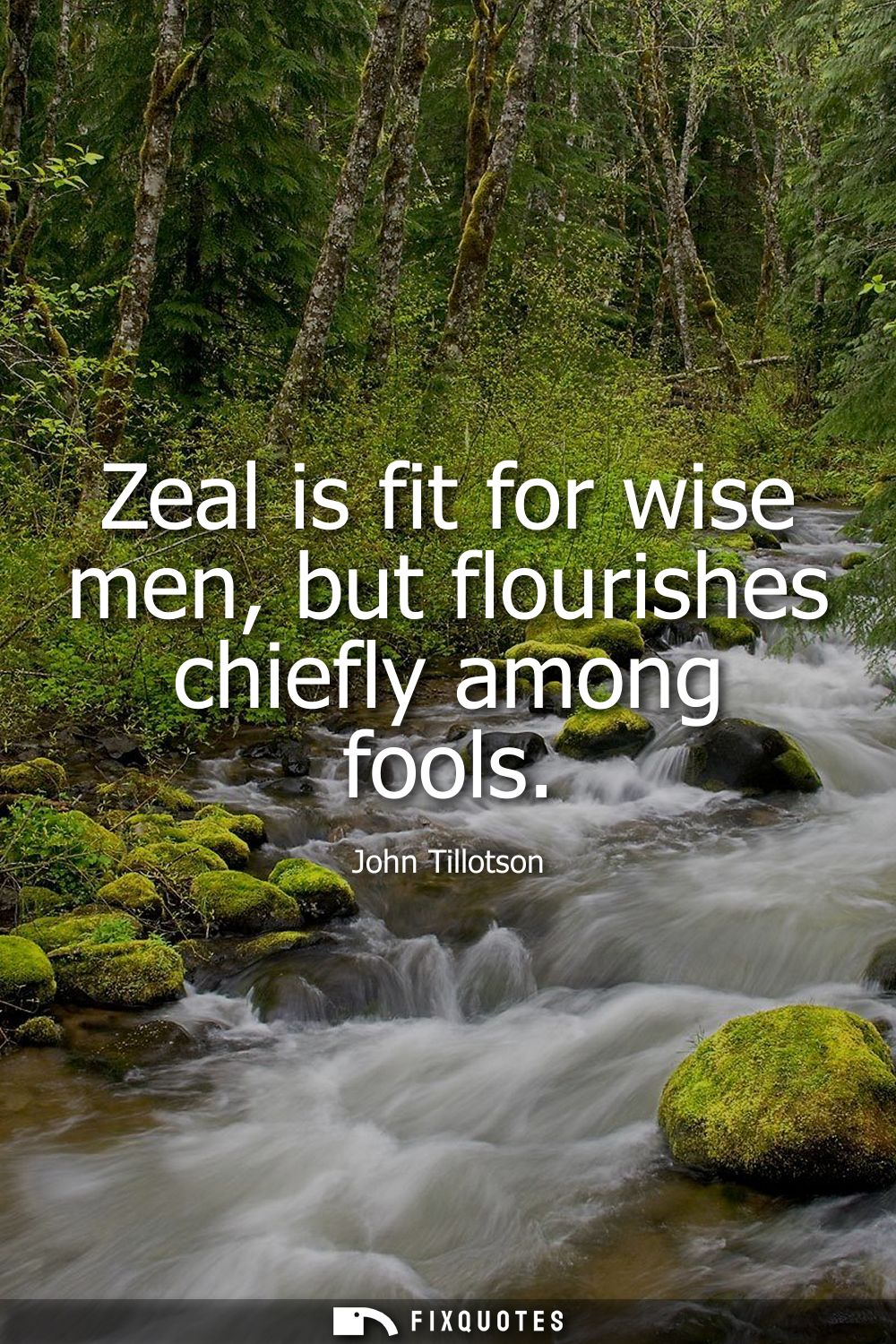
"Zeal is fit for wise men, but flourishes chiefly among fools"
About this Quote
Zeal looks like virtue in motion, which is exactly why Tillotson treats it with suspicion. In a 17th-century England still bruised by civil war, regicide, and the whiplash of religious regimes, “zeal” wasn’t a harmless personality trait; it was political fuel. Tillotson, an Anglican divine who rose after the Restoration and navigated the post-Glorious Revolution settlement, is writing from the perspective of a church trying to survive fanaticism by branding moderation as moral maturity.
The line works because it splits zeal into two audiences. “Fit for wise men” concedes that conviction has a rightful place: clarity, courage, even reform require heat. But the sting arrives immediately: it “flourishes chiefly among fools.” Flourishes is the tell. Zeal doesn’t merely appear among the foolish; it thrives there, like an invasive plant in neglected soil. The subtext is less about passion than about competence: intensity is easiest when you don’t have to do the hard work of thinking, doubting, or living with complexity.
Tillotson is also smuggling in a theory of persuasion. Wise people treat zeal as an instrument, proportioned to reality. Fools treat it as identity. That distinction is his critique of sectarian culture: the loudest certainty often signals the weakest epistemology. In an age of sermon wars and doctrinal absolutism, this sentence is a civilizing move - a bid to make restraint fashionable and to recast moderation not as lukewarm faith, but as disciplined intelligence.
The line works because it splits zeal into two audiences. “Fit for wise men” concedes that conviction has a rightful place: clarity, courage, even reform require heat. But the sting arrives immediately: it “flourishes chiefly among fools.” Flourishes is the tell. Zeal doesn’t merely appear among the foolish; it thrives there, like an invasive plant in neglected soil. The subtext is less about passion than about competence: intensity is easiest when you don’t have to do the hard work of thinking, doubting, or living with complexity.
Tillotson is also smuggling in a theory of persuasion. Wise people treat zeal as an instrument, proportioned to reality. Fools treat it as identity. That distinction is his critique of sectarian culture: the loudest certainty often signals the weakest epistemology. In an age of sermon wars and doctrinal absolutism, this sentence is a civilizing move - a bid to make restraint fashionable and to recast moderation not as lukewarm faith, but as disciplined intelligence.
Quote Details
| Topic | Wisdom |
|---|---|
| Source | John Tillotson — quotation attributed: "Zeal is fit for wise men, but flourishes chiefly among fools." (see John Tillotson entry.) |
| Cite |
Citation Formats
APA Style (7th ed.)
Tillotson, John. (2026, January 15). Zeal is fit for wise men, but flourishes chiefly among fools. FixQuotes. https://fixquotes.com/quotes/zeal-is-fit-for-wise-men-but-flourishes-chiefly-160382/
Chicago Style
Tillotson, John. "Zeal is fit for wise men, but flourishes chiefly among fools." FixQuotes. January 15, 2026. https://fixquotes.com/quotes/zeal-is-fit-for-wise-men-but-flourishes-chiefly-160382/.
MLA Style (9th ed.)
"Zeal is fit for wise men, but flourishes chiefly among fools." FixQuotes, 15 Jan. 2026, https://fixquotes.com/quotes/zeal-is-fit-for-wise-men-but-flourishes-chiefly-160382/. Accessed 15 Mar. 2026.
More Quotes by John
Add to List