
Novel: A Tale of Two Cities
Overview
Set between London and Paris on the eve and through the violence of the French Revolution, A Tale of Two Cities contrasts private loyalties with public upheaval. Charles Dickens threads the fates of a handful of characters through a world shifting from aristocratic cruelty to revolutionary vengeance, building a story of loss, renewal, and heroic self-sacrifice. Its recurring idea of being “recalled to life” frames a narrative where people are spiritually remade amid terror and love.
Setting and Premise
In 1775, banker Jarvis Lorry escorts Lucie Manette from London to Paris to recover her father, Dr. Alexandre Manette, newly released after eighteen years in the Bastille. Broken by imprisonment, he obsessively makes shoes until Lucie’s steadfast care restores him. Their return to England intertwines their lives with Charles Darnay, a reserved French émigré with a secret lineage, and Sydney Carton, a brilliant but dissipated lawyer whose resemblance to Darnay becomes both plot device and moral mirror. The two cities, one cautious and commercial, the other seething with grievance, form twin stages for a drama of identity and revolution.
Plot
Darnay is tried at London’s Old Bailey for treason, accused of carrying English military secrets to France. He escapes conviction when witnesses are unsettled by Carton’s uncanny likeness. Darnay renounces his connection to the corrupt Evremonde aristocracy, embodied by his callous uncle, the Marquis, whose carriage kills a peasant child, seeking a modest life in England. He loves and marries Lucie, while Carton, seeing in her a lost ideal, pledges to do anything for her happiness, though he claims he himself is beyond redemption.
Revolutionary fever mounts in France. Madame Defarge and her husband Ernest rally the Saint Antoine quarter, knitting a secret registry of enemies. The Bastille falls; the countryside erupts; the old order collapses. When Darnay returns to Paris to aid a former steward, Gabelle, he is seized as an emigrant traitor. Dr. Manette’s prestige as a Bastille sufferer wins a first acquittal, but the triumph is brief. The Defarges and a third denouncer produce a document that condemns Darnay anew: a letter Dr. Manette wrote in prison exposes the Evremonde brothers’ brutal crimes against a peasant family, whose surviving sister, now Madame Defarge, seeks relentless vengeance. The tribunal sentences Darnay to the guillotine.
Climax and Resolution
Carton, recognizing his chance to fulfill his vow, forces the cooperation of the spy John Barsad (also known as Solomon Pross) and arranges a desperate exchange. He drugs Darnay in the Conciergerie, swaps clothes, and has Lorry spirit the unconscious prisoner to safety with Lucie, their child, and Dr. Manette. As the Manettes flee, Madame Defarge, intent on annihilating the family line, confronts Lucie’s protector Miss Pross; a struggle ends with Madame Defarge shot by her own pistol and Miss Pross left deaf but victorious. Carton goes to the guillotine in Darnay’s place, composed and visionary, imagining the peaceful lives his sacrifice will enable and a monument raised in memory of one who finally did a far better thing than he had ever done.
Themes and Symbols
Dickens opposes justice to revenge, revealing how revolutionary wrath can mirror aristocratic cruelty. Resurrection runs through the book: Dr. Manette from the Bastille, Darnay from repeated condemnations, and Carton from moral despair to meaningful self-giving. Doubles and opposites, London and Paris, Darnay and Carton, order and chaos, suggest that identity is shaped by choice as much as by birth. Symbols knit these ideas together: the shoemaker’s bench as trauma’s prison, Madame Defarge’s knitting as fate’s ledger, Lucie’s “golden thread” binding loved ones into a restorative community, and the tumbling wine cask and red-stained streets foreshadowing the blood tide of revolution.
Citation Formats
APA Style (7th ed.)
A tale of two cities. (2025, August 21). FixQuotes. https://fixquotes.com/works/a-tale-of-two-cities/
Chicago Style
"A Tale of Two Cities." FixQuotes. August 21, 2025. https://fixquotes.com/works/a-tale-of-two-cities/.
MLA Style (9th ed.)
"A Tale of Two Cities." FixQuotes, 21 Aug. 2025, https://fixquotes.com/works/a-tale-of-two-cities/. Accessed 6 Mar. 2026.
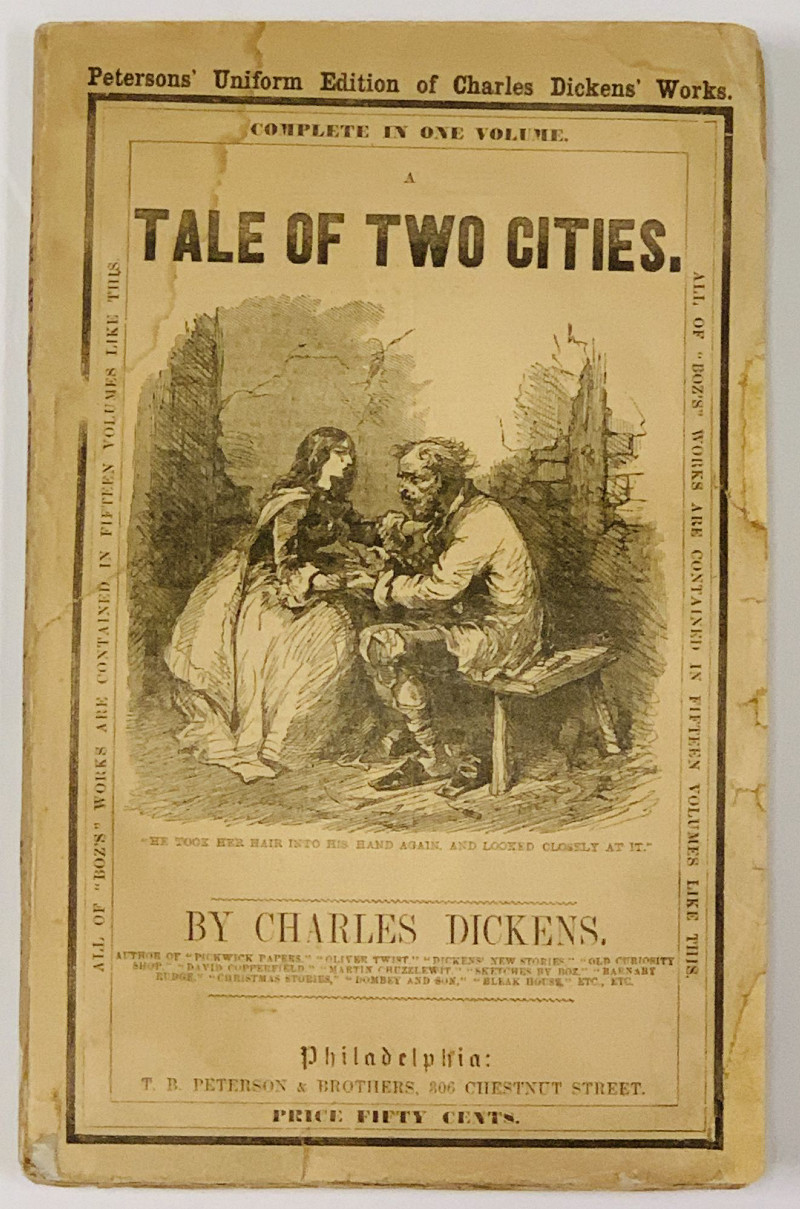
A Tale of Two Cities
A Tale of Two Cities is set in London and Paris before and during the French Revolution. The story revolves around the lives of Charles Darnay, a French aristocrat, and Sydney Carton, an English lawyer.
- Published1859
- TypeNovel
- GenreHistorical fiction
- LanguageEnglish
- CharactersCharles Darnay, Sydney Carton, Doctor Manette, Lucie Manette, Monsieur Defarge, Madame Defarge, Miss Pross, Jerry Cruncher
About the Author

Charles Dickens
Charles Dickens, a prominent Victorian author known for novels like Oliver Twist and Great Expectations, with insightful quotes.
View Profile- OccupationNovelist
- FromEngland
-
Other Works
- Oliver Twist (1838)
- A Christmas Carol (1843)
- David Copperfield (1850)
- Great Expectations (1861)