
Book: Business @ the Speed of Thought
Overview
Published in 1999, Business @ the Speed of Thought is Bill Gates’s management manifesto for the internet era. It argues that information technology is not a support function but the core nervous system of a modern enterprise, determining how fast an organization senses change, learns, decides, and acts. Gates ties strategic advantage to real-time information flow, insisting that companies must redesign processes around digital feedback loops rather than automate existing paperwork.
The Digital Nervous System
The book’s central metaphor is the “digital nervous system” (DNS): a coherent, end-to-end architecture that captures data at the source, routes it instantly to the right people, and triggers informed action. Like a biological nervous system, it depends on accurate sensors, fast signals, and reflexes that turn information into responses. For Gates, email, intranets, databases, and analytics only create value when they are integrated, standardized, and embedded in day-to-day decisions.
From Paper to Real-Time
Gates warns that paper-based processes trap insight and slow reaction times. He promotes capturing transactions electronically, eliminating redundant data entry, and replacing lagging indicators with live dashboards. Finance should close faster, sales forecasts should update continually, and operations should link demand signals directly to supply and production. The metric is cycle time from signal to response, not the size of the IT budget.
Customers, Partners, and the Web
The internet collapses distance and hierarchy, changing how companies interact with markets. Gates urges firms to move service, support, and procurement to the web so customers and suppliers can self-serve, track, and collaborate in real time. He highlights how online self-help, knowledge bases, and community forums cut costs while improving satisfaction, and how digital procurement and build-to-order models reduce inventory and increase flexibility. He anticipates mass customization and data-driven marketing built on detailed customer histories.
Management and Culture
Technology only pays off when leaders use it personally and demand measurable outcomes. Gates advocates management by email and dashboards, vigorous sharing of “bad news” so problems surface quickly, and incentives aligned with data quality and process improvement. He argues for flatter structures in which information flows broadly, not just upward, and for empowering front-line employees with the tools and context to fix issues immediately.
Security, Trust, and Standards
Because the DNS spans customers and partners, trust becomes a design requirement. Gates emphasizes authentication, authorization, audit trails, and encryption, alongside policies for privacy and data stewardship. He pushes open standards and interoperable systems to avoid islands of automation that break the information flow.
Sector Playbooks and Examples
Across healthcare, manufacturing, retail, finance, and government, the book sketches playbooks: electronic medical records and decision support to reduce errors, demand-driven production tied to sales data, online banking and risk analytics, and digital citizen services. The specifics vary, but the pattern is constant, start with outcomes, redesign processes around information, and apply technology to compress time and remove friction.
Predictions and Legacy
Written before cloud and smartphones took off, the book nevertheless anticipates always-on collaboration, digital supply chains, paperless workflows, and analytics-driven management. Many of its prescriptions, self-service portals, real-time dashboards, telemetry from products, and continuous experimentation, became standard operating practice in the decades that followed.
Limitations
Gates’s optimism underplays organizational inertia, integration cost, and the complexity of legacy systems. Cultural change, data governance, and cybersecurity risks turned out to be harder than wiring tools together. Yet the core thesis endures: advantage accrues to organizations that treat information as a strategic asset and build the reflexes to act on it at the speed of events.
Citation Formats
APA Style (7th ed.)
Business @ the speed of thought. (2025, August 22). FixQuotes. https://fixquotes.com/works/business-the-speed-of-thought/
Chicago Style
"Business @ the Speed of Thought." FixQuotes. August 22, 2025. https://fixquotes.com/works/business-the-speed-of-thought/.
MLA Style (9th ed.)
"Business @ the Speed of Thought." FixQuotes, 22 Aug. 2025, https://fixquotes.com/works/business-the-speed-of-thought/. Accessed 12 Feb. 2026.
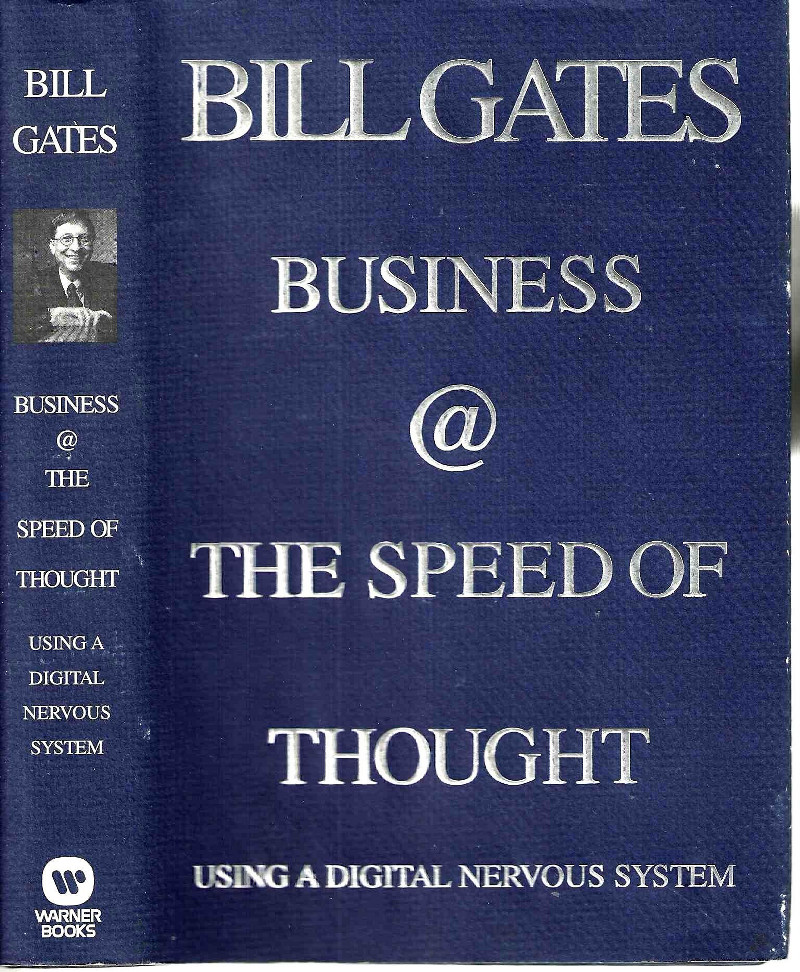
Business @ the Speed of Thought
Business @ the Speed of Thought is a book written by Bill Gates and Collins Hemingway. The book discusses how business and technology are integrated, and explains how digital infrastructures and information networks can help individuals and organizations become more responsive.
- Published1999
- TypeBook
- GenreBusiness, Non-Fiction
- LanguageEnglish
About the Author

Bill Gates
Bill Gates: founder of Microsoft, renowned author, and philanthropist. Explore his insights on technology, business, and global literacy advocacy.
View Profile- OccupationBusinessman
- FromUSA
-
Other Works
- The Road Ahead (1995)
- How to Avoid a Climate Disaster (2021)