
Play: Can't Pay? Won't Pay!
Overview
Dario Fo's 1974 play Can't Pay? Won't Pay! is a rollicking, politically charged farce that turns a small act of civil disobedience into a broadside against inflation, greed, and social hypocrisy. The action springs from a simple premise: working-class consumers refuse to be gouged and decide to take matters into their own hands. Comic energy and sharp satire propel the drama, transforming everyday domestic life into a battlefield over dignity, survival, and justice.
Plot
A group of working-class women, exhausted by rising prices and economic strain, walk out of a supermarket with bags of basic foodstuffs without paying. They bring the goods home to feed their families and distribute them to neighbors, treating the theft as a form of popular reparation. When the supermarket proprietor discovers the missing stock, he calls the police and the households are soon plunged into a web of misunderstandings, accusations, and frantic improvisation.
Husbands, who had been at work, return to confusing scenes that escalate into comic attempts at concealment and self-justification. Lies pile on lies as friends and relatives are drawn in, identities are muddled, and the lines between victim and culprit blur. Arrests and interrogations follow, and the farce reaches a climax when a larger community of women stages a public response that turns private resistance into collective protest. The ending refuses a neat moral closure; instead it foregrounds direct action and the principle that ordinary people will not passively accept economic oppression.
Comic style and staging
The play relies on fast-paced physical comedy, verbal sparring, and exaggerated situations that recall commedia dell'arte traditions. Fo's language is pungent and idiomatic, full of regional color and comic invention; the rhythm of the dialogue is as important as the plot, with abrupt interruptions, rapid exchanges, and moments of farcical silence. Staging tends to be economical and kinetic, favoring quick costume changes, confined domestic interiors that erupt into chaos, and ensemble choreography that emphasizes collective movement over solitary psychology.
Fo often mixes lowbrow jokes with barbed political commentary, allowing slapstick to coexist with pointed satire. The result is a theatrical machine that can be staged by professional companies or grassroots ensembles, and that invites audiences to laugh while recognizing the urgency of the social issues on display.
Themes and politics
At its heart the play interrogates the ethics of survival under capitalism: who is criminalized when society's rules work to the detriment of the poor, and what forms of resistance become legitimate when official remedies fail? Gender dynamics are central, as women, traditionally responsible for securing the household, become the agents of protest, revealing both their resourcefulness and the contradictions of domestic life. Authority figures, from shopkeepers to police, are shown as either impotent or complicit in systems that prioritize profit over people.
Fo refuses to sentimentalize the protagonists; instead he satirizes hypocrisy on all sides while advocating solidarity and collective refusal. The title slogan, framed as a cheeky declaration, functions as a moral challenge: if prices are exploitative, why should ordinary people quietly foot the bill?
Reception and legacy
Can't Pay? Won't Pay! became one of Fo's most famous and widely produced plays, translated and performed around the world in the 1970s and beyond. Its mix of comic immediacy and political urgency made it a favorite for activist theater and community productions, and it sparked heated debates about legality, morality, and theatrical provocation. The play's combination of uproarious farce and social critique continues to resonate in contexts where economic precarity and public anger over cost-of-living issues persist, keeping Fo's sharp laughter and moral impatience alive for new audiences.
Citation Formats
APA Style (7th ed.)
Can't pay? won't pay!. (2025, September 14). FixQuotes. https://fixquotes.com/works/cant-pay-wont-pay/
Chicago Style
"Can't Pay? Won't Pay!." FixQuotes. September 14, 2025. https://fixquotes.com/works/cant-pay-wont-pay/.
MLA Style (9th ed.)
"Can't Pay? Won't Pay!." FixQuotes, 14 Sep. 2025, https://fixquotes.com/works/cant-pay-wont-pay/. Accessed 5 Mar. 2026.
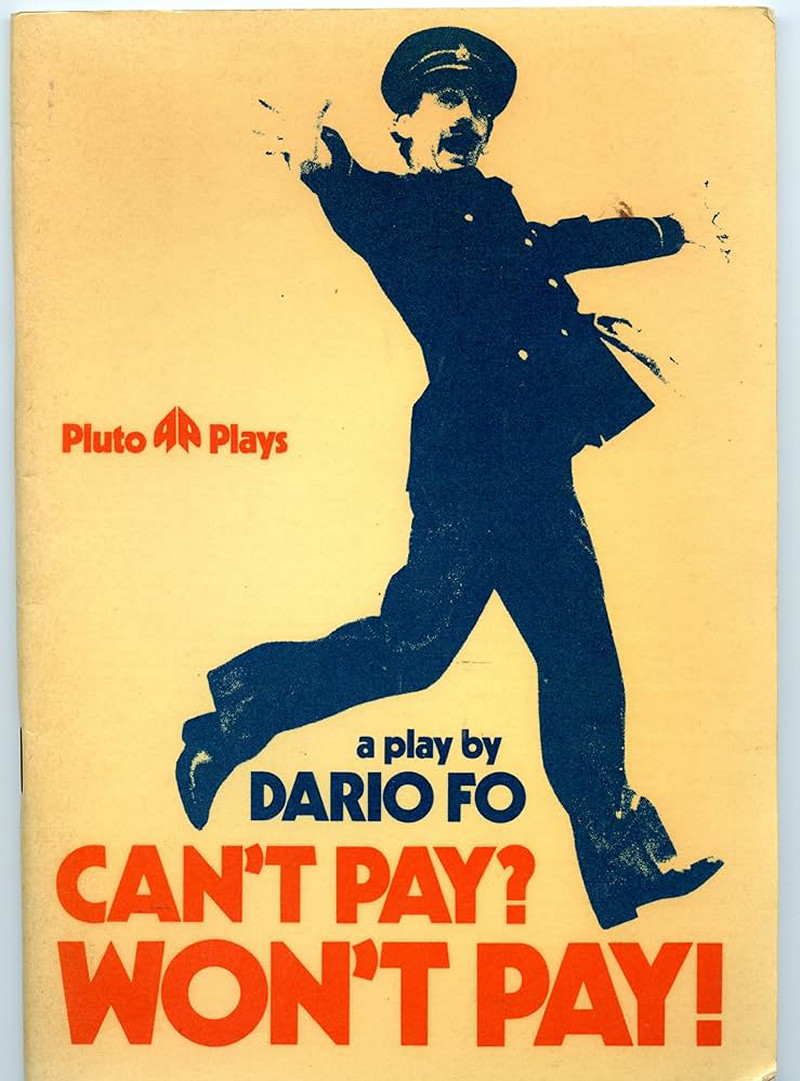
Can't Pay? Won't Pay!
Original: Non si paga, non si paga!
A satirical farce about two working-class wives who steal from a supermarket to compensate for rising prices, leading to a spiraling cascade of confusion and deception.
- Published1974
- TypePlay
- GenreComedy, Political satire
- LanguageItalian
- CharactersAntonia, Giovanni, Margherita, Luigi, Superintendent
About the Author

Dario Fo
Dario Fo, an influential Italian playwright, comedian, and Nobel Laureate known for his political satire and activism.
View Profile- OccupationPlaywright
- FromItaly
-
Other Works
- Mistero Buffo (1969)
- Accidental Death of an Anarchist (1970)
- Orgasmo Adulto Escapes from the Zoo (1976)
- Trumpets and Raspberries (1981)