
Play: Carousel
Overview
Carousel is a 1946 musical by Richard Rodgers and Oscar Hammerstein II that combines lyrical melodies with a stark dramatic core. Set against a New England coastal town and its mill community, the piece traces a passionate, volatile romance and the long wake of choices made in anger and desperation. The score and book work together to push emotional moments into song, producing some of musical theatre's most enduring and mournful numbers.
Plot and characters
The story focuses on Billy Bigelow, a charismatic but hot-tempered carousel barker, and Julie Jordan, a gentle millworker drawn to him despite the social gulf between them. Their whirlwind courtship and marriage are shadowed by Billy's insecurity and impulsive pride. When their lives spiral, Billy losing his job, a failed attempt to provide through a botched robbery, and Billy's death in the aftermath, Julie is left to raise their daughter, Louise, largely on her own.
Years later Louise grows into a young woman courted by the steady, earnest Enoch Snow. The contrast between Enoch's dependable goodness and the memory of Billy's romantic danger underpins the central conflict: the tension between romantic myth and domestic security. Billy, having died earlier, returns briefly from the afterlife intent on redeeming himself by giving his daughter the courage he denied her and the chance at a life he never secured.
Themes and emotional arc
Love is complicated and costly in Carousel. Romantic exhilaration collides with social realities, economic pressures, and the destructive effects of pride and violence. The show scrutinizes masculinity and failure: Billy's attempts to perform bravado and control often lead to harm, yet his longing to be a father and to leave a legacy drives his most human impulses. Julie's endurance, patience, and grief form the emotional center; her famous lament becomes a prayer for strength and companionship.
Redemption in Carousel is ambiguous and earned through modest courage rather than miraculous change. The story suggests that one cannot erase the past, but small acts, teaching courage, offering steadiness, breaking cycles of shame, can reshape the future. The finale rests on a note of cautious hope: reconciliation and forward motion rather than tidy absolution.
Music and legacy
Rodgers's sweeping melodies and Hammerstein's empathetic lyrics fuse to create songs that are integral to character and narrative. "If I Loved You" captures the hesitant intimacy between Julie and Billy, "Soliloquy" exposes Billy's conflicting hopes and fears about fatherhood, and "You'll Never Walk Alone" offers consolation and communal resilience after tragedy. The score's blend of lyric tenderness and robust ensemble pieces has kept Carousel in the repertory, with frequent revivals and a notable 1956 film adaptation.
Carousel's reputation rests on its daring blend of musical lyricism with morally fraught drama. Praised for emotional depth and occasionally critiqued for its portrayal of violence and gender dynamics, it remains a landmark of American musical theatre for tackling adult themes with musical sophistication and for its uncompromising look at love, consequence, and the possibility of redemption.
Citation Formats
APA Style (7th ed.)
Carousel. (2026, February 5). FixQuotes. https://fixquotes.com/works/carousel/
Chicago Style
"Carousel." FixQuotes. February 5, 2026. https://fixquotes.com/works/carousel/.
MLA Style (9th ed.)
"Carousel." FixQuotes, 5 Feb. 2026, https://fixquotes.com/works/carousel/. Accessed 28 Mar. 2026.
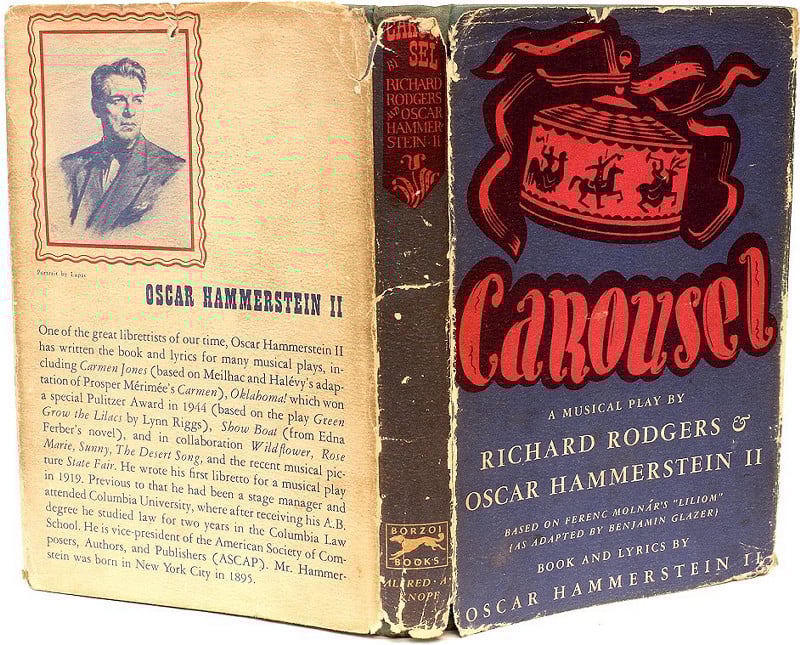
Carousel
A Rodgers and Hammerstein musical told with a dramatic emotional arc about love, consequence, and redemption. Follows the troubled romance between carousel barker Billy Bigelow and millworker Julie Jordan, and the impact of Billy's choices on their daughter. Known for songs such as "If I Loved You" and "You'll Never Walk Alone."
About the Author
Oscar Hammerstein
Oscar Hammerstein II, his collaborations with Kern and Rodgers, and his lasting influence on American musical theater.
View Profile- OccupationWriter
- FromUSA
-
Other Works
- Show Boat (1927)
- Oklahoma! (1943)
- Allegro (1947)
- South Pacific (1949)
- The King and I (1951)
- Me and Juliet (1953)
- Pipe Dream (1955)
- Flower Drum Song (1958)
- The Sound of Music (1959)