
Play: Catastrophe
Overview
Samuel Beckett’s Catastrophe (1982) is a terse, one-act play that compresses rehearsal-room routine into a stark allegory of power, complicity, and resistance. Dedicated to the imprisoned Czech playwright Václav Havel, it unfolds as a director and his assistant sculpt a silent, nearly motionless human figure into a stage image for public consumption. The plot is almost entirely procedural, adjustments, commands, light cues, but the cumulative effect is tense and political. The final gesture, a minimal break in obedience, turns an aesthetic exercise into an act of defiance.
Setting and Characters
The stage is bare save for a raised platform or plinth on which the Protagonist stands. He is elderly, nearly naked beneath a thin gown, vulnerable and shivering. The Director presides, exacting and imperious, smoking and wrapped in authority. His Assistant shuttles between them, translating the Director’s wishes into small, invasive manipulations of the body. A Lighting technician, heard and sometimes glimpsed, adjusts intensity and focus to perfect the tableau. Only the Protagonist remains mute; his body is the text.
Action
The Director arrives to inspect and refine the “picture.” He orders the removal of hat, coat, and other coverings, exposing the Protagonist to the harshness of the stage. He dictates posture, head down, spine bent, arms at the sides, fingers arranged, seeking a sculptural image of abasement. The Assistant obeys but surfaces practical concerns: the chill, the Protagonist’s age, the need to keep him steady. The Director brushes these aside, demanding further bareness, more stillness, less humanity.
Light becomes the final instrument of control. The Director requests changes in levels, angle, and color temperature, tightening the spotlight until the figure is isolated in a cone of brilliance against darkness. The rehearsal language, numbers, cues, notes, amplifies the clinical tone. The Assistant notes the risk; the Director wants the effect.
The process culminates in a set of instructions for the public showing: the Protagonist will be displayed in absolute immobility, a pure image of submission crafted to provoke awe and applause. As the Director and Assistant prepare for their bow, anticipating acclaim for their creation, the Protagonist moves. Almost imperceptibly, he raises his head and fixes the audience with a direct gaze. The lights hold. No speech is uttered, yet the hierarchy is inverted: the object looks back.
Themes
Catastrophe stages the mechanics of objectification. The Director’s authority, the Assistant’s compliance, and the technician’s functionality convert a person into material. The Protagonist’s muteness and exposure render him a specimen, until the final look asserts personhood. The play interrogates the ethics of representation, asking what it means to manufacture suffering as spectacle and who bears responsibility when art rehearses domination.
The dedication to Havel situates the drama within the politics of censorship and imprisonment. The rehearsal room doubles as a regime; commands, uniforms, and light cues echo surveillance and coercion. Yet the answer Beckett proposes is not rhetoric but a minimal, irreducible act: a head raised, a gaze returned. Silence becomes speech; the audience is implicated.
Style and Staging
Beckett’s language pares down to directives, pauses, and measurements. The rhythm of rehearsal, precise, repetitive, cold, creates a ritual of control. Visual composition is paramount: the bent figure, the white pool of light, the void around it. The humor is acid and procedural. The final image is calibrated to shock without noise, relying on the audience’s awareness that any motion has been forbidden.
Significance
Short and fiercely concentrated, Catastrophe distills Beckett’s late concerns: the ethics of looking, the politics of bodies onstage, and the possibility of resistance within extreme constraint. The Protagonist’s raised head remains one of modern theater’s most economical acts of revolt, shifting the catastrophe from the figure on the plinth to the conscience of those who watch.
Citation Formats
APA Style (7th ed.)
Catastrophe. (2025, November 8). FixQuotes. https://fixquotes.com/works/catastrophe/
Chicago Style
"Catastrophe." FixQuotes. November 8, 2025. https://fixquotes.com/works/catastrophe/.
MLA Style (9th ed.)
"Catastrophe." FixQuotes, 8 Nov. 2025, https://fixquotes.com/works/catastrophe/. Accessed 28 Mar. 2026.
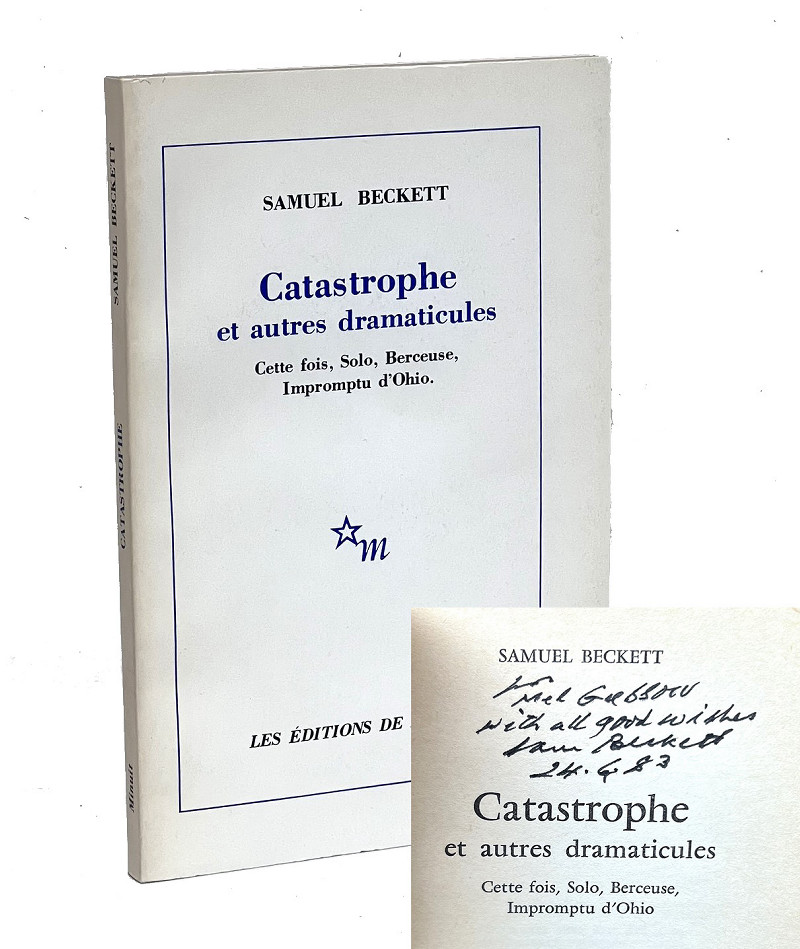
Catastrophe
A terse, politically charged short play depicting a director and his assistant preparing a disheveled, passive man for a public tableau. The work is often read as commentary on power, oppression and artistic responsibility.
About the Author

Samuel Beckett
Samuel Beckett covering life, major works, wartime years, bilingual writing, theater collaborations, Nobel Prize and quotes.
View Profile- OccupationPlaywright
- FromIreland
-
Other Works
- Murphy (1938)
- Eleutheria (1947)
- Malone Dies (1951)
- Molloy (1951)
- Watt (1953)
- Waiting for Godot (1953)
- The Unnamable (1953)
- Endgame (1957)
- Krapp's Last Tape (1958)
- Happy Days (1961)
- Cascando (1963)
- Play (1963)
- Come and Go (1965)
- Not I (1972)
- That Time (1976)
- Company (1980)
- Rockaby (1981)
- Ill Seen Ill Said (1981)
- Worstward Ho (1983)