
Speech: Discurso de Angostura
Occasion and purpose
Delivered on February 15, 1819, at the opening of the Congress of Angostura (today Ciudad Bolívar, Venezuela), Simón Bolívar’s address sought to restore civil authority amid a brutal war of independence, legitimize a new constitutional order, and chart the political future of northern South America. Speaking as the Liberator yet eager to subordinate military power to law, he offered his resignation, urged union between Venezuela and New Granada, and laid out a framework for republican government adapted to American realities rather than copied from European models.
Historical diagnosis
Bolívar begins with a stark assessment of colonial legacy and social fragmentation. Centuries of Spanish absolutism, he argues, left the people inexperienced in liberty and civic participation. He frames identity in mestizo terms, “we are not Europeans, we are not Indians”, to underscore the need for political designs that fit a mixed society scarred by inequality and despotism. The early federal experiment of 1811 is blamed for dissolution and weakness in the face of war; what is required is unity, energy in government, and institutions strong enough to survive chaos without lapsing into tyranny.
Principles and civic education
The speech balances Enlightenment ideals with pragmatic caution. Bolívar praises freedom, security, and equality before the law while warning against the perils of absolute democracy in a populace unprepared by habit and education. He insists that liberty depends on civic virtue cultivated over time, declaring that “moral and lights are our first needs.” Education, public instruction, and the nurturing of character are presented not as ornaments of liberty but as its precondition.
Constitutional architecture
Bolívar defends a strict separation of powers and urges a powerful, responsible executive checked by an independent legislature and judiciary. He proposes a bicameral legislature to slow passions and refine public will; for the upper chamber he even entertains life tenures, possibly hereditary, to anchor stability and resist factional swings. Most distinctive is his call for a “Moral Power, ” inspired by the Roman censors and the Athenian Areopagus, to oversee education, civic virtue, and public morals, an institutional guardian meant to prevent corruption and sustain republican manners rather than to wield ordinary political force.
Social reform and equality
Committed to breaking the caste barriers of colonial society, Bolívar advocates the abolition of privileges and the legal equality of all free citizens. He condemns slavery as incompatible with republican principles and supports emancipation measures already underway in the patriot ranks. Citizenship must not be a monopoly of any race or estate; the republic needs talent and virtue wherever they are found, and laws must protect the weak against the strong.
Union, war, and civil authority
Even as the independence struggle rages, Bolívar presses for the consolidation of Venezuela and New Granada into a larger republic capable of defending freedom and fostering commerce and prosperity. He urges Congress to assert civilian supremacy, regularize finance and military command, and legislate for peace in the midst of war. Though he tenders his own power to the representatives, they are asked to preserve unity of command until victory secures space for fuller deliberation.
Style and legacy
The address fuses classical republicanism, Enlightenment liberalism, and American experience into a program at once idealistic and sober. Its most original features, the insistence on civic education, the proposal of a fourth “Moral Power, ” and a strong but accountable executive, reflect Bolívar’s conviction that fragile societies need both virtue and vigor to sustain liberty. The Congress soon moved toward the union that would become Gran Colombia, and the Angostura Address endures as the clearest statement of Bolívar’s constitutional vision for the new American republics.
Citation Formats
APA Style (7th ed.)
Discurso de angostura. (2026, February 4). FixQuotes. https://fixquotes.com/works/discurso-de-angostura/
Chicago Style
"Discurso de Angostura." FixQuotes. February 4, 2026. https://fixquotes.com/works/discurso-de-angostura/.
MLA Style (9th ed.)
"Discurso de Angostura." FixQuotes, 4 Feb. 2026, https://fixquotes.com/works/discurso-de-angostura/. Accessed 12 Feb. 2026.
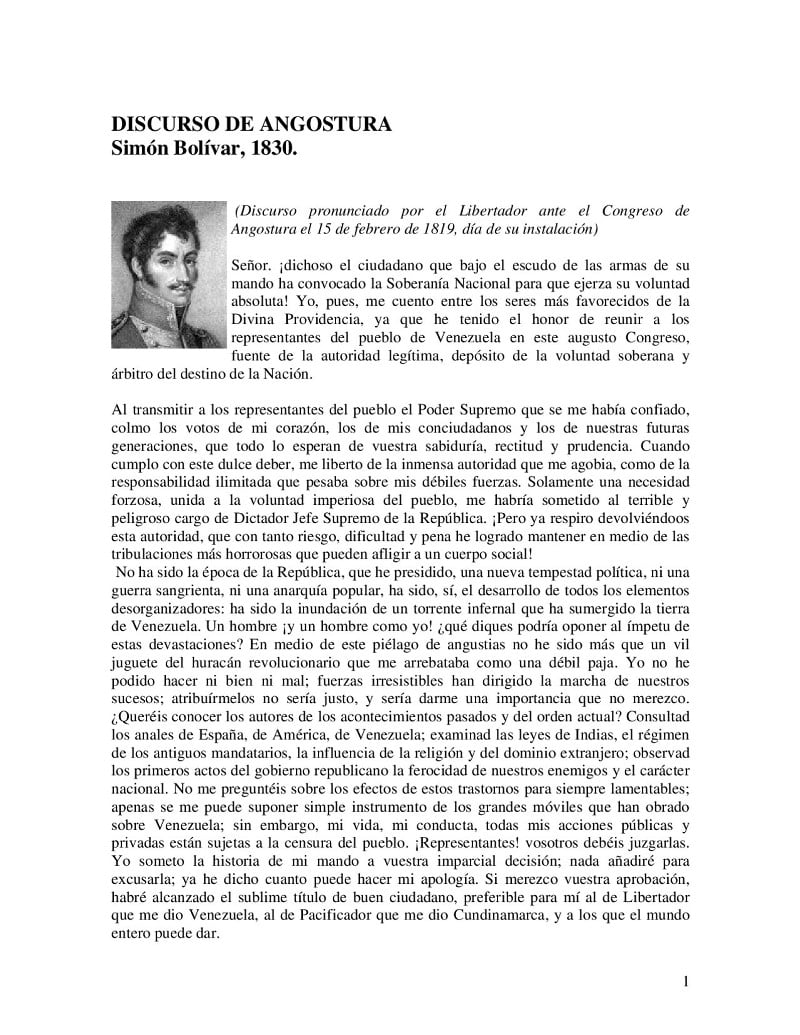
Discurso de Angostura
Bolívar's address to the newly created Congress of Gran Colombia, in which he outlined his political ideas on democracy, freedom, and the role of a constitution in the newly liberated countries of Latin America.
- Published1819
- TypeSpeech
- GenreHistorical, Political
- LanguageSpanish
About the Author

Simon Bolivar
Simon Bolivar, the liberator of South America, highlighting his leadership, struggles, and enduring legacy.
View Profile- OccupationLeader
- FromVenezuela
-
Other Works
- El Manifiesto de Cartagena (1812)
- El Decreto de Guerra a Muerte (1813)
- Carta de Jamaica (1815)