
Autobiography: Ecce Homo
Overview
Friedrich Nietzsche’s Ecce Homo, written in 1888 in Turin and published posthumously in 1908, is an audacious self-portrait that fuses autobiography, polemic, and philosophical summation. The title echoes Pilate’s words, “Behold the man, ” but Nietzsche turns the Christian gesture on its head, offering a pagan counter-confession that dramatizes his life as the precondition and proof of his ideas. He promises to explain himself and his books, staging a final, lucid reckoning just before his collapse in early 1889. The result is both a key to his oeuvre and a performance of the values he champions: affirmation, style, and the courage to stand against the moral consensus of his age.
Structure and Voice
The book is arranged in four sections, Why I Am So Wise, Why I Am So Clever, Why I Write Such Good Books, and Why I Am a Destiny, framed by a terse preface. The voice is deliberately extravagant, provocative, and ironic. Hyperbolic self-praise works as method rather than vanity, a rhetorical mask used to unmask received pieties. Nietzsche parodies saint’s lives and modern confessions, replacing sin and redemption with health, strength, and self-overcoming. His boastfulness is inseparable from his critique of humility as a covert form of ressentiment.
Self-Portrait and Physiology
Nietzsche presents his life as a discipline of taste and physiology. Recounting frail health, headaches, and isolation, he claims to have turned weakness into strength by mastering the “art of convalescence.” Diet, climate, and rhythm matter: he praises dry air, the South, walking, and moderation, while attacking alcohol and German heaviness. He links character to climate and style to bodily economy, style is physiology. This therapeutic materialism grounds his ethics of affirmation: amor fati, the love of one’s fate, including pain and loss, becomes the highest formula of strength. Solitude is cast as method; independence, as justice to oneself; cheerfulness, as signature of depth. He opposes moralism with the ideal of a “great health, ” a capacity to interpret suffering as the means of growth.
Reading Himself through His Books
Nietzsche rereads his earlier works as steps of one project: the revaluation of all values. The Birth of Tragedy diagnosed the modern loss of the Dionysian and the need for a tragic affirmation beyond Socratic optimism. Human, All Too Human marked a liberation from metaphysics through a cool, experimental psychology. Daybreak and The Gay Science refined this experimental ethos and announced the death of God, teaching laughter, dance, and a gay science beyond guilt. Thus Spoke Zarathustra is presented as his highest song, a vision of eternal recurrence and the overhuman ideal, a book for the few who can read slowly and ruminate. Beyond Good and Evil and On the Genealogy of Morality anatomize herd morality, priestly revenge, and the hidden drives behind lofty ideals. The Case of Wagner and Twilight of the Idols attack cultural decadence and rehearsals of self-hypnosis. Across these books he insists that good readers are rare, and that his aphorisms demand slowness, nuance, and a musician’s ear.
Against Morality and Christianity
Calling himself the first immoralist, Nietzsche indicts pity, egalitarianism, and the sanctification of weakness as life-denying. Christianity embodies a transvaluation born of resentment; it falsifies the instincts, poisons joy, and teaches a hatred of earthly life. He opposes this with aristocratic values, the pathos of distance, and a Dionysian yes to becoming. He also lashes German nationalism and anti-Semitism, praises French clarity, and insists that truthfulness requires cruelty toward comforting lies. The famous provocations, “I am not a man, I am dynamite, ” and the parting contrast “Dionysus versus the Crucified”, stage a cultural choice he believes imminent.
Aim and Afterlife
Ecce Homo is a self-exegesis and a gauntlet thrown at Europe. It offers a physiological ethics, a map of his books, and a mythic self-fashioning designed to survive misunderstanding. Shaped by the pathos of a final testament and complicated by later editorial handling, it remains the sharpest lens through which to read his corpus: a confession without guilt, a critique without resentment, and a hymn to the art of saying yes.
Citation Formats
APA Style (7th ed.)
Ecce homo. (2025, August 20). FixQuotes. https://fixquotes.com/works/ecce-homo/
Chicago Style
"Ecce Homo." FixQuotes. August 20, 2025. https://fixquotes.com/works/ecce-homo/.
MLA Style (9th ed.)
"Ecce Homo." FixQuotes, 20 Aug. 2025, https://fixquotes.com/works/ecce-homo/. Accessed 26 Mar. 2026.
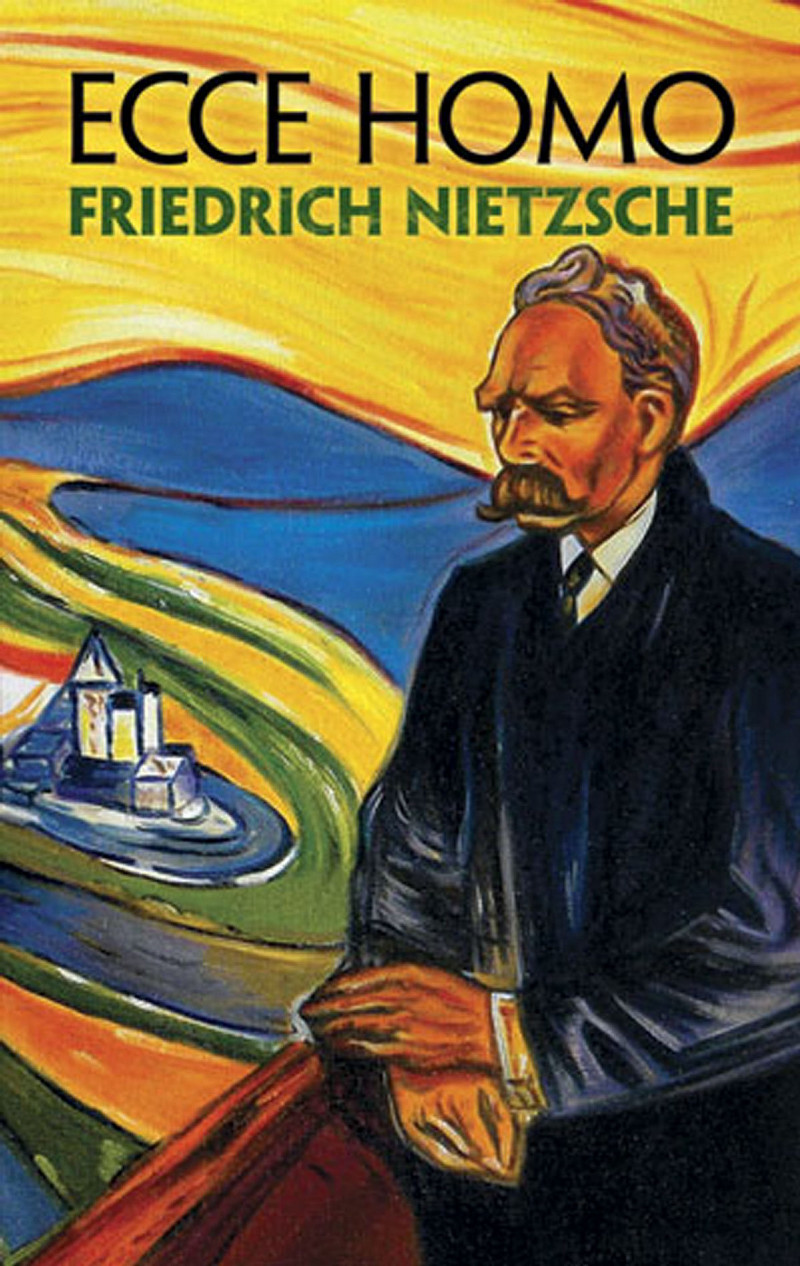
Ecce Homo
An autobiographical work in which Nietzsche reflects on his own intellectual development, personal experiences, and the significance of his philosophical ideas.
- Published1888
- TypeAutobiography
- GenrePhilosophy, Autobiography
- LanguageGerman
About the Author

Friedrich Nietzsche
Friedrich Nietzsche, a profound influence in philosophy, focusing on morality, the Ubermensch, and cultural critique.
View Profile- OccupationPhilosopher
- FromGermany
-
Other Works
- The Birth of Tragedy (1872)
- The Gay Science (1882)
- Thus Spoke Zarathustra (1883)
- Beyond Good and Evil (1886)
- On the Genealogy of Morals (1887)