
Philosophical treatise: Ethics
Overview
Published posthumously in 1677, Baruch Spinoza’s Ethics advances a radical, systematic metaphysics and a corresponding account of knowledge, emotion, and human freedom. Written in a geometric style with definitions, axioms, and propositions, it argues that understanding the necessary order of nature transforms how one lives, replacing fear and servility with rational love and equanimity.
Substance, God, and Nature
Spinoza identifies God with a single, infinite substance that has infinite attributes, of which humans grasp thought and extension. Everything that exists is a mode, an expression, of this one substance. The formula “God or Nature” signals a rejection of a personal, purposive deity and of final causes: nothing in nature occurs for the sake of ends; all follows from the necessity of divine nature. There is no transcendent creator standing apart from the world, and no free will in God or creatures. This strict determinism does not deny activity; it locates genuine power in understanding the necessity by which things follow.
Mind and Body
Mind and body are not two substances but two attributes of the same reality. The mind is the idea of the body; every bodily state has a corresponding idea in thought, and neither causes the other. This parallelism dissolves Cartesian interaction problems while preserving the integrity of mental and physical descriptions. Individual minds vary in perfection according to the adequacy of their ideas and the complexity and coherence of their bodies.
Knowledge and Adequacy
Spinoza distinguishes three kinds of cognition. Imagination or opinion relies on sensory traces, words, and hearsay, yielding partial and often confused ideas. Reason grasps common notions, features shared across things, and produces adequate, necessary knowledge of their relations. Intuitive knowledge proceeds from the adequate idea of God or Nature to the essence of particular things, yielding the highest certainty. Adequate ideas are causally self-explanatory within the intellect; their growth increases the mind’s power, clarity, and freedom from passive affect.
Affects and Human Bondage
Human affects arise from the mind’s ideas of its own body’s transitions to greater or lesser power of acting. The core of conatus, each thing’s striving to persevere in its being, underwrites desire, joy, and sadness as fundamental affects, from which complex passions derive. Because imagination is partial and future-oriented, it entangles us in hope and fear, envy and ambition, superstition and resentment. To be “in bondage” is to be determined by inadequate ideas and passive affects whose causes lie outside us.
Freedom, Virtue, and Blessedness
Freedom is not contingency but understanding necessity. As reason forms adequate ideas, affects become “active” and align with our true advantage, which is to increase our power of acting. Virtue is identical with power; to act from the guidance of reason is to live in accordance with one’s nature. Good and evil are not intrinsic qualities but relative to our striving; reason clarifies what genuinely aids our flourishing. The highest good is the intellectual love of God, a joyful, stable affect arising from intuitive knowledge of the necessity and infinity of Nature. This love is eternal in the sense that what the mind understands sub specie aeternitatis is independent of the imagination of time, conferring blessedness rather than immortality of a personal soul.
Social Life and Practical Implications
Because humans are more powerful together, reason prescribes mutual aid, friendship, justice, and civic concord. Laws and institutions can channel passions toward cooperative ends, and a wise person participates in society, moderates desires, and cultivates gratitude and generosity. The practical consequence is a life grounded in understanding rather than hope or fear, resilient amid fortune, and oriented toward joy that does not depend on external contingencies.
Citation Formats
APA Style (7th ed.)
Ethics. (2025, August 27). FixQuotes. https://fixquotes.com/works/ethics/
Chicago Style
"Ethics." FixQuotes. August 27, 2025. https://fixquotes.com/works/ethics/.
MLA Style (9th ed.)
"Ethics." FixQuotes, 27 Aug. 2025, https://fixquotes.com/works/ethics/. Accessed 12 Feb. 2026.
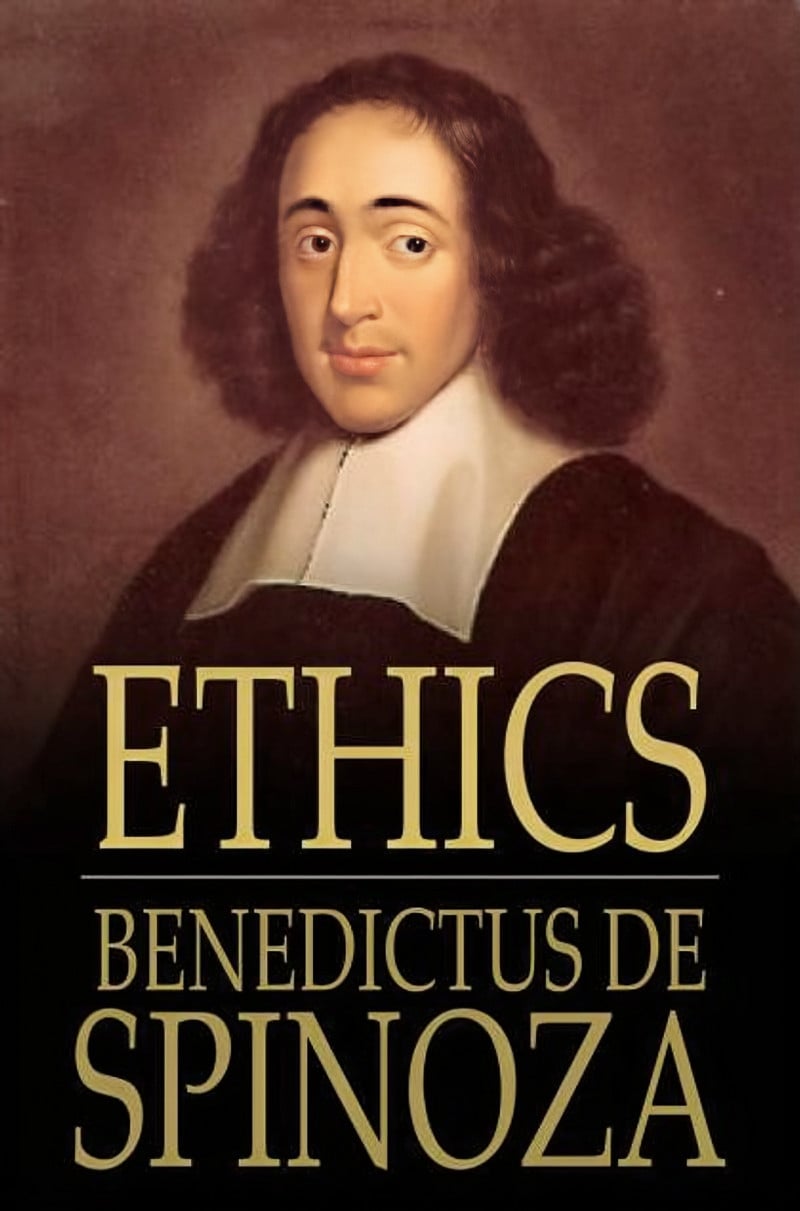
Ethics
Original: Ethica, ordine geometrico demonstrata
Ethics is a philosophical treatise written by Benedict (Baruch) de Spinoza, in which the author presents a comprehensive metaphysical and moral moral system based on the principles of geometric proofs. The primary themes of Ethics include the nature of God, the human mind, human emotions, and ethical conduct.
- Published1677
- TypePhilosophical treatise
- GenrePhilosophy
- LanguageLatin
About the Author

- OccupationPhilosopher
- FromNetherland
-
Other Works
- Letters (1661)
- Short Treatise on God, Man, and His Well-Being (1662)
- Theological-Political Treatise (1670)
- A Political Treatise (1677)