
Book: Further Poems of Emily Dickinson
Overview
Further Poems of Emily Dickinson (1929) is a posthumous anthology that broadened the public sense of Dickinson’s range by bringing to light additional poems discovered among the packets and loose sheets she left in Amherst. Prepared by Martha Dickinson Bianchi, the poet’s niece, the volume serves as a supplemental gallery to the earlier selections that had introduced Dickinson to a wide audience, gathering lyrics that intensify her preoccupations with mortality, the natural world, love, doubt, and the mind’s sovereignty. Issued during an era newly receptive to compressed, enigmatic forms, the book helped align Dickinson, who wrote decades earlier, with modernist sensibilities without reducing her to them.
Contents and Themes
The poems extend familiar Dickinson territories while complicating their contours. Death and immortality reappear not as macabre fixations but as constant coordinates by which consciousness measures itself. The speakers test the edges of experience, pain, bereavement, ecstasy, seeking “Circumference,” a term that names both limit and enlargement. Nature remains a principal theater: birds, bees, flowers, and weather moments become emblems of transition, dispatches from the outer world that mirror inner weather. Seasonal cycles register the mind’s volatility; a storm or a thaw dramatizes spiritual risk and reprieve.
Love is figured as absence as often as presence, a chemistry of yearning that acquires force through separation, renunciation, or delay. Fame and anonymity are weighed with sly wit: the value of being “nobody” persists as a tactical freedom, even as the poems scrutinize the costs and temptations of recognition. Faith is approached obliquely, less as doctrinal assent than as a rhythm of approach and recoil. The result is a poetics of experiment: belief examined under pressure, hope interrogated by intelligence, skepticism warmed by desire.
Style and Form
The volume showcases Dickinson’s unmistakable signatures: brief, compressed lyrics; abrupt volta-like turns; slant rhyme; and an elliptical syntax that lets metaphors flash and vanish with electric suddenness. Personifications, of Death, Time, Possibility, cohabit with exact observations of small phenomena, creating a scale where a bee’s errand can carry cosmic implication. Humor surfaces in riddling definitions and tart aphorisms; so does a stringent clarity about grief, which she treats not as a sentiment but as a structure of perception.
Because this edition reflects editorial habits of its time, the visual profile of the poems is somewhat regularized. Even so, the energies driving Dickinson’s language remain palpable: the pressure of thought against form, the ingenuity with which a spare lexicon renders intricate mental states, the way a single image (a door, a house, a loaded sky) can hold an argument about thresholds and shelter.
Arrangement and Editorial Mediation
The selection follows the nineteenth-century practice of grouping by theme rather than by manuscript sequence. That decision frames Dickinson as a poet of distinct domains, Life, Love, Nature, Eternity, while inevitably smoothing the fractures and experiments visible in her fascicles and drafts. Titles are sometimes supplied, punctuation softened, and capitalization rationalized, all choices meant to aid legibility for general readers. For contemporary audiences, this mediation offers a readable portal; for scholars, it marks a stage in Dickinson’s editorial afterlife, to be set alongside later, more diplomatic texts.
Significance
Further Poems affirmed that the earlier portrait of Dickinson was partial. The additional lyrics deepen her skepticism, broaden her tonal palette, and confirm her as a poet of intellectual audacity as well as feeling. The collection’s timing also mattered: in 1929, a voice at once compressed, paradoxical, and intensely interior appeared strikingly contemporary. By extending the canon beyond the familiar anthologized pieces, the book helped secure Dickinson’s reputation not as an eccentric of a few perfect lyrics but as a sustained, searching artist whose small-scale forms accommodate vast conceptual distances.
Further Poems of Emily Dickinson (1929) is a posthumous anthology that broadened the public sense of Dickinson’s range by bringing to light additional poems discovered among the packets and loose sheets she left in Amherst. Prepared by Martha Dickinson Bianchi, the poet’s niece, the volume serves as a supplemental gallery to the earlier selections that had introduced Dickinson to a wide audience, gathering lyrics that intensify her preoccupations with mortality, the natural world, love, doubt, and the mind’s sovereignty. Issued during an era newly receptive to compressed, enigmatic forms, the book helped align Dickinson, who wrote decades earlier, with modernist sensibilities without reducing her to them.
Contents and Themes
The poems extend familiar Dickinson territories while complicating their contours. Death and immortality reappear not as macabre fixations but as constant coordinates by which consciousness measures itself. The speakers test the edges of experience, pain, bereavement, ecstasy, seeking “Circumference,” a term that names both limit and enlargement. Nature remains a principal theater: birds, bees, flowers, and weather moments become emblems of transition, dispatches from the outer world that mirror inner weather. Seasonal cycles register the mind’s volatility; a storm or a thaw dramatizes spiritual risk and reprieve.
Love is figured as absence as often as presence, a chemistry of yearning that acquires force through separation, renunciation, or delay. Fame and anonymity are weighed with sly wit: the value of being “nobody” persists as a tactical freedom, even as the poems scrutinize the costs and temptations of recognition. Faith is approached obliquely, less as doctrinal assent than as a rhythm of approach and recoil. The result is a poetics of experiment: belief examined under pressure, hope interrogated by intelligence, skepticism warmed by desire.
Style and Form
The volume showcases Dickinson’s unmistakable signatures: brief, compressed lyrics; abrupt volta-like turns; slant rhyme; and an elliptical syntax that lets metaphors flash and vanish with electric suddenness. Personifications, of Death, Time, Possibility, cohabit with exact observations of small phenomena, creating a scale where a bee’s errand can carry cosmic implication. Humor surfaces in riddling definitions and tart aphorisms; so does a stringent clarity about grief, which she treats not as a sentiment but as a structure of perception.
Because this edition reflects editorial habits of its time, the visual profile of the poems is somewhat regularized. Even so, the energies driving Dickinson’s language remain palpable: the pressure of thought against form, the ingenuity with which a spare lexicon renders intricate mental states, the way a single image (a door, a house, a loaded sky) can hold an argument about thresholds and shelter.
Arrangement and Editorial Mediation
The selection follows the nineteenth-century practice of grouping by theme rather than by manuscript sequence. That decision frames Dickinson as a poet of distinct domains, Life, Love, Nature, Eternity, while inevitably smoothing the fractures and experiments visible in her fascicles and drafts. Titles are sometimes supplied, punctuation softened, and capitalization rationalized, all choices meant to aid legibility for general readers. For contemporary audiences, this mediation offers a readable portal; for scholars, it marks a stage in Dickinson’s editorial afterlife, to be set alongside later, more diplomatic texts.
Significance
Further Poems affirmed that the earlier portrait of Dickinson was partial. The additional lyrics deepen her skepticism, broaden her tonal palette, and confirm her as a poet of intellectual audacity as well as feeling. The collection’s timing also mattered: in 1929, a voice at once compressed, paradoxical, and intensely interior appeared strikingly contemporary. By extending the canon beyond the familiar anthologized pieces, the book helped secure Dickinson’s reputation not as an eccentric of a few perfect lyrics but as a sustained, searching artist whose small-scale forms accommodate vast conceptual distances.
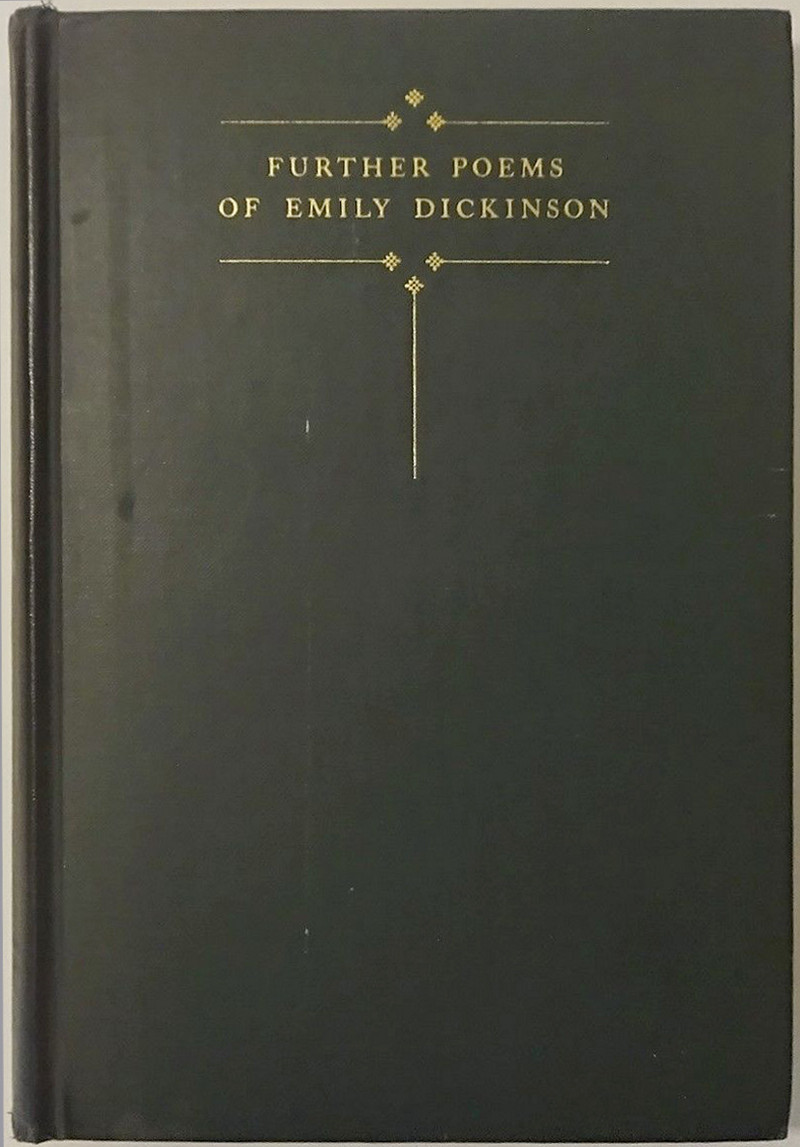
Further Poems of Emily Dickinson
A collection of Emily Dickinson's previously unpublished poetry, edited and published by Martha Dickinson Bianchi and Alfred Leete Hampson.
- Publication Year: 1929
- Type: Book
- Genre: Poetry
- Language: English
- View all works by Emily Dickinson on Amazon
Author: Emily Dickinson

More about Emily Dickinson
- Occup.: Poet
- From: USA
- Other works:
- Poems by Emily Dickinson: First Series (1890 Book)
- Poems by Emily Dickinson: Second Series (1891 Book)
- The Letters of Emily Dickinson (1894 Book)
- Poems by Emily Dickinson: Third Series (1896 Book)
- The Single Hound: Poems of a Lifetime (1914 Book)