
Book: Glasow's Gloomchasers
Overview
Arnold H. Glasow's 1981 book Glasow's Gloomchasers is a compact treasury of quips, aphorisms, and miniature essays designed to lift spirits and sharpen common sense. A longtime American humorist whose one-liners circulated widely in business newsletters and civic speeches, Glasow distills decades of observations about work, character, and everyday life into a desk-side companion meant to chase away gloom with wit and perspective. Rather than telling a continuous story, the book offers a mosaic of self-contained remarks that can be dipped into at random whenever a nudge toward clarity or cheer is needed.
Content and Structure
The entries are grouped around everyday concerns, work and leadership, sales and service, marriage and family, aging and health, worry and gratitude. Topics recur in a rhythm that suits brief reading, with each page offering a handful of punchy lines or a short paragraph that lands on a twist. The structure favors brevity and repetition with variation: a tight observation, a surprising angle, and a practical takeaway wrapped in humor. The arrangement underscores Glasow’s belief that the same simple truths light different corners of life.
Themes
Optimism tempered by realism runs throughout. Glasow does not deny frustration, failure, or folly; he reframes them as fuel for resilience. On work, he praises diligence over theatrics and underlines the power of follow-through. On leadership, he emphasizes humility, responsibility, and the habit of giving credit while quietly absorbing blame. On sales and persuasion, he leans on empathy and listening rather than clever patter. Domestic life invites gentle ribbing and reminders that patience, courtesy, and a sense of humor are sturdy household tools. The larger theme is self-mastery: the notion that attitude, habits, and small choices reliably outweigh luck.
Style and Tone
The signature effect is a clean setup with an unexpected turn, often an inversion that punctures pomposity. Wordplay is frequent but seldom flashy; the aim is a knowing smile before the insight lands. The tone is genial, Midwestern, and unpretentious, with skewers reserved for vanity, excuses, and fashionable shortcuts. Glasow’s voice suggests a colleague who has seen the same problems before and knows how to deflate them without scolding. The humor acts as solvent on defensiveness, clearing space for advice readers are willing to take.
Notable Motifs
Personal responsibility recurs, framed as freedom rather than burden. Time is treated as capital, squandered most easily by procrastination and meetings without purpose. Gratitude is presented as both lubricant and glue for relationships, making daily frictions smoother and bonds stronger. Worry appears as a poor investment, while action, especially small, consistent action, earns compounding returns. Across topics, Glasow prefers the steady path: courtesy over cleverness, persistence over brilliance, preparation over luck.
Audience and Use
The book’s primary audience is managers, salespeople, and civic leaders looking for pithy lines to anchor talks, memos, and toasts. Yet its draw is broader, appealing to readers who like their self-help diluted with comedy and their comedy fortified with sense. The design invites casual browsing: a few minutes in the morning, a reset after a rough meeting, a pick-me-up on a tough day.
Legacy
Glasow’s Gloomchasers sits in the tradition of American business wit that doubles as everyday counsel. Many of its sentiments have been echoed and reprinted for years because they marry immediacy with staying power. The book endures not as a program to follow but as a reliable spark, proving that a well-aimed sentence can brighten a mood and quietly improve a habit.
Citation Formats
APA Style (7th ed.)
Glasow's gloomchasers. (2025, November 25). FixQuotes. https://fixquotes.com/works/glasows-gloomchasers/
Chicago Style
"Glasow's Gloomchasers." FixQuotes. November 25, 2025. https://fixquotes.com/works/glasows-gloomchasers/.
MLA Style (9th ed.)
"Glasow's Gloomchasers." FixQuotes, 25 Nov. 2025, https://fixquotes.com/works/glasows-gloomchasers/. Accessed 12 Feb. 2026.
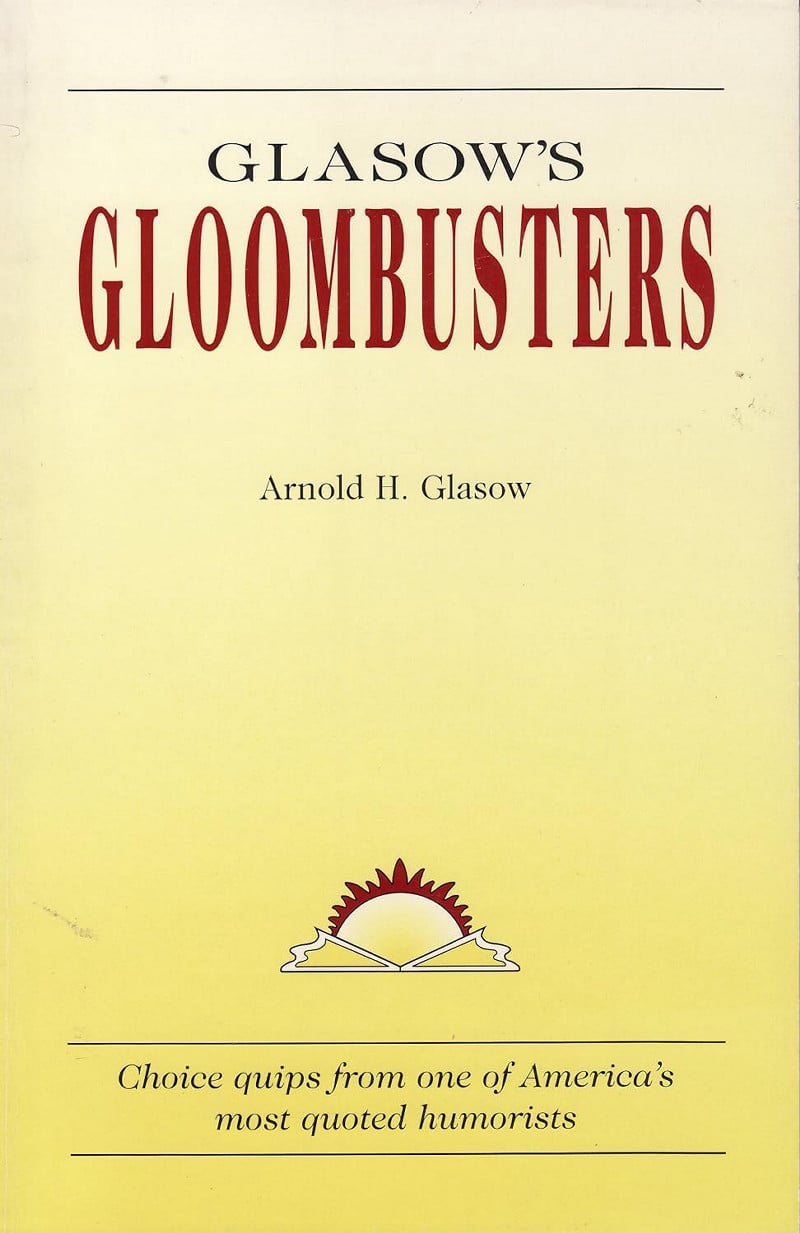
Glasow's Gloomchasers
Another collection of humorous quotes and sayings by Arnold H. Glasow.
- Published1981
- TypeBook
- GenreHumor
- LanguageEnglish
About the Author

Arnold H. Glasow
Explore the life and witty insights of Arnold H Glasow, a celebrated satirist and businessman known for his impactful quotes and business acumen.
View Profile- OccupationBusinessman
- FromUSA
-
Other Works
- Glasow's Gloombusters (1951)
- All in Fun (1970)