
Book: How to Know God
Overview
Deepak Chopra presents "How to Know God" as a guide to the inner discovery of the divine, arguing that God is not a distant entity to be located externally but a dimension of awareness accessible through altered states of consciousness. The book moves fluidly between mystical accounts drawn from Vedanta, Sufism, Christian mysticism and modern spiritual teachers, and attempts to translate those insights into a contemporary language that engages psychology and science. The tone is at once devotional and exploratory, inviting readers to treat spiritual experience as an empirical field to be investigated within their own interior life.
Central Thesis
Chopra's central claim is that knowing God is an experiential process rather than a set of doctrinal beliefs. God is described as pure awareness, the substratum of being that underlies perception, thought and emotion. The ego, defined as the stream of conditioned identity and habitual mental patterns, obscures that presence, and the spiritual path consists of progressively dissolving those obscurations until awareness recognizes itself. Knowing God therefore is presented as a realization of unity that transforms perception and identity rather than an intellectual assent to theological propositions.
Mapping the Inner Journey
The book outlines stages of spiritual development, from the restless seeking of the outer life to deeper interior states of silence, surrender and unitive consciousness. Chopra delineates how ordinary sense-bound experience gives way to subtler faculties: intuition, inner witnessing and finally abiding in pure being. Stories, metaphors and contemplative exercises are used to illuminate obstacles such as attachment, fear and the compulsion to narrate experience. Each stage is framed as both a psychological shift and a subtle recalibration of how consciousness organizes reality.
Science and the Spiritual Brain
A persistent theme is a dialogue between spirituality and neuroscience. Chopra examines correlations between meditative and mystical states and brain activity, discussing how altered neural patterns accompany experiences of transcendence while insisting that consciousness is not reducible to those patterns. He engages with contemporary research that points to specific brain states during spiritual encounters but argues that such findings do not negate the primacy or continuity of consciousness itself. The aim is to create a complementary framework in which scientific description and existential transformation inform one another.
Practices for Knowing
Practical guidance is woven through the text, emphasizing silence, meditation, contemplative prayer and inward attention as methods for cultivating receptive awareness. Techniques are presented not as mechanical recipes but as means to reorient habitual attention away from narrative selfhood toward immediate presence. Chopra encourages sustained practice, surrendering outcomes and cultivating qualities such as compassion and gratitude, which he portrays as natural expressions of expanded awareness rather than moral imperatives alone.
Style and Implications
The prose blends poetic imagery, metaphysical propositions and didactic passages, which makes the book both evocative and sometimes discursive. Readers seeking intellectual rigor in scientific detail may find the treatment of neuroscience and quantum metaphors partial, while those drawn to syncretic spiritual guidance will appreciate the integration of traditions and the emphasis on direct experience. The book is intended to be transformative for seekers ready to prioritize inner practice and to question habitual assumptions about selfhood and reality.
Conclusion
Ultimately, "How to Know God" frames the divine as an accessible dimension of being whose discovery reshapes life, relationships and purpose. It invites a shift from believing about God to knowing through cultivated states of awareness, promising that such knowledge yields a lived sense of unity, healing and meaning. The path Chopra sketches is experiential, patient and inward-directed, offering a map for those who wish to explore spirituality through both contemplative discipline and an openness to contemporary scientific perspectives.
Citation Formats
APA Style (7th ed.)
How to know god. (2026, February 4). FixQuotes. https://fixquotes.com/works/how-to-know-god/
Chicago Style
"How to Know God." FixQuotes. February 4, 2026. https://fixquotes.com/works/how-to-know-god/.
MLA Style (9th ed.)
"How to Know God." FixQuotes, 4 Feb. 2026, https://fixquotes.com/works/how-to-know-god/. Accessed 26 Mar. 2026.
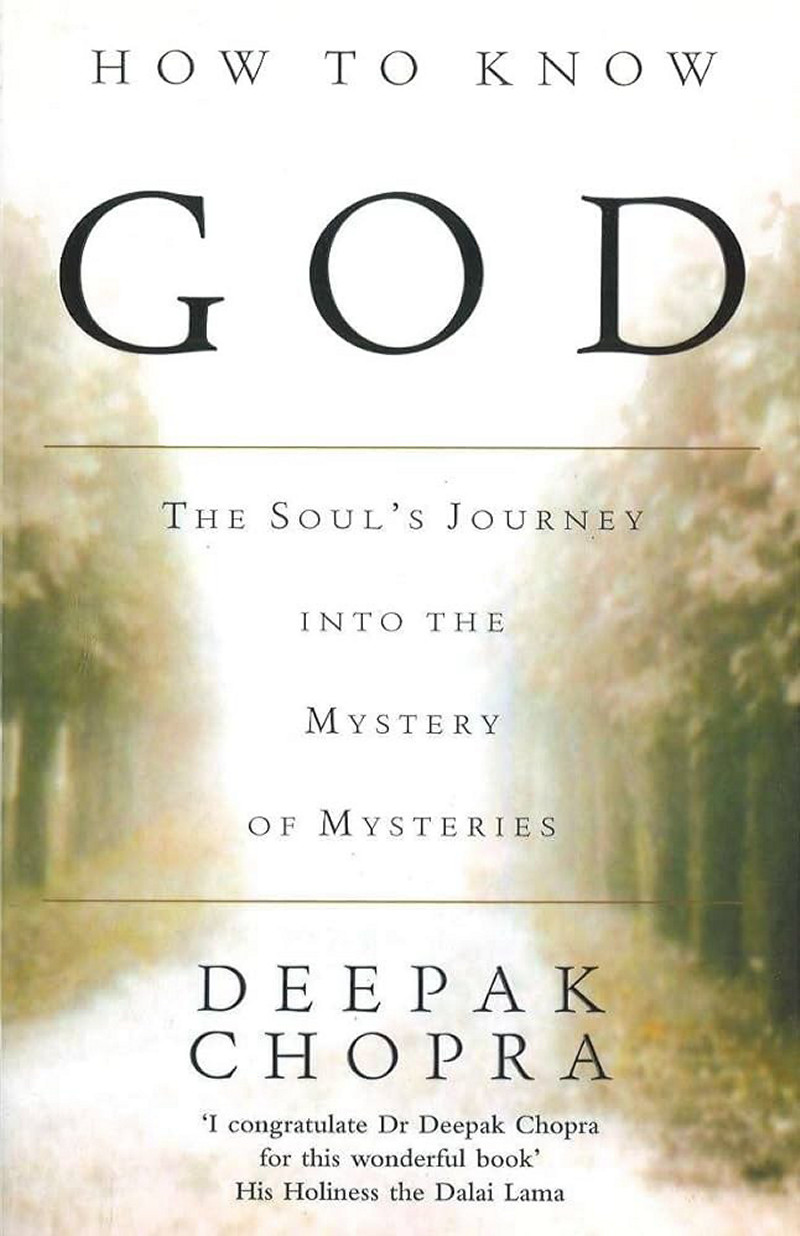
How to Know God
A groundbreaking exploration of the human experience of God, offering insights into the brain states associated with spiritual encounters and the science behind our capacity for spiritual awakening.
- Published2000
- TypeBook
- GenreSpirituality, Science
- LanguageEnglish
About the Author

Deepak Chopra
Deepak Chopra, a prominent figure in spirituality and alternative medicine, with over 80 bestselling books.
View Profile- OccupationPhilosopher
- FromUSA
-
Other Works
- Quantum Healing (1989)
- The Seven Spiritual Laws of Success (1994)
- The Return of Merlin (1995)
- The Way of the Wizard (1995)
- The Path to Love (1997)