
Essay: If I Were the Devil
Overview
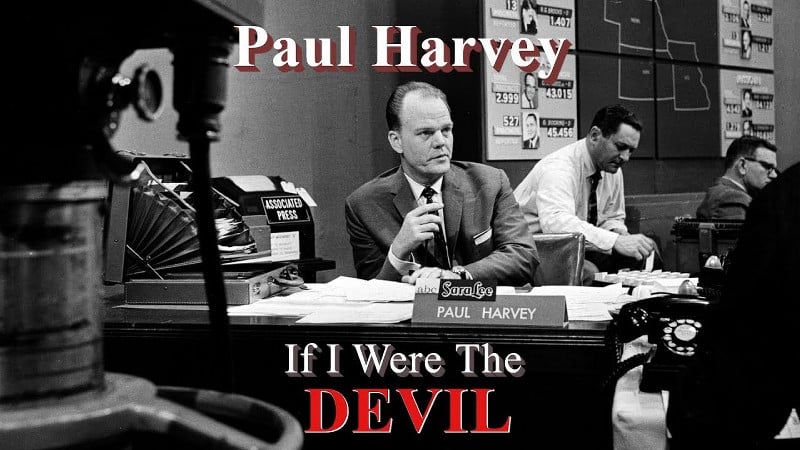
Paul Harvey's "If I Were the Devil" is a brief, dramatic radio commentary first delivered in 1965, presented as a theatrical monologue in which the narrator imagines speaking in the devil's voice. Harvey sketches a deliberate, corrosive program to weaken American society by undermining moral foundations, social institutions, and national unity. The piece uses inversion and rhetorical irony to warn listeners about cultural and moral shifts that Harvey saw as threats to the nation's character.
Imagined Voice and Strategy
The narrator adopts the persona of an adversary plotting long-range cultural subversion rather than overt conquest. Harvey frames the threats as incremental and insidious: the goal is not sudden collapse but gradual erosion of trust, virtue, and civic resolve. By speaking as the schemer, Harvey explores how small, everyday concessions, when multiplied across institutions and habits, can produce a dramatic transformation of public life over time.
Targets and Tactics
Harvey identifies many elements of American life as vulnerable: faith, education, family, patriotism, and public discourse. He suggests that fostering cynicism toward religion, replacing absolute moral language with relativism, weakening parental authority, encouraging promiscuity, and promoting selfishness and instant gratification will corrode social cohesion. He also points to the manipulation of language, the celebration of vice, the disregard for history, and erosion of respect for law and order as mechanisms that, collectively, will produce a society less resilient to internal decay.
Tone and Rhetoric
The commentary relies on plainspoken, urgent language that blends moral admonition with dramatic imagery. Harvey's approach is rhetorical rather than academic: he enumerates consequences in a manner intended to provoke moral self-examination and civic alarm. The piece juxtaposes stark moral judgments with vivid scenarios, inviting listeners to see contemporary cultural trends not as disconnected phenomena but as parts of a single, directed pattern with deep consequences for communal life.
Historical Context
Delivered in the mid-1960s, the commentary reflects anxieties common in that era, concern over social upheaval, shifting norms, and perceived declines in authority, while anticipating debates that would persist in later decades. The Cold War backdrop and rapid cultural changes of the 1960s inform its urgency. Although rooted in its time, the themes and rhetorical moves have proved resonant across subsequent generations, as headlines and cultural controversies have echoed the dilemmas Harvey described.
Legacy and Reception
"If I Were the Devil" circulated widely beyond its initial broadcast, reproduced in print and shared in political and cultural conversations as a pithy diagnosis of perceived moral decline. Supporters praised its clarity and moral seriousness, seeing it as a necessary wake-up call. Critics argued that its portrayal simplified complex social phenomena and sometimes conflated moral disagreement with moral decay. Regardless of stance, the piece became a touchstone in American rhetorical life, frequently invoked by commentators concerned with tradition, civic virtue, and the cultural consequences of rapid change.
Enduring Significance
The commentary continues to be cited because it encapsulates a recurrent pattern in public discourse: the use of vivid moral narrative to frame cultural anxiety as a unified threat. Whether read as prophetic warning, moral sermon, or rhetorical device, Harvey's imagined monologue functions as a concise map of conservative concerns about social fragmentation. Its power lies less in empirical claims than in its capacity to crystallize a worldview that prizes continuity, restraint, and moral clarity as bulwarks against social dissolution.
Citation Formats
APA Style (7th ed.)
If i were the devil. (2026, February 5). FixQuotes. https://fixquotes.com/works/if-i-were-the-devil/
Chicago Style
"If I Were the Devil." FixQuotes. February 5, 2026. https://fixquotes.com/works/if-i-were-the-devil/.
MLA Style (9th ed.)
"If I Were the Devil." FixQuotes, 5 Feb. 2026, https://fixquotes.com/works/if-i-were-the-devil/. Accessed 13 Feb. 2026.
If I Were the Devil
A short, widely circulated radio commentary in which Harvey imagines speaking as the Devil laying out a plan to undermine American society, morality, and institutions. Often quoted in political and cultural discussions.
- Published1965
- TypeEssay
- GenrePolitical Commentary, Editorial
- Languageen
About the Author
Paul Harvey
Paul Harvey covering his early life, radio career, News and Comment, The Rest of the Story, controversies, and legacy.
View Profile- OccupationJournalist
- FromUSA
-
Other Works
- So God Made a Farmer (1978)