
Book: In Search of Excellence
Overview and context
Published in 1982 by Tom Peters and Robert H. Waterman Jr., In Search of Excellence emerged during a period of anxiety about U.S. competitiveness, especially relative to Japanese firms. Drawing on their experience at McKinsey, the authors set out to identify what distinguished America’s best-run companies, arguing that performance was rooted less in strict planning and structure and more in culture, values, and action-oriented management. The book reframed excellence as a pattern of behaviors and beliefs rather than a single system or strategy, and it popularized a human-centered view of management that resonated widely with executives and practitioners.
Research approach
The authors examined 43 companies across industries, technology, consumer goods, manufacturing, and services, chosen for sustained performance and reputation. Their method leaned heavily on qualitative fieldwork: interviews with executives and frontline employees, site visits, and pattern recognition across cases. Rather than building a statistical model, they sought recurring themes in how managers actually worked. This lens tilted the analysis toward observable practices, how leaders talked about values, how teams solved problems, how organizations encouraged initiative, aiming to capture the lived texture of effective management.
The eight attributes of excellence
The book distills its findings into eight interlocking attributes. A bias for action: favor quick experiments and tangible tests over protracted analysis. Close to the customer: immerse in customer problems and service quality. Autonomy and entrepreneurship: cultivate many internal champions and small bets. Productivity through people: trust, respect, and involvement unleash discretionary effort. Hands-on, value-driven: leaders model a few clear, nonnegotiable values that guide daily decisions. Stick to the knitting: focus on businesses you understand deeply. Simple form, lean staff: keep structures uncomplicated and corporate centers small. Simultaneous loose-tight properties: uphold a tight core of values while allowing decentralized freedom in execution. Together these principles elevate speed, learning, and coherence without sacrificing local initiative.
The 7-S framework
Peters and Waterman also popularized McKinsey’s 7-S model, arguing that performance depends on alignment among seven elements: strategy, structure, systems, skills, staff, style, and shared values. They contended that the so-called soft elements, style, skills, staff, and shared values, often matter more than formal strategy and structure, because they shape behavior at scale. Excellence, in their view, comes from consistent reinforcement across these elements, not from reorganizations or planning cycles alone.
People, culture, and managerial practice
A signature theme is that culture is a manager’s primary lever. Practices such as management by wandering around, storytelling, recognition of small wins, and visible adherence to a short list of values sustain motivation and clarity. The authors highlight small teams, proximity to the customer, and rapid prototyping as mechanisms that keep organizations agile. They celebrate middle managers and frontline contributors as sources of innovation, challenging the notion that strategy is the preserve of the top.
Illustrative exemplars
Examples include Hewlett-Packard’s informal, collegial style and MBWA; 3M’s encouragement of grassroots entrepreneurship; IBM’s obsession with service quality; Procter & Gamble’s disciplined brand management; Johnson & Johnson’s credo-driven decision-making; and McDonald’s operational consistency. These vignettes show values translated into routines, not slogans.
Impact and critique
The book became a management classic, shifting attention from planning to people and sparking decades of work on culture, customer focus, and empowerment. Critics later questioned its methodology and noted that several exemplar firms stumbled, raising survivorship and halo concerns. Yet many of the book’s claims, act quickly, stay close to customers, honor a few clear values, keep structures simple, and let capable people run, have proven durable. Its enduring contribution is a practical, human-centered blueprint for building organizations that learn, adapt, and execute with purpose.
Citation Formats
APA Style (7th ed.)
In search of excellence. (2026, February 4). FixQuotes. https://fixquotes.com/works/in-search-of-excellence/
Chicago Style
"In Search of Excellence." FixQuotes. February 4, 2026. https://fixquotes.com/works/in-search-of-excellence/.
MLA Style (9th ed.)
"In Search of Excellence." FixQuotes, 4 Feb. 2026, https://fixquotes.com/works/in-search-of-excellence/. Accessed 27 Mar. 2026.
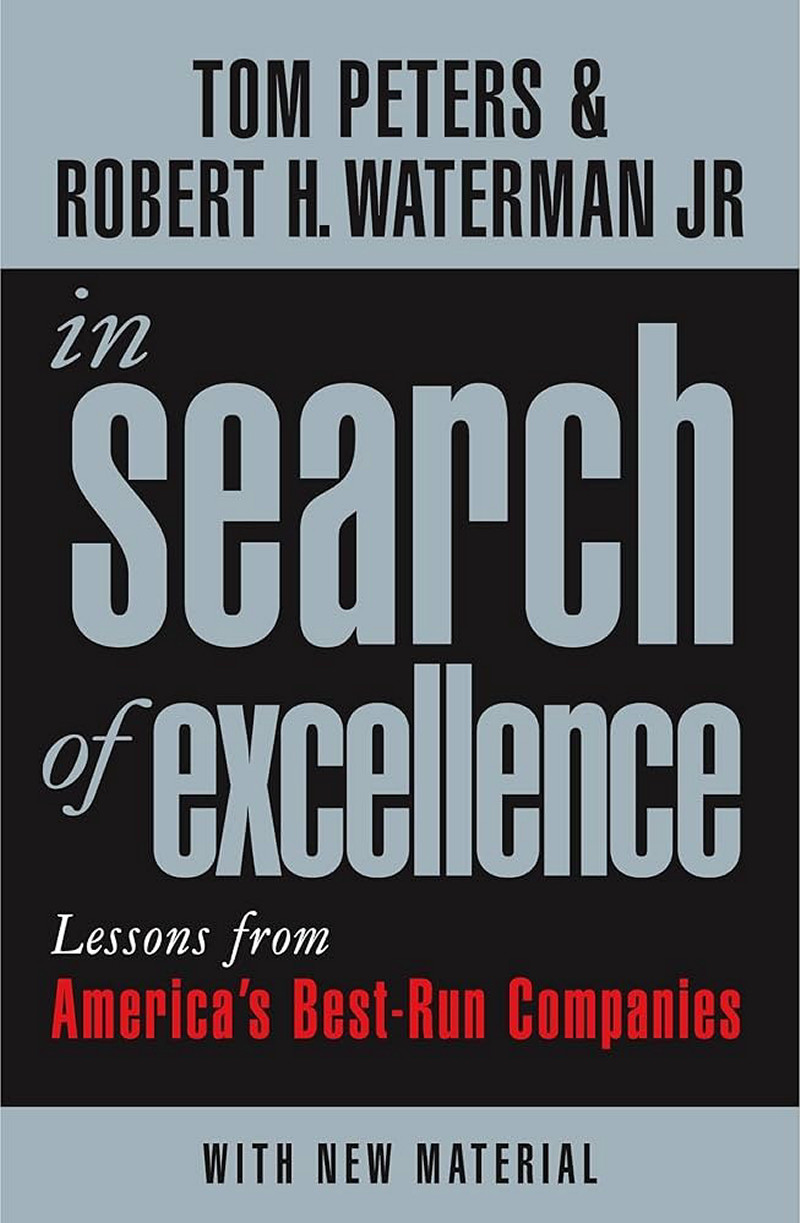
In Search of Excellence
In Search of Excellence is a book dealing with many of the themes of the growing 'excellence movement' in management. It provides insights into the methods and practices adopted by some of the most successful American corporations.
- Published1982
- TypeBook
- GenreBusiness, Management, Leadership
- LanguageEnglish
About the Author

Tom Peters
Tom Peters, acclaimed author and expert in business management and organizational culture.
View Profile- OccupationBusinessman
- FromUSA
-
Other Works
- A Passion for Excellence (1985)
- Thriving on Chaos (1987)
- Liberation Management (1992)
- The Pursuit of Wow! (1994)
- The Tom Peters Seminar (1994)