
Book: Innovation and Entrepreneurship
Overview
Peter Drucker presents innovation and entrepreneurship as disciplined, teachable practices rather than flashes of genius. He breaks the subject into three integrated parts: the practice of innovation, the practice of entrepreneurship, and entrepreneurial strategies. Innovation is defined as purposeful action that converts change into new value and customer satisfaction. Entrepreneurship is the behavior of systematically searching for opportunities, organizing resources, and managing for results in any institution, business, public service, or nonprofit.
Innovation as a Discipline
Innovation starts with analysis and ends with measurement. It begins with the customer, the use, and the result rather than with the inventor’s idea. Drucker stresses that successful innovators are not risk-seeking gamblers but careful workers who concentrate on a few simple, focused opportunities, test quickly, learn from feedback, and build on what already works. Above all, they aim for leadership in a small domain and then expand, choosing opportunities that are simple, specific, and have clear users.
Sources of Innovative Opportunity
Drucker catalogs seven recurring sources where innovators reliably find opportunities: the unexpected (success, failure, or outside events); incongruities between reality and assumptions; process needs that invite a better method; changes in industry or market structure; demographics that alter demand; shifts in perception, mood, and meaning; and new knowledge in science or the arts. He argues the most productive sources are often the least glamorous, unexpected successes, process needs, and structural changes, because they are close to the market, timely, and less risky. Knowledge-based innovations can be transformative but tend to have long lead times and high uncertainty.
Entrepreneurship as Behavior
Entrepreneurship is a practice of managing for opportunity. It applies to small and large firms, public agencies, and nonprofits. Drucker introduces entrepreneurial management as a set of habits: focus on opportunities rather than problems, commit resources to promising initiatives, organize abandonment of the obsolete, and design feedback to measure results. He distinguishes between small business and entrepreneurial business: the latter is designed to grow, systematize innovation, and build a market, regardless of initial size. Risk is to be managed by concentration, simplicity, and rigorous testing, not by diversification for its own sake.
Entrepreneurial Strategy
Drucker outlines several archetypal strategies. Being first with the most seeks leadership through a bold, focused entry. Creative imitation lets a follower rapidly convert another’s idea into a market-winning configuration. Entrepreneurial judo turns an incumbent’s strengths, such as high prices or complex offerings, against it with a simpler, more accessible alternative. Niche strategies secure a defensible position by dominating a specialized segment. Another route is to alter the economic characteristics of a product, market, or industry, changing price points, delivery, or user expectations to create new value.
Policies and Institutions
Established organizations can be entrepreneurial if they build structures that protect new ventures, start small, and scale only after results are proven. Top management must legitimize systematic innovation, allocate resources to opportunities, and practice organized abandonment of yesterday’s successes. Drucker extends the same logic to public service, urging mission clarity, definition of results, and accountability for outcomes in social innovation.
Enduring Lessons
Innovation and entrepreneurship are purposeful work. Start with the user and the result, search systematically for opportunities, keep efforts simple and focused, concentrate resources where leadership is attainable, measure outcomes, and discard what no longer performs. Progress comes less from grand visions than from steady, organized practice.
Citation Formats
APA Style (7th ed.)
Innovation and entrepreneurship. (2026, February 5). FixQuotes. https://fixquotes.com/works/innovation-and-entrepreneurship/
Chicago Style
"Innovation and Entrepreneurship." FixQuotes. February 5, 2026. https://fixquotes.com/works/innovation-and-entrepreneurship/.
MLA Style (9th ed.)
"Innovation and Entrepreneurship." FixQuotes, 5 Feb. 2026, https://fixquotes.com/works/innovation-and-entrepreneurship/. Accessed 5 Mar. 2026.
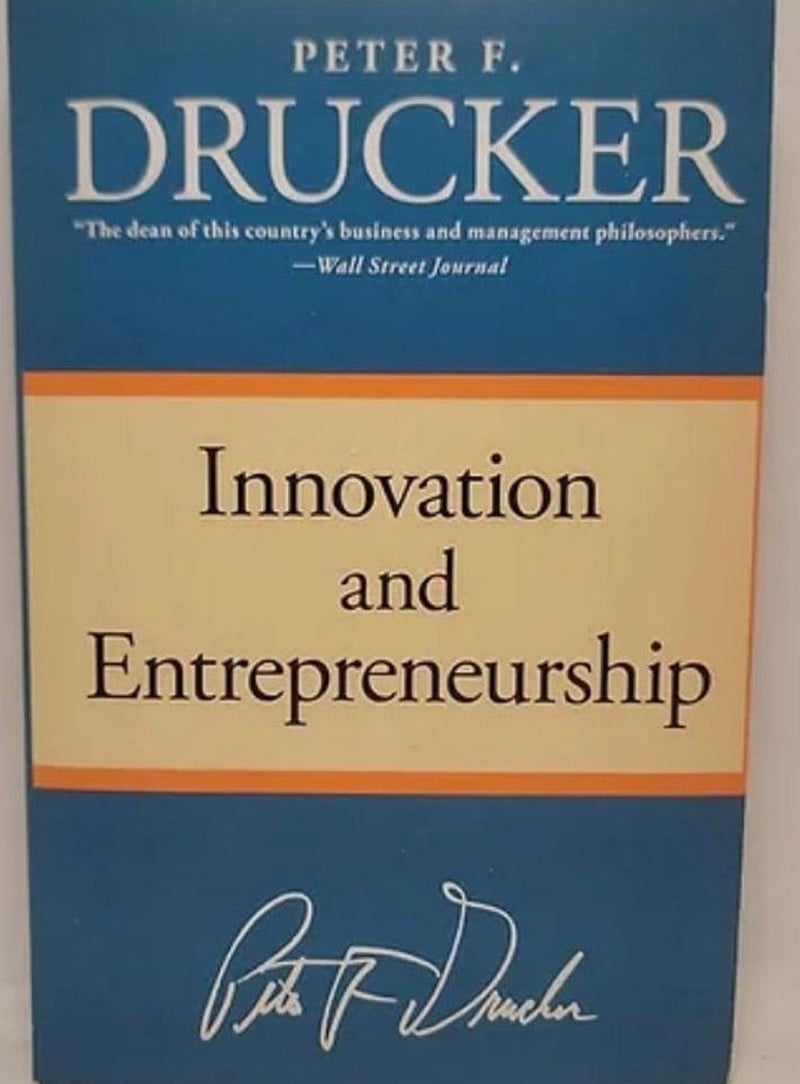
Innovation and Entrepreneurship
Analyzes entrepreneurship and the systematic practice of innovation in both new ventures and established organizations; offers principles and practices for spotting opportunities and converting them into economic results.
- Published1985
- TypeBook
- GenreBusiness, Entrepreneurship
- Languageen
About the Author

Peter Drucker
Peter Drucker, the management thinker who popularized management by objectives and introduced the knowledge worker.
View Profile- OccupationBusinessman
- FromUSA
-
Other Works
- The End of Economic Man (1939)
- The Future of Industrial Man (1942)
- Concept of the Corporation (1946)
- The Practice of Management (1954)
- Managing for Results (1964)
- The Effective Executive (1967)
- The Age of Discontinuity: Guidelines to Our Changing Society (1969)
- Management: Tasks, Responsibilities, Practices (1973)
- Managing in Turbulent Times (1980)
- The Frontiers of Management (1986)
- The New Realities (1989)
- Managing the Non-Profit Organization: Practices and Principles (1990)
- Post-Capitalist Society (1993)
- Management Challenges for the 21st Century (1999)