
Play: Life of Galileo
Overview
Bertolt Brecht’s Life of Galileo charts the career of the Italian astronomer and physicist as he challenges entrenched authority with empirical observation. In the 1943 version, developed during Brecht’s exile and closely associated with his collaboration with Charles Laughton, the play retains an episodic, didactic structure characteristic of epic theatre while deepening Galileo’s human contradictions. It presents scientific discovery as a social process fraught with economic interests, institutional power, and personal compromise.
Setting and Context
The action spans the early 17th century, moving from Padua and Venice to Florence and Rome, then to Galileo’s final house arrest in Arcetri. Brecht stages the rise of the Copernican view in a world organized around feudal hierarchies and scholastic doctrine. Placards, reported news, and short interludes interrupt the drama, keeping the audience aware of shifting public opinion and the material stakes of knowledge.
Synopsis
We meet Galileo in modest circumstances, tutoring the boy Andrea Sarti and struggling for funds. He embraces Copernicus’s sun-centered model and, hearing of a Dutch spyglass, refines it into a telescope that he sells to the Venetian authorities as a military asset. The sale wins him support but also exposes the entanglement of science and commerce. Moving to the Medici court in Florence, he seeks status and freedom to research, demonstrating celestial phenomena, Jupiter’s moons, sunspots, that undermine the fixed heavens of Aristotle.
Opposition coalesces among court philosophers and churchmen, who defend the old order as the underpinning of social stability. Galileo’s friend Sagredo urges caution; the Little Monk pleads that overturning the cosmos will shatter the faith of the poor. A plague outbreak interrupts inquiry, dramatizing both the urgency of practical knowledge and the vulnerability of bodies under authority. Galileo refuses to halt observations, risking exposure to confirm what lenses reveal.
As his findings spread, Rome becomes a theater of conflict. Cardinal Bellarmine warns that scripture cannot be publicly contradicted, while the cultivated Cardinal Barberini, soon to be Pope Urban VIII, shows sympathy but prioritizes institutional control. Galileo’s Dialogue, written to outmaneuver censorship, is read as a challenge to papal authority. Summoned before the Inquisition, he confronts the machinery of punishment and the threat of torture.
Galileo’s Recantation
Under pressure, Galileo abjures his teachings. The recantation shatters his circle; students who saw knowledge as liberation witness its public betrayal. Brecht treats the act neither as simple cowardice nor as heroism, but as the pivotal compromise of an intellectual navigating survival under tyranny. Confined to house arrest, deprived of the public forum and his instruments, Galileo lives on in diminished circumstances.
Aftermath and Final Meeting
Years later, Andrea visits him in secret. The once ardent disciple denounces the capitulation, claiming that fear has set back human emancipation. Galileo responds with an indictment of his own conduct: by yielding, he allowed authority to harness science rather than be reshaped by it. Yet he has continued to work in private, composing the manuscript on motion and material resistance that will anchor modern physics. He slips this work to Andrea to smuggle beyond Italy, ensuring its circulation even as he rejects martyrdom.
Themes and Style
Brecht explores the social function of science, the ethics of intellectual responsibility, and the nexus of truth with power and profit. The play interrogates whether knowledge can be neutral when embedded in hierarchical institutions, and whether survivalist pragmatism corrodes the very purpose of inquiry. Estrangement devices prevent sentimental identification, inviting spectators to judge decisions, contexts, and consequences rather than characters alone.
Ending
Galileo remains a figure of ambivalence: a revolutionary thinker who transformed humanity’s place in the cosmos, and a compromised man whose retreat enabled his work’s preservation while burdening the trajectory of reason with caution. The 1943 version balances admiration for empirical courage with suspicion of capitulation, leaving the audience to wrestle with what science owes to society, and what it must risk to tell the truth.
Citation Formats
APA Style (7th ed.)
Life of galileo. (2026, February 4). FixQuotes. https://fixquotes.com/works/life-of-galileo/
Chicago Style
"Life of Galileo." FixQuotes. February 4, 2026. https://fixquotes.com/works/life-of-galileo/.
MLA Style (9th ed.)
"Life of Galileo." FixQuotes, 4 Feb. 2026, https://fixquotes.com/works/life-of-galileo/. Accessed 27 Mar. 2026.
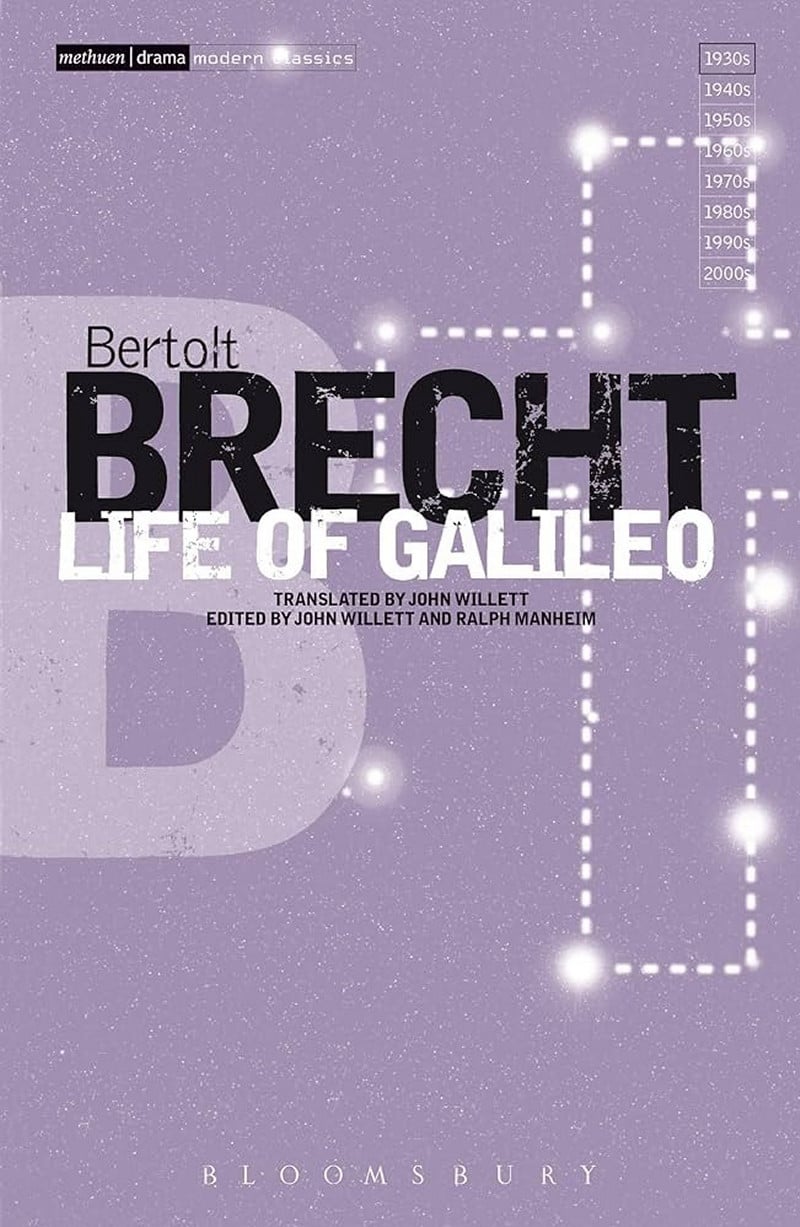
Life of Galileo
Original: Leben des Galilei
Follows the life of the Italian philosopher and astronomer Galileo Galilei, focusing on his conflicts with the Catholic Church over his support of heliocentrism.
- Published1943
- TypePlay
- GenreDrama, Historical
- LanguageGerman
- CharactersGalileo Galilei, Andrea Sarti, The Little Monk, Virginia, Cardinal Barberini
About the Author

Bertolt Brecht
Bertolt Brecht, the influential playwright known for Epic Theatre and his impactful collaborations and legacy.
View Profile- OccupationPoet
- FromGermany
-
Other Works
- Ba'al (1918)
- The Threepenny Opera (1928)
- Fear and Misery of the Third Reich (1938)
- Mother Courage and Her Children (1941)
- The Good Person of Szechwan (1943)
- The Caucasian Chalk Circle (1948)