
Book: Mein Kampf
Overview
Adolf Hitler’s Mein Kampf, first published in 1925 (with a second volume in 1926), blends autobiography with an ideological manifesto that lays out the core tenets of National Socialism. It articulates an aggressively nationalist, racist, and antisemitic worldview, rejects democracy and liberalism, and calls for authoritarian leadership, social militarization, and territorial expansion. The book explains how a vanguard movement, guided by a singular leader and powered by propaganda and paramilitary discipline, could seize power and remake Germany.
Publication and Structure
Written largely while Hitler was imprisoned after the failed Beer Hall Putsch of 1923, the work is divided into two volumes. The first traces Hitler’s life through his early years in Austria, his time in Vienna and Munich, his service in World War I, and the political turmoil that followed. The second turns to programmatic arguments: how to organize a movement, the role of propaganda, the party’s aims, and the policies he believed necessary for Germany’s revival. The prose is polemical and repetitive, mixing personal anecdotes with sweeping claims and conspiratorial interpretations of history.
Autobiographical Elements
Hitler recounts a frustrated youth marked by an abandoned art career and formative years in Vienna, which he presents as the crucible of his racism and antisemitism. He interprets the multiethnic Habsburg capital as evidence of decay, blaming Jews and socialists for cultural decline. World War I becomes the defining experience: he depicts the front as a school of character and Germany’s defeat as a betrayal, adopting the false “stab-in-the-back” myth. After the war, he describes joining a small nationalist group that would become the Nazi Party, honing techniques of mass agitation, rallies, symbols, uniforms, and learning to fuse political messaging with spectacle.
Ideology and Worldview
The book organizes history around racial struggle. Hitler asserts a hierarchy with “Aryans” as culture-creators and portrays Jews as a hostile, conspiratorial force undermining nations from within. He condemns Marxism and parliamentary democracy alike as tools of dissolution, demanding a state based on the Führerprinzip, unquestioned obedience to a leader who embodies the nation’s will. He rejects the Versailles Treaty as intolerable, calls for the unification of all Germans, and insists on rearmament. Domestic policy, in his view, requires strict gender roles, natalist social policy, eugenics, and the cultivation of youth for military service. Foreign policy centers on acquiring Lebensraum in Eastern Europe, rationalized as a natural and necessary expansion for the German people.
Propaganda and Organization
Mein Kampf devotes substantial attention to political technique. Hitler argues that effective propaganda simplifies complex issues into stark binaries, appeals to emotion over reason, and relies on relentless repetition. He emphasizes visual symbols, ritual, and myth to forge collective identity, and he praises disciplined organization and the strategic use of violence and intimidation to dominate public spaces. While he accuses enemies of employing the “big lie,” his own method valorizes absolute confidence and sweeping claims to mobilize mass support.
Programmatic Aims
The text outlines a path to power that combines legal participation with readiness to abandon legality once control is secured. It calls for dismantling parliamentary constraints, centralizing authority, and fusing party and state. Economic and social life are to be subordinated to the national interest, with autarky as an aspiration and perceived internal enemies eliminated from public life. The party is presented as a revolutionary instrument capable of reshaping culture, education, and the press to align with the regime’s goals.
Legacy within the Narrative
Many of the book’s themes, racial persecution, totalitarian leadership, militarization, and conquest, foreshadow policies later enacted under Nazi rule. The text functions as both justification and blueprint, presenting a violent, exclusionary program as historical necessity. Its combination of autobiography, conspiracy, and prescriptive politics reveals how personal grievance was transformed into an expansive ideology that aimed to recast Germany and Europe through dictatorship and war.
Adolf Hitler’s Mein Kampf, first published in 1925 (with a second volume in 1926), blends autobiography with an ideological manifesto that lays out the core tenets of National Socialism. It articulates an aggressively nationalist, racist, and antisemitic worldview, rejects democracy and liberalism, and calls for authoritarian leadership, social militarization, and territorial expansion. The book explains how a vanguard movement, guided by a singular leader and powered by propaganda and paramilitary discipline, could seize power and remake Germany.
Publication and Structure
Written largely while Hitler was imprisoned after the failed Beer Hall Putsch of 1923, the work is divided into two volumes. The first traces Hitler’s life through his early years in Austria, his time in Vienna and Munich, his service in World War I, and the political turmoil that followed. The second turns to programmatic arguments: how to organize a movement, the role of propaganda, the party’s aims, and the policies he believed necessary for Germany’s revival. The prose is polemical and repetitive, mixing personal anecdotes with sweeping claims and conspiratorial interpretations of history.
Autobiographical Elements
Hitler recounts a frustrated youth marked by an abandoned art career and formative years in Vienna, which he presents as the crucible of his racism and antisemitism. He interprets the multiethnic Habsburg capital as evidence of decay, blaming Jews and socialists for cultural decline. World War I becomes the defining experience: he depicts the front as a school of character and Germany’s defeat as a betrayal, adopting the false “stab-in-the-back” myth. After the war, he describes joining a small nationalist group that would become the Nazi Party, honing techniques of mass agitation, rallies, symbols, uniforms, and learning to fuse political messaging with spectacle.
Ideology and Worldview
The book organizes history around racial struggle. Hitler asserts a hierarchy with “Aryans” as culture-creators and portrays Jews as a hostile, conspiratorial force undermining nations from within. He condemns Marxism and parliamentary democracy alike as tools of dissolution, demanding a state based on the Führerprinzip, unquestioned obedience to a leader who embodies the nation’s will. He rejects the Versailles Treaty as intolerable, calls for the unification of all Germans, and insists on rearmament. Domestic policy, in his view, requires strict gender roles, natalist social policy, eugenics, and the cultivation of youth for military service. Foreign policy centers on acquiring Lebensraum in Eastern Europe, rationalized as a natural and necessary expansion for the German people.
Propaganda and Organization
Mein Kampf devotes substantial attention to political technique. Hitler argues that effective propaganda simplifies complex issues into stark binaries, appeals to emotion over reason, and relies on relentless repetition. He emphasizes visual symbols, ritual, and myth to forge collective identity, and he praises disciplined organization and the strategic use of violence and intimidation to dominate public spaces. While he accuses enemies of employing the “big lie,” his own method valorizes absolute confidence and sweeping claims to mobilize mass support.
Programmatic Aims
The text outlines a path to power that combines legal participation with readiness to abandon legality once control is secured. It calls for dismantling parliamentary constraints, centralizing authority, and fusing party and state. Economic and social life are to be subordinated to the national interest, with autarky as an aspiration and perceived internal enemies eliminated from public life. The party is presented as a revolutionary instrument capable of reshaping culture, education, and the press to align with the regime’s goals.
Legacy within the Narrative
Many of the book’s themes, racial persecution, totalitarian leadership, militarization, and conquest, foreshadow policies later enacted under Nazi rule. The text functions as both justification and blueprint, presenting a violent, exclusionary program as historical necessity. Its combination of autobiography, conspiracy, and prescriptive politics reveals how personal grievance was transformed into an expansive ideology that aimed to recast Germany and Europe through dictatorship and war.
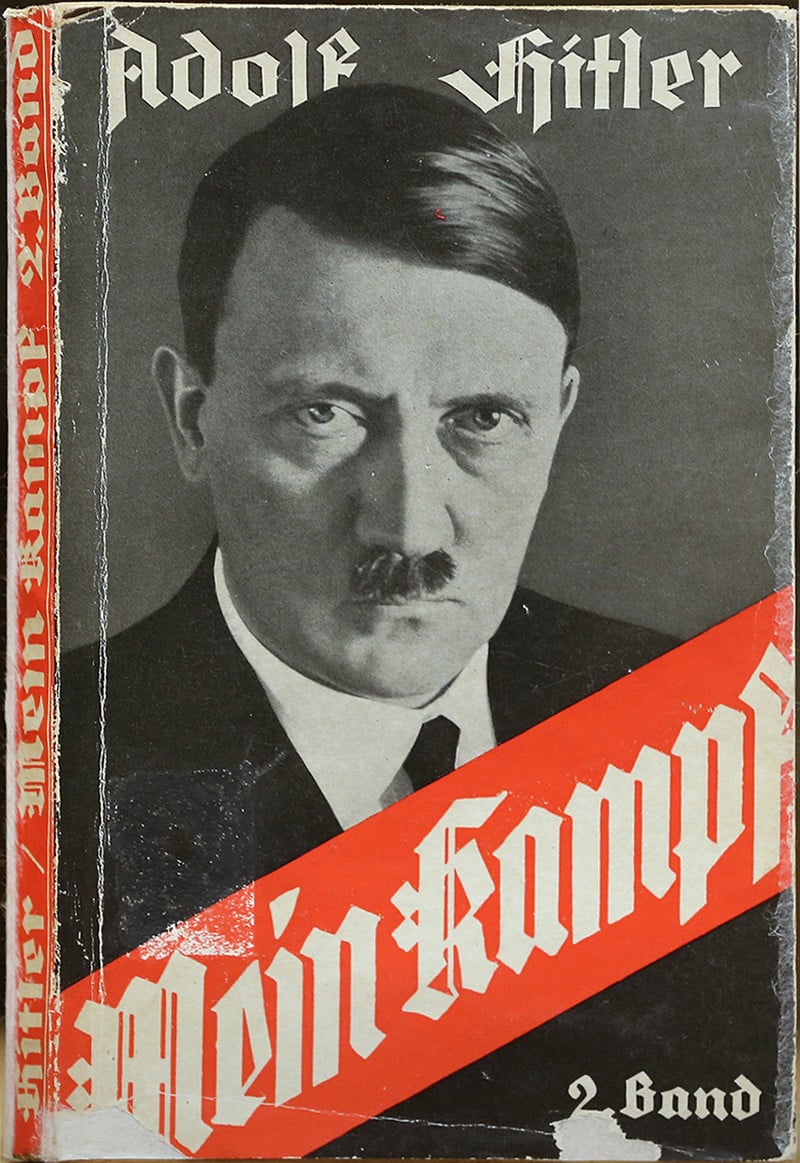
Mein Kampf
Mein Kampf is an autobiographical manifesto by Adolf Hitler, in which he outlines his political ideology and plans for the future of Germany. It combines elements of autobiography with an exposition of Hitler's National Socialist political ideology.
- Publication Year: 1925
- Type: Book
- Genre: Autobiography, Political manifesto
- Language: German
- View all works by Adolf Hitler on Amazon
Author: Adolf Hitler

More about Adolf Hitler
- Occup.: Criminal
- From: Germany
- Other works:
- Zweites Buch (1928 Book)