
Aphorisms: More Unkempt Thoughts
Overview
Stanislaw Lec’s More Unkempt Thoughts gathers terse, barbed aphorisms forged out of mid-century Europe’s wreckage and the gray routine of postwar authoritarianism. The form is fragmentary by design: compressed flashes of paradox, satire, and cold clarity that leave room for the reader to complete the thought. Written as a sequel to his earlier collection of aphorisms, it deepens the same preoccupations, power, language, responsibility, faith, and despair, while sharpening their edge. Lec’s vantage point is that of a survivor who distrusts slogans and miracles alike. He writes with a calm, surgical wit that refuses consolation, yet he preserves a stubborn space for conscience and for the faint, practical kinds of hope that withstand disappointment.
Power and Ideology
A central current is the anatomy of domination. Lec sketches the small mechanics of tyranny: ritualized obedience, inflated rhetoric, theatrical trials of loyalty, the co-opting of memory. He notices how a regime colonizes the tongue until words become uniforms, and how fear teaches the citizen to edit his own thoughts before the censor must. The aphorisms track the moral evasions that attend collective wrongdoing, the way each person disclaims agency while the avalanche rolls. Iconoclasm does not escape his suspicion either; he warns that a toppled idol leaves a pedestal that others will climb. For Lec, the danger lies not only in malevolent leaders but in habits of mind, opportunism, fatigue, and the comfort of belonging, that make domination possible without constant violence.
Language, Truth, and Knowledge
Lec watches language closely because he knows it is where reality is kneaded into shape. He notes how weak arguments are padded with grand words, how euphemism can turn cruelty into policy, and how chatter drowns out thought. Yet he is no relativist. His skepticism is moral, not fashionable: truth may be hard to reach, but lies have fingerprints. He measures progress with a grim tape; technology changes the utensil while the appetite remains savage. The aphorisms return to memory as a scruple against denial: shutting one’s eyes halts a spectacle, not a fact. History recurs with new make-up; novelty often means a change of costume. The reader is asked to live with uncertainty without surrendering the obligation to discern.
The Self, Ethics, and Art
Against the temptation to grand gestures, Lec prizes modest acts that cost something and are performed without applause. He distrusts purity and heroics that require a stage; virtue, he suggests, does its work off-camera. The self protects itself with illusions, and he probes those kindly lies with dry humor, self-importance, the appetite for certainty, the delight in other people’s guilt. Writers and thinkers are not absolved; he needles their vanity and reminds them that a sharp pen can be a fashionable accessory as much as a tool of truth. Humor, for Lec, is not an escape hatch but a method: laughter pries open what solemnity would leave sealed. The aphorism’s sudden turn, its hinge from setup to reversal, enacts the ethical snap of waking up.
Tone, Method, and Afterlife
The style is spare, crystalline, and often unsettlingly playful. Lec works by inversion, by the small misalignment that makes a platitude confess its opposite. The fragments connect laterally: a note on pedestals speaks to a remark on revolutions; a joke about punctuation shadows an observation on censorship. The resulting mosaic captures a world where absurdity is both comic and deadly serious. More Unkempt Thoughts endures because it diagnoses recurring civic and private vices, credulity, rhetorical intoxication, moral outsourcing, that survive changes in flags and media. Its counsel is a demanding one: conserve irony, husband memory, suspect grandeur, and keep a place ready for the quiet, unadvertised deed.
Citation Formats
APA Style (7th ed.)
More unkempt thoughts. (2026, February 4). FixQuotes. https://fixquotes.com/works/more-unkempt-thoughts/
Chicago Style
"More Unkempt Thoughts." FixQuotes. February 4, 2026. https://fixquotes.com/works/more-unkempt-thoughts/.
MLA Style (9th ed.)
"More Unkempt Thoughts." FixQuotes, 4 Feb. 2026, https://fixquotes.com/works/more-unkempt-thoughts/. Accessed 12 Feb. 2026.
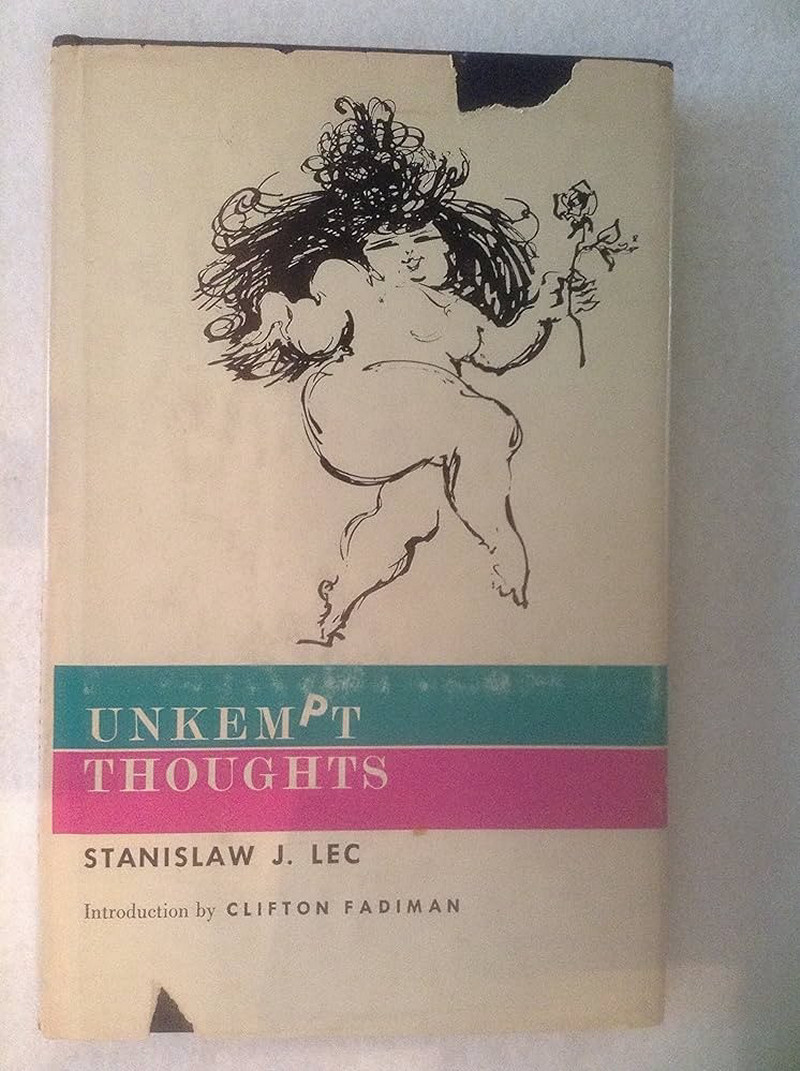
More Unkempt Thoughts
Original: Nowe Myśli nieuczesane
A continuation of Unkempt Thoughts, featuring more aphoristic observations on life and human nature.
- Published1964
- TypeAphorisms
- GenreAphorisms
- LanguagePolish
About the Author

Stanislaw Lec
Stanislaw Lec, a renowned Polish aphorist known for his satirical wit and philosophical insights.
View Profile- OccupationPoet
- FromPoland
-
Other Works
- Unkempt Thoughts (1957)