
Book: Only the Paranoid Survive
Overview
Andy Grove presents a compact, forceful argument about how companies survive and thrive when the rules of their industry change dramatically. He frames corporate life as a succession of moments when the environment shifts so fundamentally that past strategies become obsolete. The title "Only the Paranoid Survive" captures the imperative for leaders and organizations to keep questioning assumptions and to act decisively when signals of change appear.
Strategic Inflection Points
At the heart of Grove's thinking is the concept of the strategic inflection point: a critical event or trend that alters the competitive landscape, often by an order of magnitude, and forces a reassessment of strategy. These points can come from new technologies, changing customer behavior, regulatory moves, or aggressive competitors, and they often arrive disguised as small anomalies. Grove emphasizes that what separates survivors from victims is the ability to recognize when an anomaly is not noise but a symptom of a deeper shift.
Detecting Change
Grove advises leaders to watch for "tenfold" changes, disruptions that scale up impact quickly rather than incremental shifts. Early warning signs include persistent negative surprises, unexplained declines in performance, and stubborn resistance of old assumptions to explanation. He stresses systematic attention to data and to reports from the front lines, arguing that middle managers and engineers are often the first to notice the mismatch between reality and the mental map held by senior leaders.
Responding to Inflection Points
Once a strategic inflection point is identified, the response must be both rapid and candid. Grove warns against paralysis, denial, and half-measures; successful responses require decisive reallocation of resources, experimentation with new business models, and sometimes painful divestments. He recommends creating focused teams to explore new directions, running small-scale tests quickly to learn what works, and scaling up the successful approaches without worshiping past investments.
Leadership and Organizational Culture
Grove elevates leadership behaviors that foster vigilance and adaptability. He champions a culture of constructive confrontation where candid debate and critical feedback are routine, and where dissenting views are heard rather than suppressed. Paranoia, in Grove's sense, is disciplined skepticism: leaders must challenge internal orthodoxies, enable open communication, and mobilize the organization to accept uncomfortable tradeoffs when survival is at stake.
Practical Lessons and Legacy
Grove peppers his analysis with concrete examples drawn from the technology industry, most notably his own experience at Intel during the shift from commodity memory chips to microprocessors. These cases illustrate how companies can misread threats, cling to obsolete success formulas, or pivot successfully by embracing new realities. The work remains influential for its concise framework and its insistence that strategic agility is not optional: continuous awareness, clear judgement, and the willingness to act are the fundamentals that determine whether a company navigates an inflection point or is overtaken by it.
Citation Formats
APA Style (7th ed.)
Only the paranoid survive. (2025, September 13). FixQuotes. https://fixquotes.com/works/only-the-paranoid-survive/
Chicago Style
"Only the Paranoid Survive." FixQuotes. September 13, 2025. https://fixquotes.com/works/only-the-paranoid-survive/.
MLA Style (9th ed.)
"Only the Paranoid Survive." FixQuotes, 13 Sep. 2025, https://fixquotes.com/works/only-the-paranoid-survive/. Accessed 6 Mar. 2026.
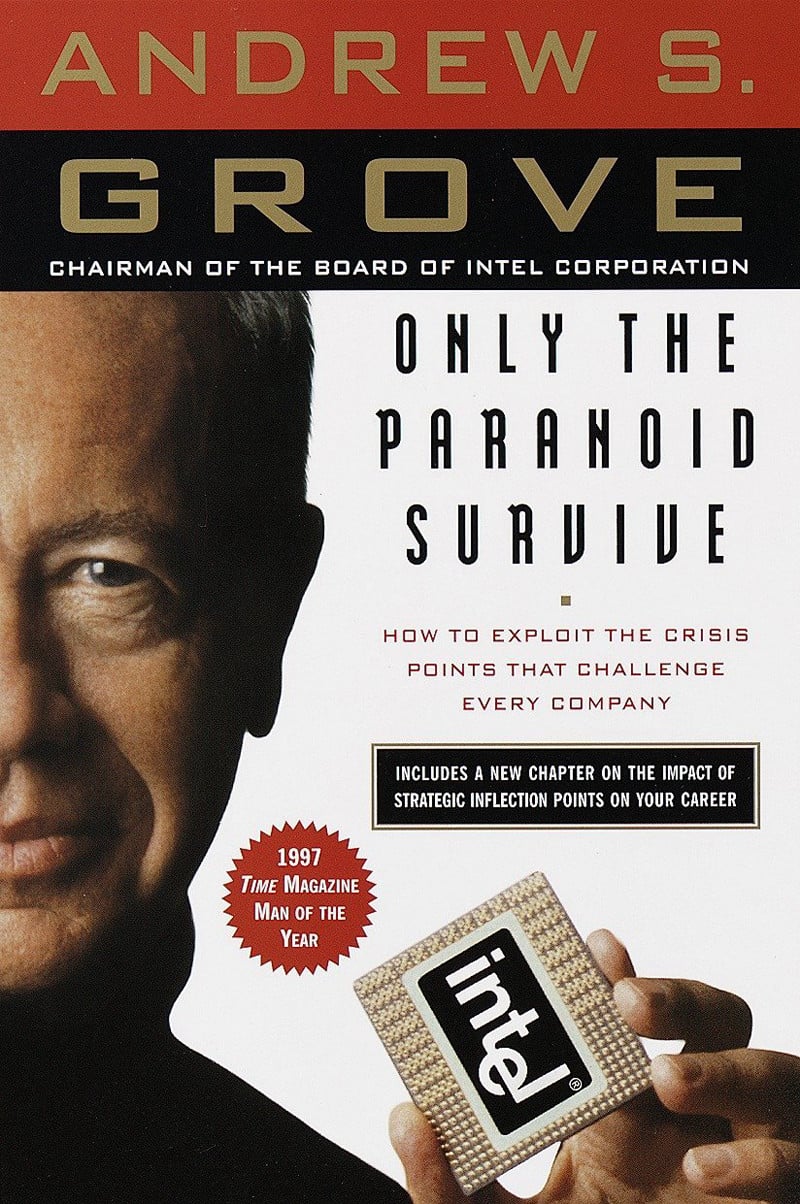
Only the Paranoid Survive
Only the Paranoid Survive focuses on strategic inflection points, which are critical moments that can make or break a company. The book discusses how businesses must adapt and evolve to survive, using examples from the technology industry.
- Published1996
- TypeBook
- GenreBusiness, Management
- LanguageEnglish
About the Author

Andy Grove
Andy Grove, co-founder of Intel, and his impact on the semiconductor industry and modern computing.
View Profile- OccupationBusinessman
- FromHungary
-
Other Works
- High Output Management (1983)
- Swimming Across: A Memoir (2001)