
Book: Outlandish Proverbs
Overview
Outlandish Proverbs (1640) is a compact treasury of wisdom gathered, polished, and posthumously published under the initials “G.H.” of the poet and Anglican priest George Herbert. Rather than an authored treatise, it is a curated sequence of brief, memorable sayings, moral, practical, and often wry, drawn from common speech and from older European traditions. The title’s “outlandish” signals both strangeness and foreignness: many entries adapt or translate proverbs current on the Continent, then naturalize them into crisp English. Later, the collection expanded and circulated under the name Jacula Prudentum, “darts of the wise”, capturing the book’s point: quick, pointed sentences designed to lodge in memory and guide conduct.
Form and Sources
Herbert presents the proverbs as a numbered run of stand-alone maxims, without commentary, argument, or narrative frame. The effect is a mosaic of social observation. He gathers sayings from Latin, French, Spanish, Italian, and older English stock, refitting them with a poet’s ear for balance and cadence. He does not claim authorship of the ideas so much as editorial stewardship; his hand shows in the compression, the antithesis, and the fine tuning of idiom that made many sayings portable in English for centuries.
Themes and Tone
Across more than a thousand brief entries, recurring concerns emerge: prudence in speech and action; the limits and uses of power; the tests of friendship; the costs of haste and the rewards of patient industry; household order and thrift; the pull of fortune and the governance of Providence. The moral posture is recognizably early modern and Anglican: practical piety rather than doctrinal dispute, an ethic of measure, duty, and self-command. Yet the voice is rarely heavy. Wit steadies the admonition and keeps it worldly-wise. A string of famous examples shows the range: “Living well is the best revenge” distills a stoic ethic; “Whose house is of glass must not throw stones at another” chastens hypocrisy; “Every mile is two in winter” turns observation into empathy; “Hell is full of good meanings and wishes” warns that intention without action is a trap.
Language and Style
Herbert’s touch is lapidary. Many sentences balance by antithesis (“More words, less wisdom”), hinge on homely image (“A small leak will sink a great ship”), or compress a social lesson into a single turn of phrase (“A dwarf on a giant’s shoulders sees the farther of the two”). The diction is plain and current, designed to be repeated, remembered, and re-used in household, parish, court, and market. The style’s discipline, no examples, no proofs, just the polished sentence, invites readers to supply contexts, which is part of the collection’s enduring flexibility.
Cultural Snapshot and Values
The proverbs chart the habits and anxieties of seventeenth-century England: respect for rank and office tempered by skepticism about lawyers, physicians, and talkative clergy; esteem for labor and frugality; trust in divine timing alongside worldly caution. Some maxims mirror the period’s gender and class assumptions, which can read as sharp or unjust to modern eyes. As a social document, the book registers how communal wisdom polices behavior and stabilizes expectations; as literature, it shows how compression and cadence can carry a culture’s tacit knowledge across time.
Legacy
Outlandish Proverbs has had a long afterlife, with many entries passing into English as if they were native and authorless. The later Jacula Prudentum title captures its enduring function: barbed, serviceable sayings that travel well. Whether read for moral counsel, stylistic pleasure, or historical insight, Herbert’s collection remains a portable school of sense, training the tongue to economy and the judgment to steadiness.
Sources
Citation Formats
APA Style (7th ed.)
Outlandish proverbs. (2026, February 4). FixQuotes. https://fixquotes.com/works/outlandish-proverbs/
Chicago Style
"Outlandish Proverbs." FixQuotes. February 4, 2026. https://fixquotes.com/works/outlandish-proverbs/.
MLA Style (9th ed.)
"Outlandish Proverbs." FixQuotes, 4 Feb. 2026, https://fixquotes.com/works/outlandish-proverbs/. Accessed 22 Mar. 2026.
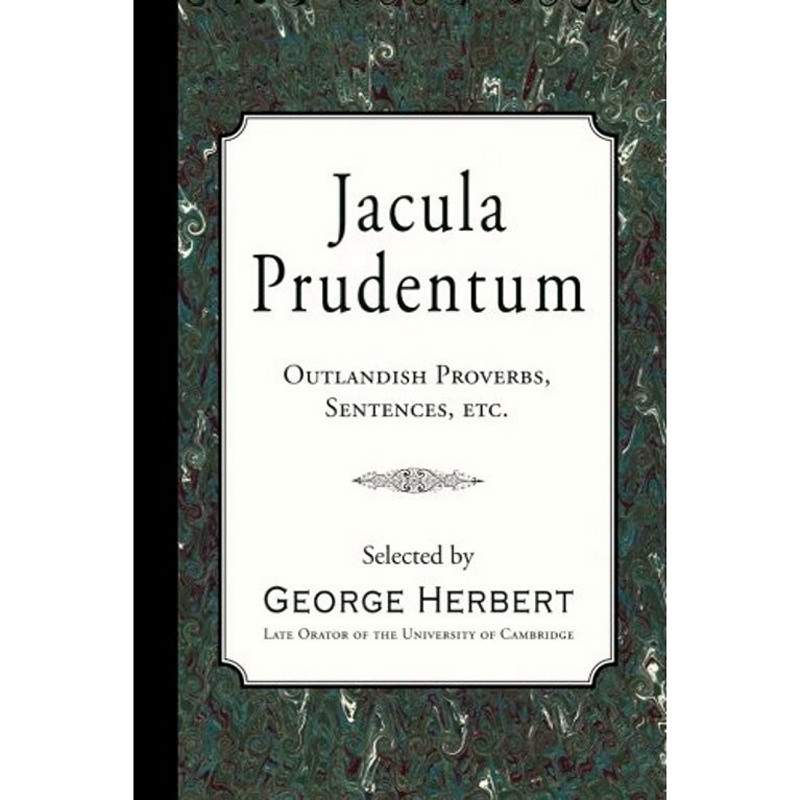
Outlandish Proverbs
Original: Jacula Prudentum: or Outlandish Proverbs, Sentences, etc.
Outlandish Proverbs is a collection of proverbial and proverb-like sayings derived from various sources, including both classical literature and popular wisdom. These sayings provide insight into the cultural values and beliefs of the time.
- Published1640
- TypeBook
- GenreNon-Fiction, Proverbs
- LanguageEnglish
About the Author

George Herbert
George Herbert, an influential English poet and Anglican cleric, known for his religious poetry and devotion.
View Profile- OccupationPoet
- FromUnited Kingdom
-
Other Works
- The Temple (1633)
- The Country Parson (1652)