
Collection: Poems
Overview
Poems (1922) is a posthumous collection that brought Isaac Rosenberg's verse to a wider public and secured his place among the major poets of the First World War. The volume assembles poems written before and during Rosenberg's service in France and Belgium, presenting a range that stretches from early urban and pastoral pieces to some of the most vividly remembered trench poems. The gathering emphasized the sharpness of his voice, his moral urgency, and the technical skill evident in compressed, striking lines.
Content and themes
The collection includes many of the poems now most associated with Rosenberg: "Break of Day in the Trenches", "Returning, We Hear the Larks", "Dead Man's Dump", "Louse Hunting" and the earlier "On Receiving News of the War", among others. A persistent concern throughout is the human cost of modern warfare, rendered with particular attention to the ordinary soldier's perspective and the indignities he suffers. Rosenberg's poems also return to animal life, urban detail, and mythic allusion, using such material to register empathy, irony, and a sense of moral dislocation.
Style and imagery
Rosenberg's diction is terse but richly textured; he moves swiftly between colloquial speech and older, almost biblical cadences. Images often arrive as startling juxtapositions, the lamb or louse in the trenches, the skylark above no-man's-land, so that delicacy and brutality collide in a single line. His use of rhythm and sharp consonance gives the poems an audible intensity, while economy of phrase forces the reader to inhabit brief, intense perceptions rather than long expository stretches.
Voice and perspective
The collection foregrounds a distinctive, sometimes contradictory voice: alert, witty, indignant, and tender. Rosenberg's working-class Jewish background inflects many poems through a sensitivity to marginality and an ear for street speech, but his work is not limited to social realism. He often blends personal observation with myth and classical reference, allowing individual scenes to point toward broader ethical questions about culture, history, and humanity under strain.
Formal concerns and craft
Formally, the poems resist a single school. Some pieces show a compressed lyricism and careful lineation, others a more irregular, conversational cadence. The poet's control of tone, shifts from irony to compassion, from mockery to mourning, creates an emotional architecture as convincing as any formal innovation. Metaphor and image are central tools: Rosenberg compresses whole situations into brief emblems, so that one memorable image carries the weight of context and consequence.
Reception and legacy
When the volume appeared, it played a decisive role in consolidating Rosenberg's reputation; readers and critics began to place him alongside other major war poets. Over time, scholars have emphasized his mixture of modern sensibility and classical awareness, his ability to fuse street detail with mythic reach, and his uncompromising attention to the soldier's bodily and psychic experience. The poems continue to attract attention for their moral clarity, linguistic vitality, and the peculiar mixtures of compassion and irony that make Rosenberg's voice unmistakable.
Enduring significance
The 1922 collection has endured because it captures both the specificities of the First World War and a broader human questioning about art, suffering, and belonging. The poems resist facile sentimentality while retaining moments of lyric grace, making them powerful tools for readers who wish to understand war not as abstraction but as a cluster of lived, sensorial moments. Rosenberg's ability to make those moments resonate across time remains the collection's central achievement.
Sources
Citation Formats
APA Style (7th ed.)
Poems. (2026, February 5). FixQuotes. https://fixquotes.com/works/poems14/
Chicago Style
"Poems." FixQuotes. February 5, 2026. https://fixquotes.com/works/poems14/.
MLA Style (9th ed.)
"Poems." FixQuotes, 5 Feb. 2026, https://fixquotes.com/works/poems14/. Accessed 12 Feb. 2026.
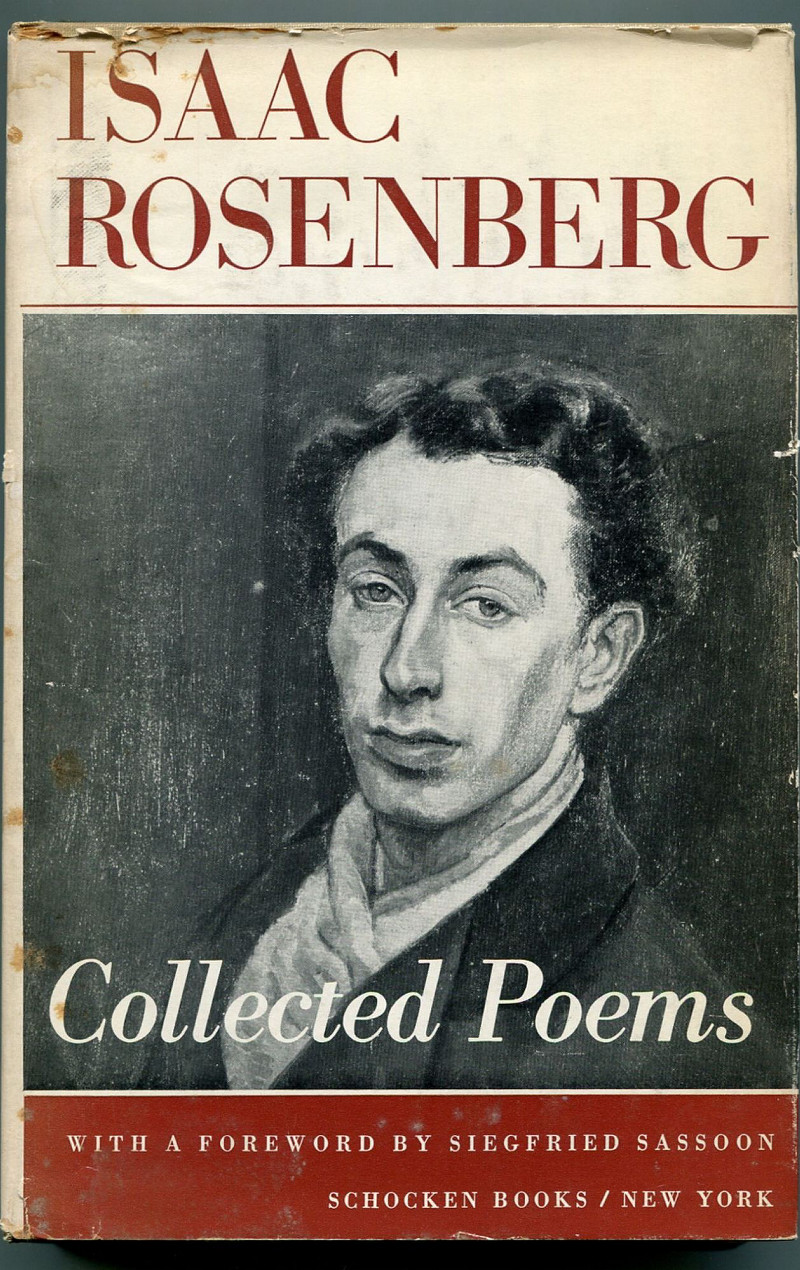
Poems
Posthumous volume gathering Rosenberg's poetry, including many of his best-known war poems and earlier works, helping establish his reputation among World War I poets.
- Published1922
- TypeCollection
- GenrePoetry, Collection
- Languageen
About the Author

Isaac Rosenberg
Isaac Rosenberg, the English World War I poet whose life from Bristol to London shaped his stark, influential poetry.
View Profile- OccupationPoet
- FromEngland
-
Other Works
- Night and Day (1912)
- On Receiving News of the War (1914)
- Youth (1915)
- Break of Day in the Trenches (1916)
- Returning, We Hear the Larks (1917)
- Dead Man's Dump (1917)
- A Worm (1917)
- Marching (1917)
- Louse Hunting (1917)
- The Immortals (1917)
- Daughters of War (1918)