
Play: Rockaby
Overview
Samuel Beckett’s Rockaby is a late, distilled chamber play that compresses a life into a handful of hypnotic movements. An elderly woman, identified simply as W, sits in a rocking chair and listens to a recorded voice that recounts her story in the third person. The drama unfolds almost entirely through the interplay of that voice and the chair’s motion, making action and narration inseparable. Over some fifteen minutes, repetition, silence, and stillness gradually erode the borders between self and story, until the play closes on an extinguishing calm that feels like a lullaby to death.
Staging and Structure
The stage is nearly bare and dim, a tight light isolating W in her rocker. The chair’s movement starts and stops with the recorded voice; when the voice stops, the rocking stops; after a pause, W speaks a single word to cue the cycle to resume. Across four brief sequences, this call-and-response pares theater to its essentials: body, breath, sound, and time. The recorded monologue is measured and incantatory, its phrasing echoing the chair’s sway, so that narrative and mechanism appear to regulate one another. W’s live presence is real, yet the voice both accompanies and replaces her, as if she has outsourced selfhood to a machine.
Action and Narrative
The voice tells of a woman who has reduced her life to ritual. She sits at a window, looking for another living soul, searching across windows and streets in the hope of finding someone like herself. The world answers with emptiness, or with presence that does not answer back. She narrows the field of her looking, moves from roaming gazes to the confinement of her own room, and finally to the still point of the chair. The quest for a counterpart dwindles into a strict routine of watching, rocking, and waiting.
The monologue’s third person turns the woman into her own subject, watched and spoken from a slight remove, while the taped quality suggests a story long since fixed. As the sequences accumulate, the narrative contracts: outward seeking becomes inward settling; vigilance becomes acceptance. The voice’s recurring refrains, about the time to continue or to stop, mark thresholds. Each time the chair halts, W’s small word restarts the telling and the rocking, as if desire and habit briefly outweigh the pull toward silence.
Themes and Tone
Rockaby fuses lullaby and elegy. The rocker conjures maternal care and infant soothing, but here the roles are folded into one, the woman rocking herself toward extinction. Beckett’s characteristic minimalism turns repetition into meaning: the restricted vocabulary, the cyclical rhythm, and the punctuating pauses enact the exhaustion of possibility. The third-person self-narration makes identity porous; the recorded voice may be a memory of the woman’s own voice, an echo of a mother’s, or the mind’s final scaffolding. Vision and attention are central: the looking that once reached outward becomes a vigil for the end, a watching for the moment when there is no more to watch.
Ending and Effect
In the final cycle, the desire to hear and move again ebbs. The recorded account runs to completion, the rocking slows and ceases, and W does not call for another turn. Darkness and stillness seal the action. The effect is both tender and stark: a life summarized as a pattern of repetition that gently lets itself stop. Rockaby achieves pathos without sentimentality, a farewell sung softly by a machine that has finished its work.
Citation Formats
APA Style (7th ed.)
Rockaby. (2025, November 8). FixQuotes. https://fixquotes.com/works/rockaby/
Chicago Style
"Rockaby." FixQuotes. November 8, 2025. https://fixquotes.com/works/rockaby/.
MLA Style (9th ed.)
"Rockaby." FixQuotes, 8 Nov. 2025, https://fixquotes.com/works/rockaby/. Accessed 26 Mar. 2026.
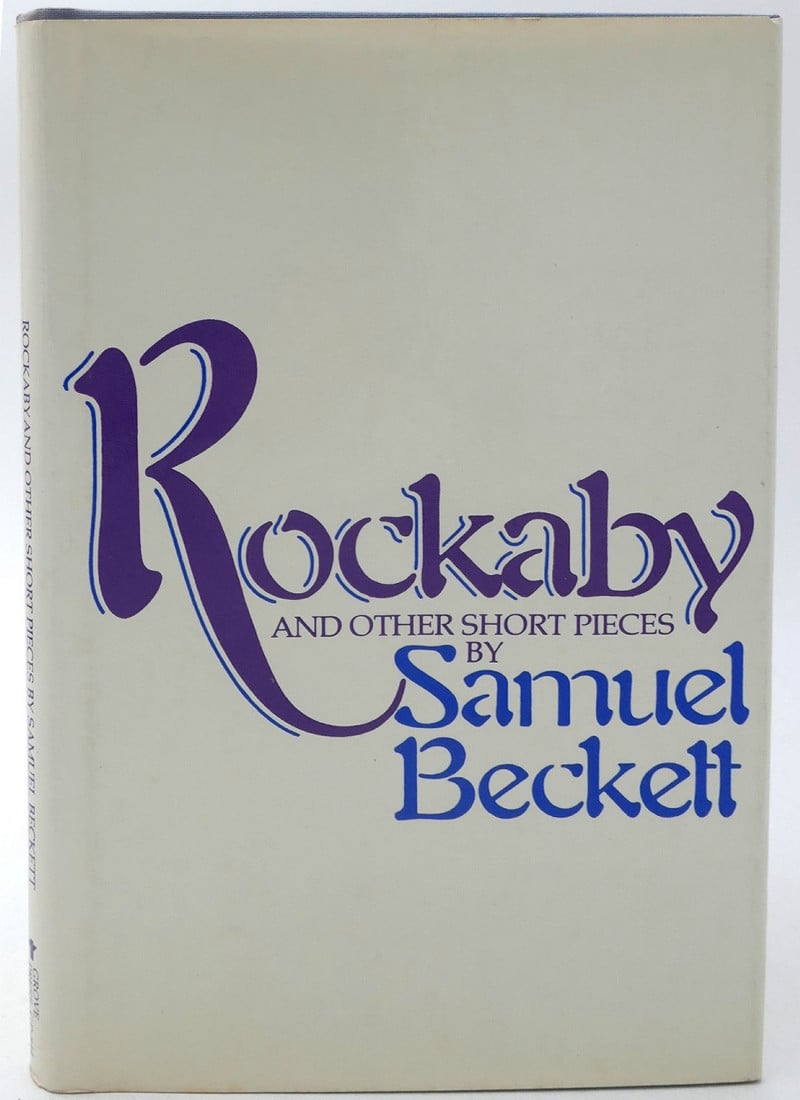
Rockaby
A short, haunting piece featuring a woman who listens to a recorded voice reading fragments and slowly rocks herself in a chair. Themes include loneliness, repetition and the approach of death.
About the Author

Samuel Beckett
Samuel Beckett covering life, major works, wartime years, bilingual writing, theater collaborations, Nobel Prize and quotes.
View Profile- OccupationPlaywright
- FromIreland
-
Other Works
- Murphy (1938)
- Eleutheria (1947)
- Malone Dies (1951)
- Molloy (1951)
- Watt (1953)
- Waiting for Godot (1953)
- The Unnamable (1953)
- Endgame (1957)
- Krapp's Last Tape (1958)
- Happy Days (1961)
- Cascando (1963)
- Play (1963)
- Come and Go (1965)
- Not I (1972)
- That Time (1976)
- Company (1980)
- Ill Seen Ill Said (1981)
- Catastrophe (1982)
- Worstward Ho (1983)