
Poetry: Rumuz-i-Bekhudi
Overview
"Rumuz-i-Bekhudi" (Secrets of Selflessness), published in 1917, is Muhammad Iqbal’s Persian masnavi that pairs with "Asrar-i-Khudi". Where the earlier poem awakens the creative self, this companion text turns that self toward the life of the community, arguing that the individual attains fullness by losing the isolated ego in a higher collective purpose. Addressed to a Muslim audience bruised by colonial subjugation and inner stagnation, it maps the ethical, spiritual, and institutional conditions for renewing the Ummah and restoring its moral sovereignty.
Structure and Voice
Written in didactic, flowing couplets, the poem moves through short discourses, parables, and apostrophes to the community, the youth, and the Prophet. Iqbal speaks as mentor and witness, stitching Quranic allusion and Persian imagery into a sequence that runs from the solitude of the seeker to the discipline of law, from personal ardor to collective order. The voice alternates between intimate counsel and public exhortation, concluding in praise of the Prophet and a summons to pledge, unity, and action.
Selflessness as Completion of the Self
Bekhudi is not annihilation of personhood but its enlargement. The self, tempered in struggle, yields its private caprice to a higher ordinance and discovers a broader, more enduring life in the body of the Ummah. The surrender is not to men or custom but to the divine pattern revealed through prophecy. In that pattern the rights and duties of persons find measure, and energies that scatter in isolation are harnessed toward a common telos.
Law, Discipline, and Freedom
Against the caricature of law as shackles, Iqbal portrays sharia as the scaffolding of freedom: prayer as rhythm, fasting as vigilance, almsgiving as social conscience, pilgrimage as axis of unity. Discipline concentrates power; it turns the heat of love into luminous work. Scholastic rigidity and antinomian mysticism are both rejected; thought must be wedded to action, and ecstasy must ripen into character and institutions.
Love, Prophecy, and the Center
Love (ishq) is the cement of the community, but its form is given by the Prophet, whom Iqbal presents as the perfected human and living center of history. Attachment to him is not sentiment but a creative imitation that breeds courage, mercy, and justice. The Kaaba becomes the spatial emblem of this centripetal love: a house around which hearts learn orbit, measure, and fraternity.
Community, Nation, and Justice
The poem distinguishes race and territory from the millah. True polity springs from shared creed and ethical vocation, not blood or soil. Equality and dignity flow from servanthood to God, binding ruler and ruled to the same law. Tyranny is denounced, along with exploitative wealth and parasitic leisure; dignity of labor and care for the vulnerable are cast as signs of collective health. Jihad is framed as disciplined striving, moral, intellectual, and civic, rather than mere clash of arms.
Education, Youth, and Leadership
Iqbal calls for an education that breeds eagles: vision, self-reliance, and hardihood. Leaders should be creative, just, and awake to the needs of their age; mere custodianship of formulas will not suffice. Renewal requires ijtihad, the reopening of moral reasoning under the sovereignty of revelation, so that forms serve life rather than ossify it.
Imagery and Style
Desert caravans, gardens, seeds becoming trees, rivers joining oceans, moths circling a candle, and the falcon’s aloof flight mark the poem’s symbolic lexicon. The heart is a mirror to be polished, the community a living organism animated by a single spirit. The cadence is exhortatory yet lyrical, fusing Persian romantic texture with Quranic gravity.
Aim and Resonance
"Rumuz-i-Bekhudi" urges a transition from solitary ardor to shared destiny. By locating freedom within law, love within form, and individuality within a moral commonwealth, it sketches a path for communal rebirth. Its closing salutations to the Prophet and appeals for unity crystallize a program of spiritual democracy, ethical discipline, and creative action, addressed to an age of confusion yet confident in the regenerative power of faith lived together.
Citation Formats
APA Style (7th ed.)
Rumuz-i-bekhudi. (2026, February 4). FixQuotes. https://fixquotes.com/works/rumuz-i-bekhudi/
Chicago Style
"Rumuz-i-Bekhudi." FixQuotes. February 4, 2026. https://fixquotes.com/works/rumuz-i-bekhudi/.
MLA Style (9th ed.)
"Rumuz-i-Bekhudi." FixQuotes, 4 Feb. 2026, https://fixquotes.com/works/rumuz-i-bekhudi/. Accessed 6 Mar. 2026.
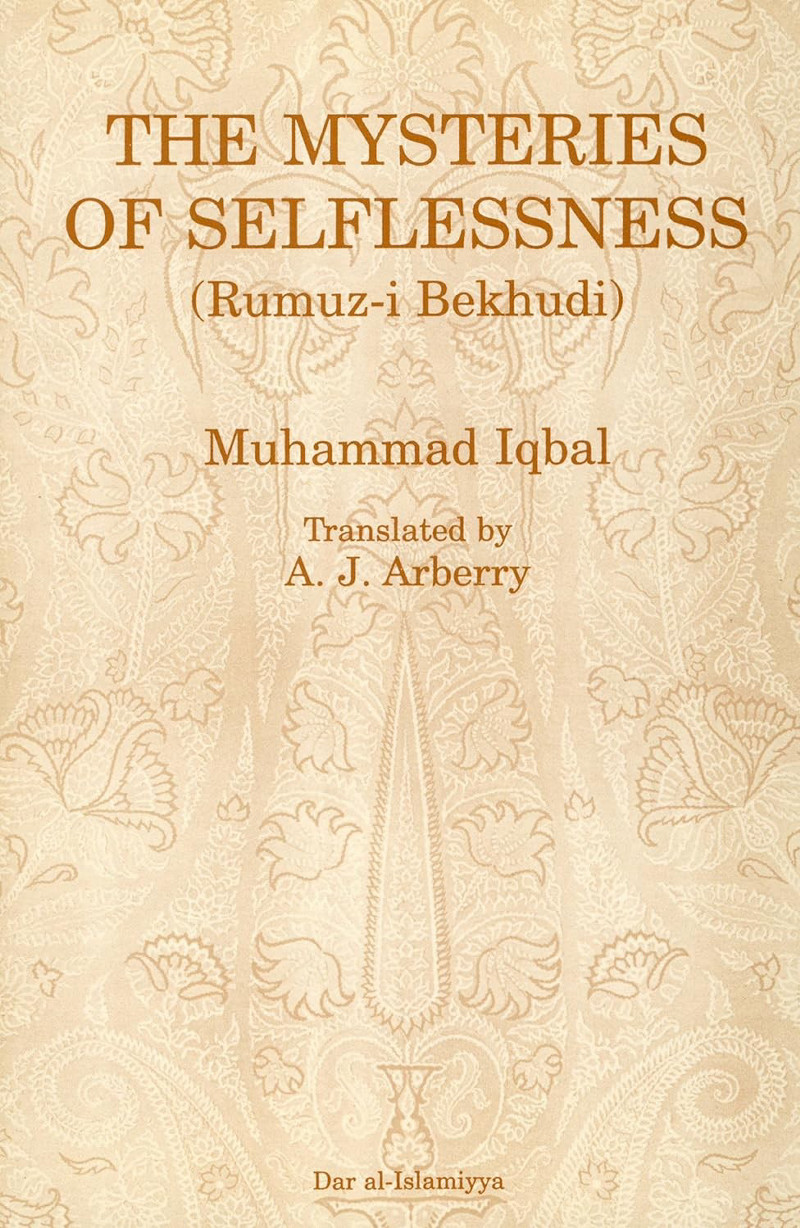
Rumuz-i-Bekhudi
Original: رموز بیخودی
Rumuz-i-Bekhudi is a philosophical poetry book, which contains Iqbal's teachings on the concept of the self, his emphasis on the importance of strengthening the self, and how it would lead to a strong and powerful society.
- Published1917
- TypePoetry
- GenrePhilosophy, Poetry
- LanguagePersian
About the Author

Muhammad Iqbal
Muhammad Iqbal: poet, philosopher, and visionary who inspired Pakistan's conception. His works continue to influence millions globally.
View Profile- OccupationPoet
- FromPakistan
-
Other Works
- Asrar-e-Khudi (1915)
- The Secrets of the Self (1920)
- Bang-i-Dra (1924)
- Javid Nama (1932)
- Zarb-i-Kalim (1936)