
Simply Speaking: How to Communicate Your Ideas With Style, Substance, and Clarity
Overview
Peggy Noonan's Simply Speaking offers a lively, practical guide to making ideas come alive in speech and on the page. Drawing on her years as a presidential speechwriter and her love of classic rhetoric, Noonan blends memoir, close readings of famous addresses, and hands-on instruction to show how clarity, rhythm, and humanity turn words into influence. The book moves between analysis of historic speeches and down-to-earth advice for anyone who needs to persuade, inform, or inspire.
The tone is conversational and candid, often illustrated with Noonan's own drafts and the revisions that shaped them. Rather than presenting a rigid formula, the book returns again and again to a few organizing principles, simplicity, concreteness, and voice, that are applicable whether preparing a short note, a long op-ed, or a major public address.
Core Principles
At the heart of Noonan's argument is the idea that substance and style are inseparable: clarity is a moral and practical requirement for good communication. She emphasizes concrete images over abstractions, short sentences over jargon, and a single guiding idea that anchors the whole piece. These choices make material easier to understand and more likely to be remembered.
Noonan also champions economy and selection: excellent writing is the product of ruthless editing. She advises writers and speakers to cut what is unnecessary, to seek vivid detail, and to aim for the natural rhythms of speech. Sound and cadence, she argues, are as important as logic in persuading an audience.
Techniques and Examples
Noonan uses close readings of speeches by figures such as Ronald Reagan, Winston Churchill, and Abraham Lincoln to demonstrate how imagery, repetition, and timing work in practice. She breaks down famous openings and memorable lines to reveal the craft behind them, showing how a single evocative image or a well-placed pause can transform a message.
Practical techniques include crafting a strong opening that frames the issue, using anecdote to humanize abstract points, and shaping the middle of a talk so it builds toward a compelling conclusion. Noonan illustrates how small, concrete details often carry the emotional weight that abstract arguments cannot.
Voice and Authenticity
A recurring theme is the importance of being oneself on the page and at the podium. Noonan insists that genuine voice, language that feels lived-in and honest, connects more deeply than polished but generic prose. She warns against adopting overly formal or technical styles that distance the audience and encourages writers to practice speaking aloud to find natural rhythms.
This authenticity extends to moral clarity: effective communicators must know what they believe and be willing to express those convictions plainly. The book frames rhetorical skill as a servant of truth and sympathy rather than mere persuasion techniques.
Practical Application
Simply Speaking is structured as a manual for action: it offers revision strategies, rehearsal tips, and guidance on tailoring a message to a particular audience or medium. Noonan's insights on timing, pausing, and using silence as a rhetorical device are as attentive to delivery as they are to drafting.
The result is a readable, usable handbook for anyone who wants to sharpen how they convey ideas. Whether preparing a campaign speech, a business presentation, or a personal letter, readers are left with concrete habits, think visually, cut mercilessly, read aloud, be human, that make communication clearer, more persuasive, and more resonant.
Citation Formats
APA Style (7th ed.)
Simply speaking: How to communicate your ideas with style, substance, and clarity. (2025, September 12). FixQuotes. https://fixquotes.com/works/simply-speaking-how-to-communicate-your-ideas/
Chicago Style
"Simply Speaking: How to Communicate Your Ideas With Style, Substance, and Clarity." FixQuotes. September 12, 2025. https://fixquotes.com/works/simply-speaking-how-to-communicate-your-ideas/.
MLA Style (9th ed.)
"Simply Speaking: How to Communicate Your Ideas With Style, Substance, and Clarity." FixQuotes, 12 Sep. 2025, https://fixquotes.com/works/simply-speaking-how-to-communicate-your-ideas/. Accessed 2 Apr. 2026.
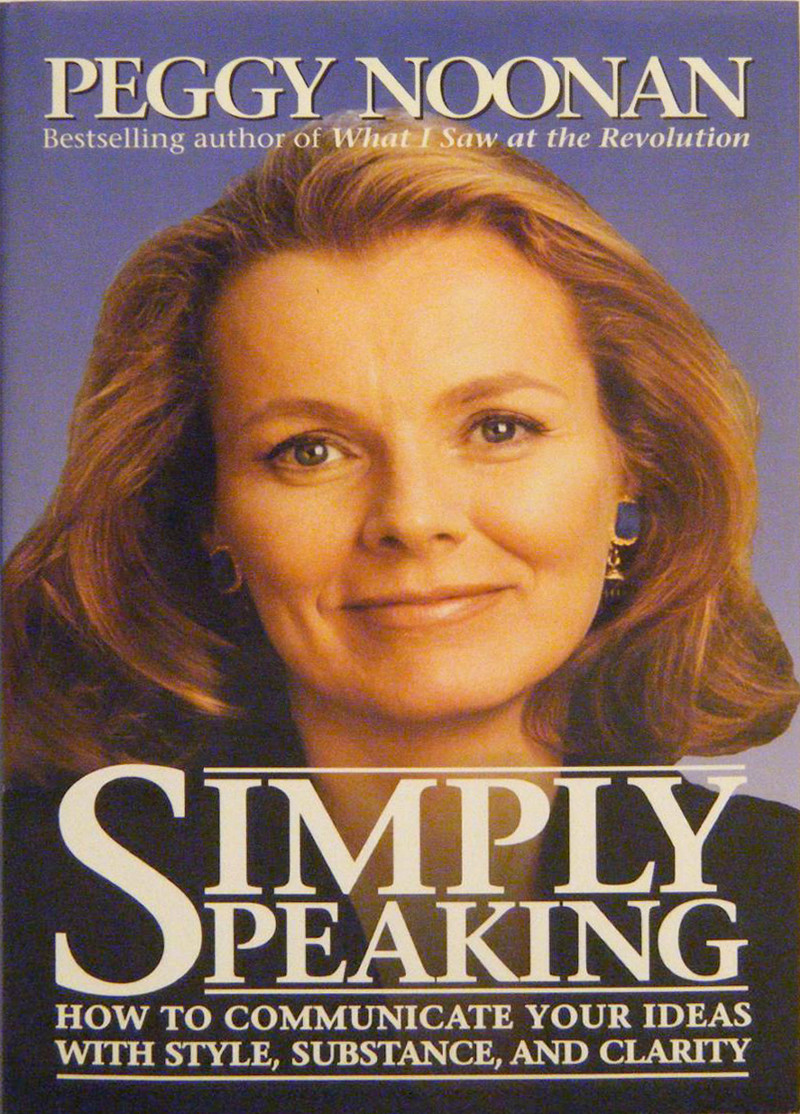
Simply Speaking: How to Communicate Your Ideas With Style, Substance, and Clarity
This book offers practical advice on how to communicate ideas effectively through writing and public speaking, using examples from the author's own experiences and the speeches of historical figures.
- Published1998
- TypeBook
- GenreNon-Fiction, Self-help
- LanguageEnglish
About the Author

Peggy Noonan
Peggy Noonan, renowned speechwriter and author, through her biography and influential quotes.
View Profile- OccupationWriter
- FromUSA
-
Other Works
- What I Saw at the Revolution: A Political Life in the Reagan Era (1990)
- Life, Liberty and the Pursuit of Happiness (1994)
- The Case Against Hillary Clinton (2000)
- When Character Was King: A Story of Ronald Reagan (2001)
- John Paul The Great: Remembering a Spiritual Father (2005)
- Patriotic Grace: What It Is and Why We Need It Now (2008)
- The Time of Our Lives (2015)