
Play: Strife
Overview
"Strife" (first performed in 1909) is a tightly focused industrial drama set in a single English company town during a bitter labor dispute. John Galsworthy centers the play on a strike at the Trenartha Tin Plate Works, but the real subject is less the economics of wages than the moral and psychological machinery that keeps a conflict grinding forward even when compromise would spare suffering. The action unfolds over a short span of time and mostly indoors, giving the story a pressurized, almost courtroom-like intensity as arguments, loyalties, and resentments collide.
Setting and central conflict
The strike has dragged on long enough to wound both sides. Workers' families are running out of food and hope, while the company's owners and directors worry about costs, reputation, and control. Each camp arrives with a narrative of righteousness: the men believe they are defending dignity and a fair share of profit, and the directors insist they are protecting the firm's survival and the principle of authority. Yet Galsworthy refuses to romanticize either group. Instead, he shows how collective causes can become shields for stubborn pride, and how institutions, unions and boards alike, can harden into engines that punish the very people they claim to represent.
Key figures: Anthony and Roberts
At the center stand two uncompromising leaders who embody the title. John Anthony, the company's aging chairman, treats any concession as surrender. To him, yielding to the men would invite future demands and undermine discipline, so he clings to a hard line even as fellow directors begin to view his stance as reckless. On the workers' side, David Roberts, a principled union figure, also resists compromise. He distrusts half-measures and fears that accepting less than the men asked for will signal weakness and betray solidarity. Both men are portrayed as sincere, even admirable in their integrity, but also as dangerously inflexible. Their mirror-image pride turns negotiation into a contest of wills, and the strike becomes a proving ground for personal absolutism rather than a solvable dispute.
Pressure, persuasion, and the cost to ordinary people
Around these leaders, the play gathers more pragmatic voices who can see the human toll accumulating. Anthony's colleagues and family pressure him to soften, not out of pure sympathy for the workers but because they recognize the company's position is not as secure as Anthony insists. Among the strikers, hunger and anxiety erode unity, and the reality of unpaid rent and sick children makes ideology feel remote. Galsworthy repeatedly shifts attention from speeches about principle to the quieter suffering that principle can excuse. As the days wear on, tension grows between the official line of the union leadership and the desperate needs of families who must survive the present before they can win the future.
The domestic sphere becomes a moral counterweight to the public standoff. Women and children, often sidelined in political debates, appear as the ones who pay first and most severely for prolonged conflict. Their presence is not sentimental decoration; it is evidence that "strife" is never contained within meeting rooms. It leaks into kitchens, infirmaries, and friendships, turning abstract policy into bodily harm and fear.
Turning points and the movement toward resolution
As conditions worsen, moderate directors and moderate workers begin to explore settlement, realizing that neither side can truly "win" without losing something essential. The possibility of compromise emerges not as a noble epiphany but as a pressured recognition of reality: production cannot remain halted forever, and families cannot remain hungry forever. Yet the same mechanism that makes compromise necessary also makes it humiliating. Anthony and Roberts, invested in the purity of their positions, find it harder to step back the closer disaster draws. Their authority depends on unwavering certainty, and wavering would expose them to criticism from their own allies.
The eventual shift toward settlement comes less from a triumphant argument than from exhaustion, fear, and the moral shock of escalating consequences. Galsworthy suggests that institutions often change course only when forced by visible damage, and that leaders who equate concession with defeat may become liabilities to their own side. The conflict's end, when it arrives, does not feel like a clean victory. It feels like a grudging return to the possible after an avoidable descent into harm.
Meaning and dramatic impact
"Strife" is often read as a critique of extremism and the dangerous romance of "standing firm". Galsworthy does not deny that injustices exist or that power imbalances shape negotiations; instead, he shows how moral certainty can turn into a trap, making compassion seem like weakness and practicality seem like betrayal. The play's power lies in its balance: it exposes the callousness of corporate authority and the rigidity of doctrinaire militancy, while keeping the audience's attention on the people crushed between slogans. By the end, the title resonates as a diagnosis of a social illness, conflict sustained by pride, identity, and fear, rather than a simple description of a strike.
Citation Formats
APA Style (7th ed.)
Strife. (2026, February 16). FixQuotes. https://fixquotes.com/works/strife/
Chicago Style
"Strife." FixQuotes. February 16, 2026. https://fixquotes.com/works/strife/.
MLA Style (9th ed.)
"Strife." FixQuotes, 16 Feb. 2026, https://fixquotes.com/works/strife/. Accessed 7 Mar. 2026.
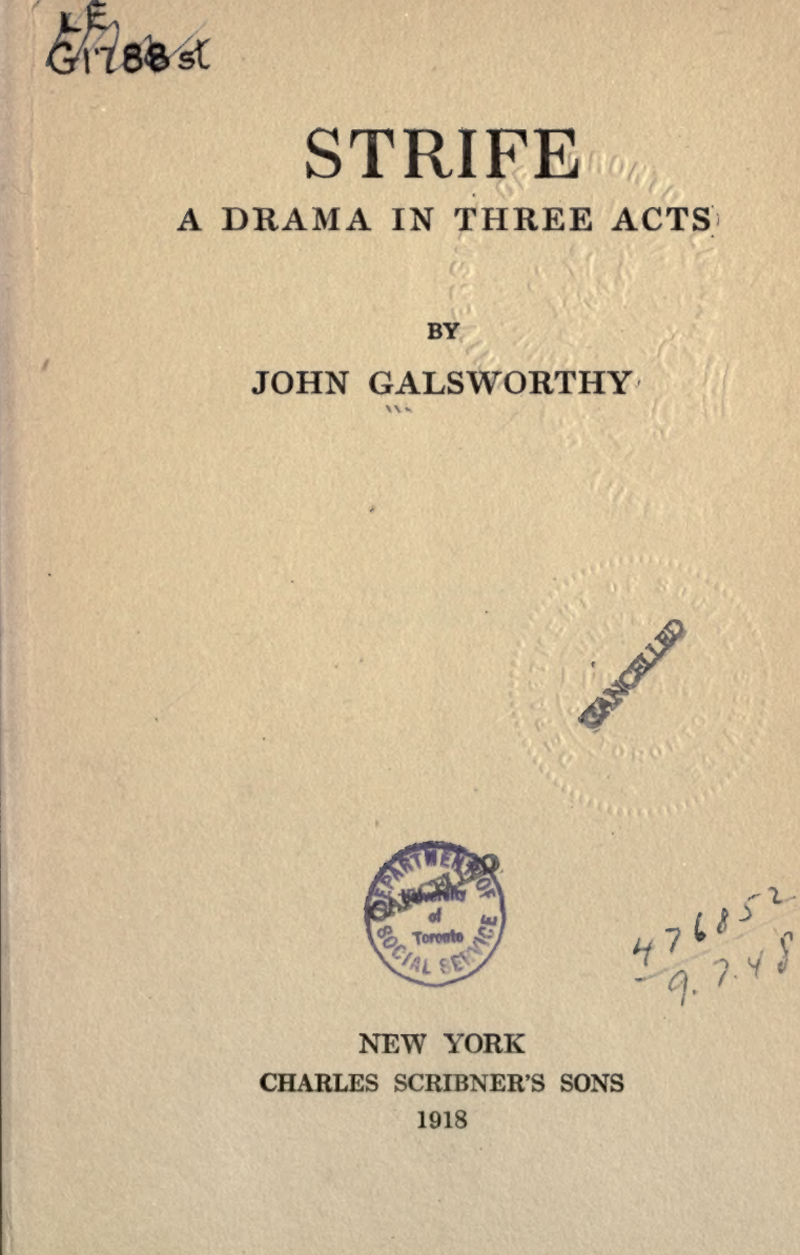
Strife
A powerful play about industrial conflict and class struggle, centering on a prolonged strike and the human costs of confrontation between workers and employers.
- Published1909
- TypePlay
- GenrePlay, Social commentary, Drama
- Languageen
- Links
About the Author

John Galsworthy
John Galsworthy, Nobel Prize winning novelist and playwright, featuring notable quotes, the Forsyte Saga, social critique, and key plays.
View Profile- OccupationAuthor
- FromEngland
-
Other Works
- The Island Pharisees (1904)
- The Silver Box (1906)
- The Man of Property (1906)
- Justice (1910)
- Indian Summer of a Forsyte (1918)
- In Chancery (1920)
- The Skin Game (1920)
- To Let (1921)
- The Forsyte Saga (1922)
- Loyalties (1922)
- The White Monkey (1924)
- The Silver Spoon (1926)
- Swan Song (1928)