
Book: Talking Straight
Overview
Lee Iacocca’s 1988 book Talking Straight is a blunt, highly readable manifesto about leadership, competitiveness, and national renewal from the CEO who helped rescue Chrysler. Less a second autobiography and more a call to action, it blends boardroom lessons, factory-floor anecdotes, and policy opinions into a single argument: America succeeds when it puts quality, common sense, and long-term thinking ahead of fads, financial engineering, and excuse making.
Context and tone
Coming on the heels of Iacocca’s bestselling Iacocca: An Autobiography, the book speaks from the vantage point of a hands-on executive fresh off a high-stakes turnaround. The tone is plainspoken and impatient with jargon. He praises ingenuity, scolds complacency, and insists that problems, whether in a company or a country, yield to clarity, accountability, and speed. The Chrysler saga frames his points: government loan guarantees were a lifeline, but discipline, product focus, and partnership with workers paid the loans back early and restored credibility.
Competitiveness and trade
Iacocca draws a hard line on global competition. He admires the precision, discipline, and customer focus of Japanese manufacturers but argues that their home market is effectively closed, creating an uneven playing field. His refrain is reciprocity: if the U.S. opens its market, trading partners should genuinely open theirs. He rejects blanket protectionism yet defends the right to push for fair trade when predatory pricing or structural barriers distort competition. Beneath the rhetoric is a strategic concern: a nation that outsources its manufacturing base risks hollowing out its skills, middle class, and innovative capacity.
Quality, product, and the customer
Quality is presented as the nonnegotiable cornerstone of competitive success. Iacocca elevates engineers and product people over spreadsheet jockeys, pressing leaders to get close to the shop floor and to the customer. The K-cars and the minivan illustrate his larger point: winning products come from listening, simplifying, and iterating, not from slogans. He stresses that quality is systemic, design, suppliers, production, and service must align, and that management’s job is to keep priorities ruthlessly clear and visible.
Management and culture
The book argues for lean structures and visible leadership. Iacocca values urgency, direct communication, and measurement. He pushes managers to cut layers, own results, and reward the people who build and sell things. He prefers profit sharing and performance-based pay to guaranteed perks, and he expects unions to be pragmatic partners, not adversaries. Throughout, he warns against short-termism: quarterly games, financial gimmicks, and headline-chasing erode the foundations of durable companies.
Public policy and national priorities
Talking Straight expands from corporate advice to civic prescription. Iacocca calls for investment in education, job training, and infrastructure as the bedrock of productivity. He decries budget and trade deficits as drags on confidence and competitiveness. He wants an energy policy that reduces vulnerability to oil shocks and a regulatory climate that balances safety and innovation without strangling enterprise. His Statue of Liberty, Ellis Island restoration work is offered as proof that public-private partnerships can mobilize resources and pride when government alone cannot.
Ethics and leadership
The throughline is character. Iacocca insists that leaders tell the truth, face facts early, and take responsibility when they miss. He is skeptical of management fads and insists on basics: hire people of substance, set a few priorities, hammer on execution, and keep score. Credibility, earned by doing what you say you will do, is portrayed as a competitive asset in its own right.
Legacy
As a snapshot of late-1980s corporate America, the book captures the anxiety of deindustrialization and the promise of renewal. Its prescriptions are unapologetically practical: build great products, invest in people, demand fair play abroad, and hold leaders to results. Talking Straight stands as a punchy blend of memoir, manual, and civic sermon from a CEO arguing that candor and competence are not just virtues but strategies for national and corporate revival.
Citation Formats
APA Style (7th ed.)
Talking straight. (2025, August 26). FixQuotes. https://fixquotes.com/works/talking-straight/
Chicago Style
"Talking Straight." FixQuotes. August 26, 2025. https://fixquotes.com/works/talking-straight/.
MLA Style (9th ed.)
"Talking Straight." FixQuotes, 26 Aug. 2025, https://fixquotes.com/works/talking-straight/. Accessed 25 Mar. 2026.
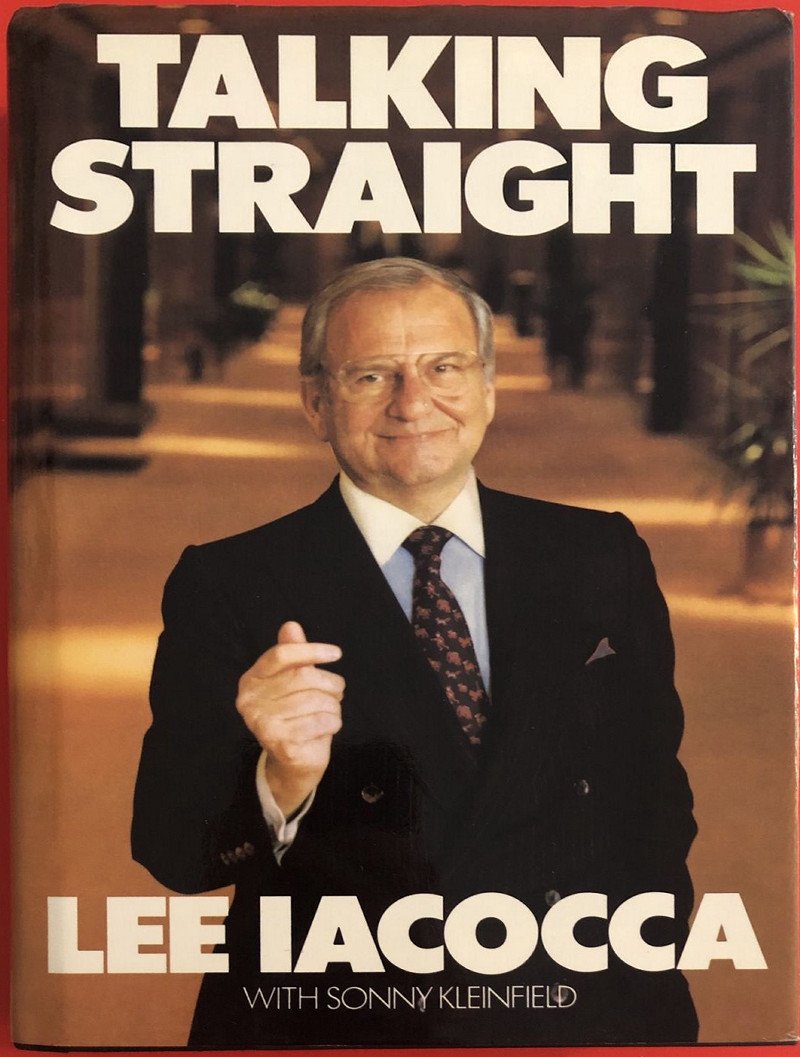
Talking Straight
In this book, Lee Iacocca shares his thoughts on business, the nation, and the future. Having turned around Chrysler's fortunes, Iacocca reflects on his career and opinions on leadership, productivity, competitiveness, and quality, as well as his thoughts about politics and the American Dream.
- Published1988
- TypeBook
- GenreBusiness, Memoir, Autobiography
- LanguageEnglish
About the Author

Lee Iacocca
Lee Iacocca, the visionary who revolutionized Chrysler, co-created the Ford Mustang, and critiqued leadership in his books.
View Profile- OccupationBusinessman
- FromUSA
-
Other Works
- Iacocca: An Autobiography (1984)
- Where Have All the Leaders Gone? (2007)