
Book: The Birth of Tragedy
Thesis
Nietzsche proposes that Greek tragedy arises from the creative tension and fleeting reconciliation of two artistic drives: the Apollonian impulse toward form, clarity, and individuation, and the Dionysian impulse toward ecstasy, music, and the dissolution of boundaries. Tragedy at its height makes suffering not merely bearable but aesthetically meaningful, offering a vision in which life is affirmed despite its terrors.
Apollonian and Dionysian
The Apollonian names the realm of dream, image, measure, and the principium individuationis, the shaping power that gives boundaries to chaos and crafts beautiful illusions. The Dionysian names the realm of intoxication, rapture, and primordial unity, where the individual self is overwhelmed by the currents of life. Greek culture flourished by balancing these rival truths: Apollo consoles by image and restraint; Dionysus exposes the abyss and the ecstatic unity beneath appearances. Art worthy of the name emerges where these drives confront one another and are brought into fruitful tension.
Birth and Structure of Greek Tragedy
Tragedy is born from the spirit of music, specifically the Dionysian chorus, which Nietzsche regards as the primordial core of the art-form rather than mere background. In the choral song, the community experiences a collective transfiguration: through rhythm and ritual, it becomes the satyr-chorus, a mask through which the audience glimpses the depth of nature and the universality of suffering. Onto this musical ground, the Apollonian overlays myth and visible form, the dialogic action, characters, and scenic imagery, giving articulate shape to the musically intuited truth. In Aeschylus and Sophocles, this synthesis reaches a summit: the tragic hero, radiant in Apollonian clarity, is hurled against the Dionysian ground of fate, guilt, and necessity, and his fall becomes a luminous affirmation of the whole.
Decline: Euripides and Socrates
Nietzsche traces the death of tragedy to Euripides, guided by the spirit he calls Socratic. Instead of letting music and myth speak the depths, Euripides brings the spectator onto the stage as judge and reasoner, demanding that everything be explainable and morally defensible. The choruses lose their metaphysical weight, the gods become psychological or didactic devices, and argument displaces the Dionysian surge. Behind Euripides stands Socrates, emblem of the theoretical man and the optimism of knowledge: if virtue is knowledge and error is curable by reason, then suffering becomes a problem to be solved rather than a destiny to be affirmed. The result is the Alexandrian age, scholarly, scientific, witty, but severed from the tragic wisdom that once animated Greek life.
Art, Music, and the Justification of Life
Under the influence of Schopenhauer, Nietzsche claims music is a direct expression of the world’s underlying reality, while the plastic arts and poetry present its images. Tragedy fuses them: music gives the metaphysical truth of becoming; myth and image render it bearable and beautiful. The world’s horror is not negated; it is transfigured. Life is justified not by moral theodicies or rational proofs but by art’s power to make suffering meaningful and to reveal a higher unity in which destruction and creation belong together.
Modern Resonance and Rebirth
Nietzsche ends by calling for a rebirth of the tragic through a renewal of music and myth, envisioning a future art that counters the sterile optimism of science and the sentimentalities of opera. He casts contemporary German music, especially Wagner’s, as a possible vehicle for this renewal, capable of restoring the Dionysian depth that once made Greek tragedy a profound affirmation of life.
Citation Formats
APA Style (7th ed.)
The birth of tragedy. (2026, February 5). FixQuotes. https://fixquotes.com/works/the-birth-of-tragedy/
Chicago Style
"The Birth of Tragedy." FixQuotes. February 5, 2026. https://fixquotes.com/works/the-birth-of-tragedy/.
MLA Style (9th ed.)
"The Birth of Tragedy." FixQuotes, 5 Feb. 2026, https://fixquotes.com/works/the-birth-of-tragedy/. Accessed 6 Mar. 2026.
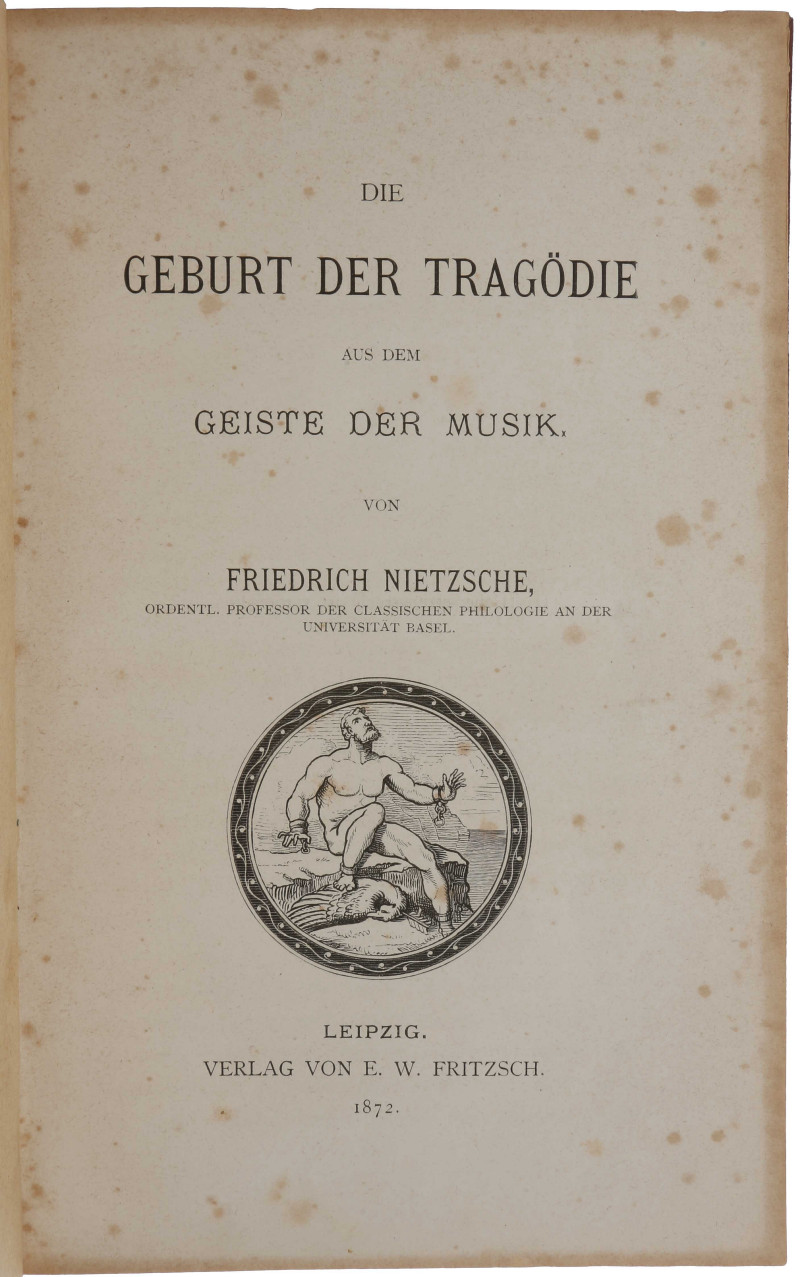
The Birth of Tragedy
Original: Die Geburt der Tragödie
An examination of the duality between the Apollonian and Dionysian principles in ancient Greek culture and its impact on the development of tragedy.
- Published1872
- TypeBook
- GenrePhilosophy
- LanguageGerman
About the Author

Friedrich Nietzsche
Friedrich Nietzsche, a profound influence in philosophy, focusing on morality, the Ubermensch, and cultural critique.
View Profile- OccupationPhilosopher
- FromGermany
-
Other Works
- The Gay Science (1882)
- Thus Spoke Zarathustra (1883)
- Beyond Good and Evil (1886)
- On the Genealogy of Morals (1887)
- Ecce Homo (1888)