
Book: The Blue and Brown Books
Overview
The Blue and Brown Books collects two sets of dictated lecture notes Ludwig Wittgenstein gave to his Cambridge students in 1933–35, published posthumously in 1958 under the subtitle “Preliminary Studies for the Philosophical Investigations.” Together they mark the shift from the picture-theory of the Tractatus to the later focus on ordinary language, showing how philosophical problems arise from misunderstandings of how words are used. Instead of offering theories, the texts stage reminders and comparisons that dissolve confusions by examining the “grammar” of our concepts, how words function within practices.
Origins and form
The notes were dictated, not polished, and retain a conversational, experimental tone. Wittgenstein proposes simple thought-experiments, toy languages, and carefully chosen examples to bring readers from abstract speculation back to the variegated ways language operates. The style alternates between questions and replies, abrupt shifts of perspective, and instructions to look at everyday cases. The result is a method rather than a doctrine: clarification by surveying usage.
The Blue Book
The Blue Book opens by criticizing a persistent philosophical picture: that every meaningful word names an object and that understanding consists in having a mental correlate for it. Wittgenstein shows why images and inner episodes cannot anchor meaning. An image can be interpreted in countless ways; what fixes an expression is its place in a practice. Ostensive definition, pointing and saying “This is red”, works only within a learned technique that decides whether “red” names a color, an object, a shape, or a surface quality. The notes urge a shift from explaining meaning to describing the rules that govern use.
From here, they examine psychological verbs such as “understand,” “intend,” “expect,” and “read,” showing how grammatical differences map the differences in circumstances, criteria, and behavior that license their application. The temptation to seek hidden entities (a mental act of understanding, a private pointing) is replaced by attention to public criteria and training. A recurring target is the Augustinian picture of language: as if words were labels and sentences mere compounds of names. That picture misleads because it obscures the multiplicity of language’s roles, instructing, reporting, joking, commanding, calculating, and the ways meaning depends on context and technique.
The Brown Book
The Brown Book develops these themes through systematic “language-games.” Wittgenstein invents miniature practices, buying and selling by color and shape tokens, giving and obeying orders, or coordinating tasks, to display how words acquire sense by their role in an activity. This foregrounds the social character of rule-following: grasp of a rule is shown in what counts as going on in the same way, learned through training and correction, not secured by a private mental leap. The notes explore family resemblance, the way concepts lack strict essences yet are held together by overlapping similarities; and they examine how we talk about time, reading, and the experience of understanding without positing occult processes behind the scenes.
A persistent contrast emerges between explanation and description. Philosophical explanations that postulate hidden mechanisms are replaced by descriptions that survey use and assemble reminders, yielding clarity without theory. This method underwrites later discussions of aspect perception and the grammar of sensation words, and foreshadows the critique of a private language by stressing public criteria for correct application.
Significance
The Blue and Brown Books are a workshop for the later Wittgenstein. They exhibit the therapeutic ideal, “Don’t think, look”, and the idea that philosophical problems are cured by mapping our language-games. They prepare the ground for Philosophical Investigations by introducing meaning as use, family resemblance, and the communal nature of rule-following, influencing ordinary language philosophy and reshaping debates on mind, meaning, and method.
The Blue and Brown Books collects two sets of dictated lecture notes Ludwig Wittgenstein gave to his Cambridge students in 1933–35, published posthumously in 1958 under the subtitle “Preliminary Studies for the Philosophical Investigations.” Together they mark the shift from the picture-theory of the Tractatus to the later focus on ordinary language, showing how philosophical problems arise from misunderstandings of how words are used. Instead of offering theories, the texts stage reminders and comparisons that dissolve confusions by examining the “grammar” of our concepts, how words function within practices.
Origins and form
The notes were dictated, not polished, and retain a conversational, experimental tone. Wittgenstein proposes simple thought-experiments, toy languages, and carefully chosen examples to bring readers from abstract speculation back to the variegated ways language operates. The style alternates between questions and replies, abrupt shifts of perspective, and instructions to look at everyday cases. The result is a method rather than a doctrine: clarification by surveying usage.
The Blue Book
The Blue Book opens by criticizing a persistent philosophical picture: that every meaningful word names an object and that understanding consists in having a mental correlate for it. Wittgenstein shows why images and inner episodes cannot anchor meaning. An image can be interpreted in countless ways; what fixes an expression is its place in a practice. Ostensive definition, pointing and saying “This is red”, works only within a learned technique that decides whether “red” names a color, an object, a shape, or a surface quality. The notes urge a shift from explaining meaning to describing the rules that govern use.
From here, they examine psychological verbs such as “understand,” “intend,” “expect,” and “read,” showing how grammatical differences map the differences in circumstances, criteria, and behavior that license their application. The temptation to seek hidden entities (a mental act of understanding, a private pointing) is replaced by attention to public criteria and training. A recurring target is the Augustinian picture of language: as if words were labels and sentences mere compounds of names. That picture misleads because it obscures the multiplicity of language’s roles, instructing, reporting, joking, commanding, calculating, and the ways meaning depends on context and technique.
The Brown Book
The Brown Book develops these themes through systematic “language-games.” Wittgenstein invents miniature practices, buying and selling by color and shape tokens, giving and obeying orders, or coordinating tasks, to display how words acquire sense by their role in an activity. This foregrounds the social character of rule-following: grasp of a rule is shown in what counts as going on in the same way, learned through training and correction, not secured by a private mental leap. The notes explore family resemblance, the way concepts lack strict essences yet are held together by overlapping similarities; and they examine how we talk about time, reading, and the experience of understanding without positing occult processes behind the scenes.
A persistent contrast emerges between explanation and description. Philosophical explanations that postulate hidden mechanisms are replaced by descriptions that survey use and assemble reminders, yielding clarity without theory. This method underwrites later discussions of aspect perception and the grammar of sensation words, and foreshadows the critique of a private language by stressing public criteria for correct application.
Significance
The Blue and Brown Books are a workshop for the later Wittgenstein. They exhibit the therapeutic ideal, “Don’t think, look”, and the idea that philosophical problems are cured by mapping our language-games. They prepare the ground for Philosophical Investigations by introducing meaning as use, family resemblance, and the communal nature of rule-following, influencing ordinary language philosophy and reshaping debates on mind, meaning, and method.
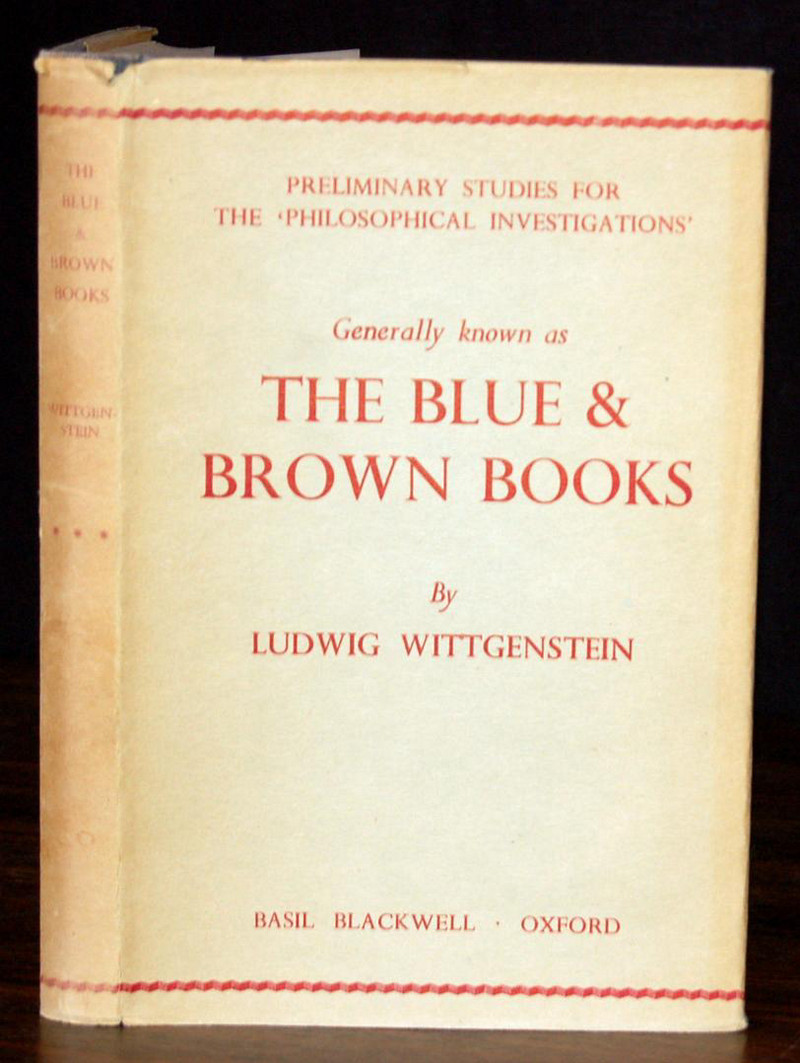
The Blue and Brown Books
Original Title: Das Blaue Buch und Das Braune Buch
A collection of lectures on the philosophy of language delivered by Wittgenstein in 1933-34 at the University of Cambridge.
- Publication Year: 1958
- Type: Book
- Genre: Philosophy, Language
- Language: German, English
- View all works by Ludwig Wittgenstein on Amazon
Author: Ludwig Wittgenstein

More about Ludwig Wittgenstein
- Occup.: Philosopher
- From: Austria
- Other works:
- Tractatus Logico-Philosophicus (1921 Book)
- Philosophische Untersuchungen (1953 Book)
- On Certainty (1969 Book)
- Remarks on the Foundations of Mathematics (1978 Book)