
Book: The Chronology of Ancient Kingdoms Amended
Overview
Isaac Newton’s The Chronology of Ancient Kingdoms Amended, published posthumously in 1728, advances a radical compression of early Greek, Egyptian, and Near Eastern history. Arguing that ancients exaggerated their antiquity, Newton re-dates foundational events and reigns to bring pagan chronologies into closer alignment with the Hebrew Bible. He challenges the long historical schemes of Manetho and the Greek chronographers, shortens the timelines of legendary epochs, and proposes synchronisms anchored to Scripture, especially the reigns of David and Solomon and the campaign of the Egyptian Shishak against Judah.
Purpose and Method
Newton’s aim is corrective rather than encyclopedic: to amend what he regarded as inflated or confused traditions by applying cross-checks from astronomy, regnal lists, genealogies, and festival calendars. A signature move is the use of precession of the equinoxes. Interpreting ancient descriptions of the equinoctial and solstitial colures relative to the constellations, traditions he associated with the sphere of Chiron and later with Eudoxus, he argues that the positions imply a sky configuration consistent with the era of the Argonauts. Converting angular displacement into years at a standard precessional rate, he dates the Argonautic expedition to the 10th century BCE. He supplements this with calibrated averages for generations, with regnal year totals pruned for overlaps, and with synchronisms such as Olympiads, priestly lists, and notable invasions.
Principal Revisions
Early Greek history is shifted several centuries later than the classical scheme. The Argonauts are placed near the mid-10th century BCE, and the Trojan War follows in the early 9th century. This compression pulls the mythical and heroic age close to the historically fixed Olympiads, reducing the gap traditionally claimed by Greek chronographers. The return of the Heraclidae, the founding of many Greek cities and cults, and the careers of early lawgivers are likewise relocated.
Egyptian chronology is cut back most aggressively. Newton treats Manetho’s dynasties as largely parallel houses ruling different regions rather than a continuous line, bringing the floruit of famous kings into the first millennium BCE. He identifies the conquering Sesostris with the biblical Shishak (usually equated with Shoshenq I), thereby dating the vaunted Asian campaigns of Egypt to the years just after Solomon. Claims of immense Egyptian antiquity are dismissed as political and priestly aggrandizement, and the earliest secure anchors are tied to interactions with Israel and later with Greece.
Assyrian, Babylonian, Median, and Persian sequences are likewise adjusted, with attention to synchronisms around the Neo-Assyrian rise and the Persian conquest. The sweep from the first remembered times down to Alexander the Great is presented as a clarified, shorter arc, stitched together by cross-referenced reigns rather than by legendary lifespans.
Structure and Contents
The volume gathers several essays: a short chronicle from the first memory of things in Europe to Alexander; treatments of the Egyptians and of the four eastern empires; and an extended description of the Temple of Solomon. The temple study reconstructs dimensions, courts, and furnishings from biblical texts and rabbinic commentary, proposing precise measures and cosmological symbolism. It functions as both a chronological anchor, via Solomon’s reign, and a model of sacred architecture whose proportions reflect divine order.
Reception and Legacy
The book sparked immediate controversy. Classical scholars and astronomers challenged his star-based dating and rejected the wholesale compression of Egyptian and Greek antiquity. Later Egyptology and cuneiform studies confirmed far longer timelines than Newton allowed. Yet the project proved influential as a bold attempt to fuse astronomical reasoning, textual criticism, and sacred history. It reveals Newton’s broader intellectual program: a unified account in which natural philosophy, scripture, and the histories of nations are reconciled under a single, critically tested chronology.
Citation Formats
APA Style (7th ed.)
The chronology of ancient kingdoms amended. (2025, August 22). FixQuotes. https://fixquotes.com/works/the-chronology-of-ancient-kingdoms-amended/
Chicago Style
"The Chronology of Ancient Kingdoms Amended." FixQuotes. August 22, 2025. https://fixquotes.com/works/the-chronology-of-ancient-kingdoms-amended/.
MLA Style (9th ed.)
"The Chronology of Ancient Kingdoms Amended." FixQuotes, 22 Aug. 2025, https://fixquotes.com/works/the-chronology-of-ancient-kingdoms-amended/. Accessed 12 Feb. 2026.
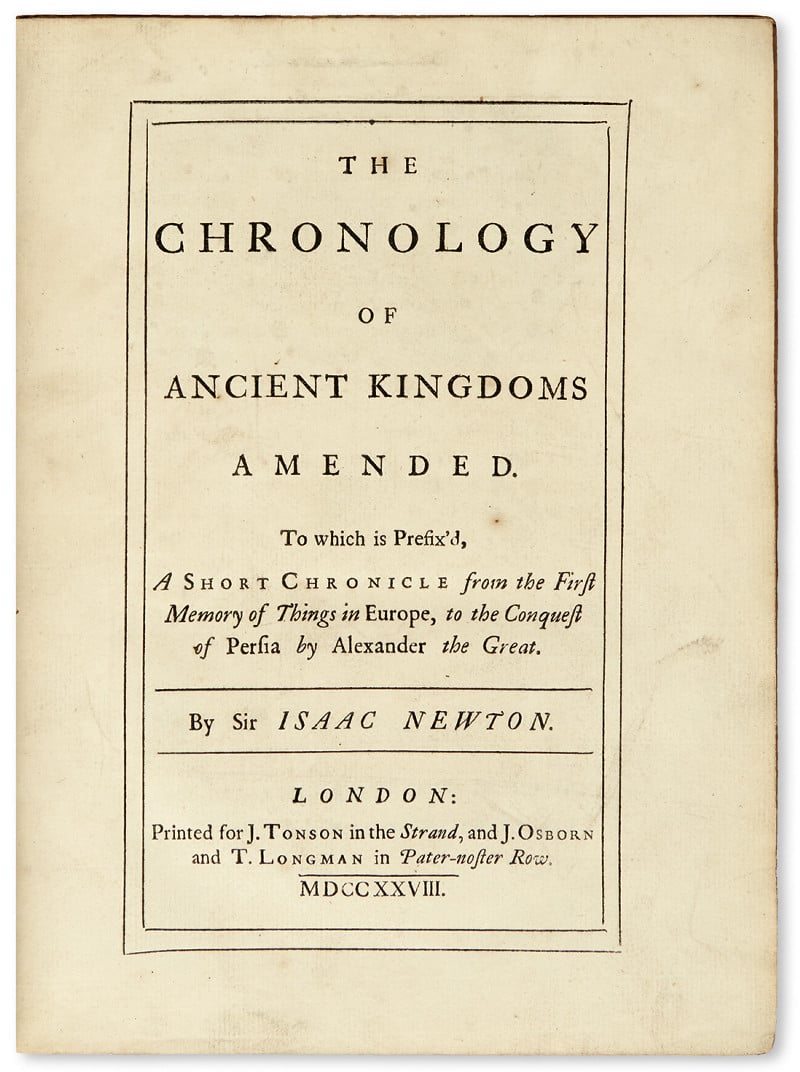
The Chronology of Ancient Kingdoms Amended
The Chronology of Ancient Kingdoms Amended is a work by Isaac Newton that examines the history of ancient civilizations and proposes a revised chronology for their reigns. The book is a work of historical and chronological research, analyzing the reigns of various ancient kingdoms in an attempt to clarify historical timelines.
- Published1728
- TypeBook
- GenreHistory
- LanguageEnglish
About the Author

Isaac Newton
Isaac Newton, the influential physicist and mathematician who revolutionized science with his laws of motion and gravity.
View Profile- OccupationMathematician
- FromEngland
- Other Works