
Book: The Crown of Wild Olive
Overview
John Ruskin’s The Crown of Wild Olive (1866) gathers three public lectures, Work, Traffic, and War, delivered to audiences of workers, merchants, and the general public in mid-Victorian Britain. Speaking as an art critic turned social moralist, Ruskin challenges the dominant economic and industrial assumptions of his age. He argues that wealth without justice is corruption, that labor’s true end is the cultivation of life rather than the multiplication of goods, and that both commerce and conflict must be judged by moral law. The title invokes the Greek victor’s wreath of wild olive, a spare emblem of honor that contrasts with the era’s gilt symbols of luxury and gain; Ruskin proposes that the genuine crown for a nation is the quiet reward of rightful work, honest trade, and disciplined courage in defense of the common good.
Work
In Work, Ruskin confronts the conditions and purposes of labor in an industrial economy. He insists that the worth of work lies not in the magnitude of output or profit but in the life it fosters, health of body, integrity of spirit, and beauty in the things made. Division of labor that maims the worker’s mind or character is a social failure, however efficient it appears. He assigns real leadership to employers, who must treat their role as a captain’s duty toward a crew: to secure fair conditions, to direct labor toward useful ends, and to cultivate skill and pride rather than grind men into mechanical parts. He denounces luxury industries that consume human effort for trifles while neglecting necessities, and urges that education, craftsmanship, and the design of useful, well-made goods are the proper path to national prosperity.
Traffic
Traffic addresses merchants on the proposed building of a new Exchange and unfolds into a meditation on the sources of taste and the ethics of architecture. Ruskin argues that buildings are declarations of what a people truly reveres; no sum of money can purchase noble architecture if the community’s real worship is of wealth itself. Beauty in stone requires truth in life. He urges the audience to examine their aims in trade: if justice and charity govern exchange, art will follow; if greed rules, art will become sham display. He links commerce to character, warning that a market grounded in deceit, adulteration, and reckless speculation cannot produce either admirable buildings or a healthy city. The merchant’s first craft is honesty, his first ornament the trust of his neighbors.
War
War tackles the moral paradox of conflict. Ruskin acknowledges the severe discipline and certain virtues awakened by peril, courage, self-sacrifice, obedience, yet condemns wars of vanity, profit, or national rivalry. Peace, he argues, is not the mere absence of fighting but the presence of righteousness; a society at perpetual commercial war, crushing rivals by fraud or starvation, cannot claim to be peaceful. He distinguishes honorable defense of home and law from predatory aggression, and he favors a citizenly spirit that unites martial discipline with civic duty. The ideal is a nation so just that it rarely must fight, and so trained in virtue that it can.
Style, Images, and Aim
Ruskin writes in an orator’s cadence, mixing classical allusion, Biblical moral vision, and concrete examples from workshops, markets, and streets. The wild olive crown binds the lectures into a single ethic: labor as service, trade as trust, and strength as guardianship. Throughout, he contests the cold calculus of laissez-faire economics with a humane political economy that measures wealth by the well-being of persons and the beauty of their works.
Significance
The Crown of Wild Olive stands as a compact statement of Ruskin’s social philosophy at the height of industrial expansion. It pushed Victorians to connect aesthetics with ethics and to judge prosperity by justice. Its call for responsible leadership, dignified work, and morally grounded commerce remains a bracing counterpoint to purely utilitarian accounts of progress.
Citation Formats
APA Style (7th ed.)
The crown of wild olive. (2026, February 5). FixQuotes. https://fixquotes.com/works/the-crown-of-wild-olive/
Chicago Style
"The Crown of Wild Olive." FixQuotes. February 5, 2026. https://fixquotes.com/works/the-crown-of-wild-olive/.
MLA Style (9th ed.)
"The Crown of Wild Olive." FixQuotes, 5 Feb. 2026, https://fixquotes.com/works/the-crown-of-wild-olive/. Accessed 6 Feb. 2026.
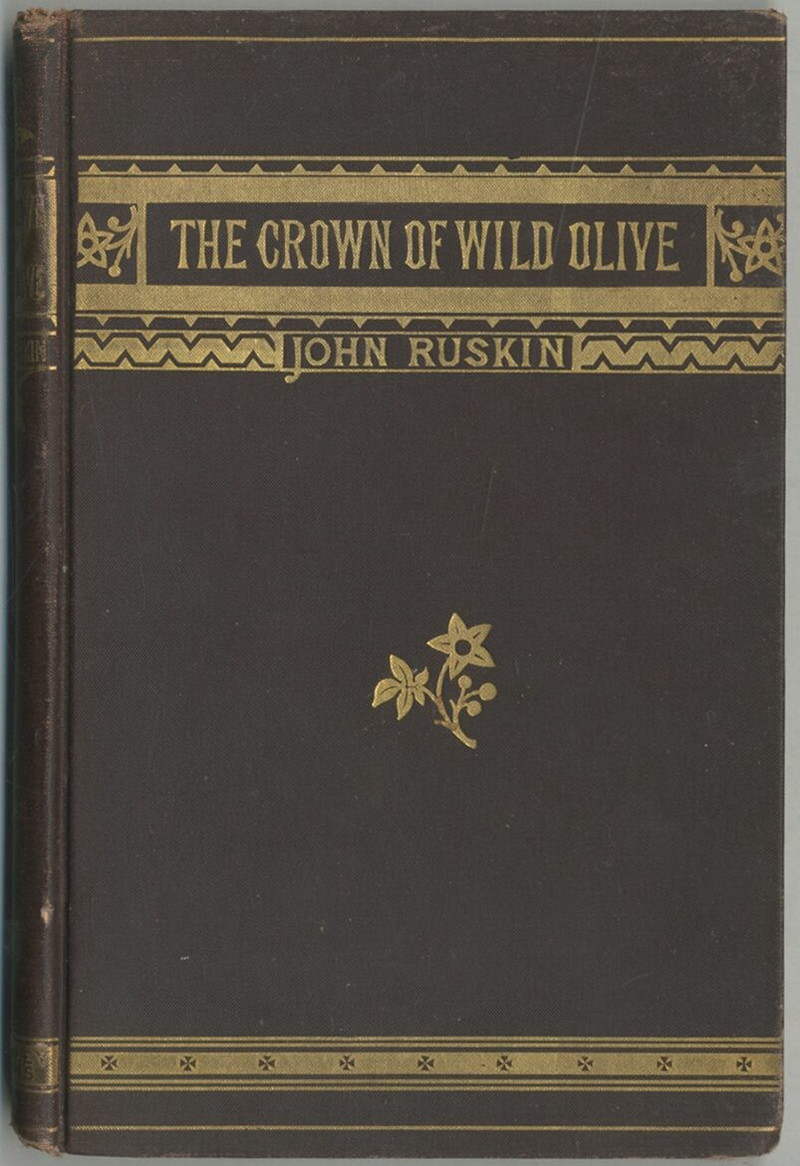
The Crown of Wild Olive
The Crown of Wild Olive is a collection of four essays by John Ruskin, centered around the relationship between art, labor, and social values. The essays explore topics such as the role of altruism in society, the importance of work, and the influence of industrial capitalism on the art.
- Published1866
- TypeBook
- GenreArt, Social criticism, Non-Fiction
- LanguageEnglish
About the Author

John Ruskin
John Ruskin, a major English writer and art critic renowned for his socio-political critiques and impact on 19th-century society.
View Profile- OccupationWriter
- FromEngland
-
Other Works
- Modern Painters (1843)
- The Seven Lamps of Architecture (1849)
- The Stones of Venice (1851)
- Unto This Last (1860)
- Sesame and Lilies (1865)
- Fors Clavigera (1871)