
The Dance of Life: The Other Dimension of Time
Overview
Edward T. Hall examines time as a cultural phenomenon that is as structured and meaningful as language or space. He argues that time is an organizing dimension of social life that people experience and enact differently across cultures, shaping behavior, values, and institutions. Hall presents time as a "dance" with patterns, rhythms, and rules that govern how individuals coordinate action, express respect, and manage social relationships.
Core Concepts
Hall contrasts two fundamental orientations toward time: monochronic time, in which activities are scheduled sequentially, punctuality and deadlines are paramount, and time is treated as a commodity; and polychronic time, in which multiple activities proceed simultaneously, relationships take precedence over strict schedules, and interruptions are normal. He also identifies temporal focuses such as past-oriented, present-oriented, and future-oriented societies, and shows how those orientations influence memory, ritual, planning, and innovation.
Time as Nonverbal Communication
Time functions as a form of nonverbal communication that conveys values and intentions. Punctuality, duration of meetings, willingness to wait, and the pacing of conversation all signal social priorities. Hall uses ethnographic vignettes and cross-cultural comparisons to show how the same observable behavior, arriving late, cutting a conversation short, or extending hospitality, can be interpreted very differently depending on the underlying time system. Misreading temporal cues often generates misunderstanding in international business, diplomacy, and everyday interaction.
Social Organization and Institutions
Temporal patterns are embedded in institutions such as work, education, law, and religion. Hall explains how industrialized, monochronic societies organize labor through schedules, time clocks, and segmented workdays, while polychronic societies rely more on flexible arrangements anchored by social obligations and event-based timing. He explores how children are socialized into particular time habits, how family life reflects temporal priorities, and how urban rhythms and transportation systems reinforce collective temporal structures.
Practical Implications
Awareness of cultural time styles has practical consequences for cross-cultural communication, management, and design. Hall highlights how business negotiations fail when parties operate under conflicting temporal logics, and he suggests strategies for reducing friction by recognizing and adapting to differing time expectations. He also points to urban planning, scheduling practices, and education as arenas where sensitivity to temporal culture can improve cooperation and efficiency.
Method and Examples
Hall draws on field observations, interviews, and comparative examples from Europe, the Americas, the Middle East, and Asia. His approach combines anthropological description with applied insight, using memorable anecdotes to illustrate distinctions between event time and clock time, and to reveal how temporal norms are internalized and reproduced in daily routines. The examples serve to map a spectrum of time behaviors rather than to present rigid typologies.
Critique and Legacy
Hall's framing of time as a cultural variable has been influential in anthropology, intercultural training, and management studies. His dichotomy of monochronic and polychronic remains widely cited, though critics caution against overgeneralization and note that individuals often blend time styles depending on context, social class, and technology. The book predates digital acceleration and globalization, so some specific claims require reexamination in light of contemporary temporal practices, yet its core insight, that time is culturally constituted and communicative, retains strong explanatory power.
Conclusion
Time emerges in Hall's account as an active force that organizes social life, communicates values, and shapes conflict and cooperation. By treating time as a cultural pattern to be read and negotiated, the analysis offers tools for improving cross-cultural understanding and for rethinking the taken-for-granted rhythms that structure work, relationships, and collective life.
Citation Formats
APA Style (7th ed.)
The dance of life: The other dimension of time. (2026, February 4). FixQuotes. https://fixquotes.com/works/the-dance-of-life-the-other-dimension-of-time/
Chicago Style
"The Dance of Life: The Other Dimension of Time." FixQuotes. February 4, 2026. https://fixquotes.com/works/the-dance-of-life-the-other-dimension-of-time/.
MLA Style (9th ed.)
"The Dance of Life: The Other Dimension of Time." FixQuotes, 4 Feb. 2026, https://fixquotes.com/works/the-dance-of-life-the-other-dimension-of-time/. Accessed 28 Mar. 2026.
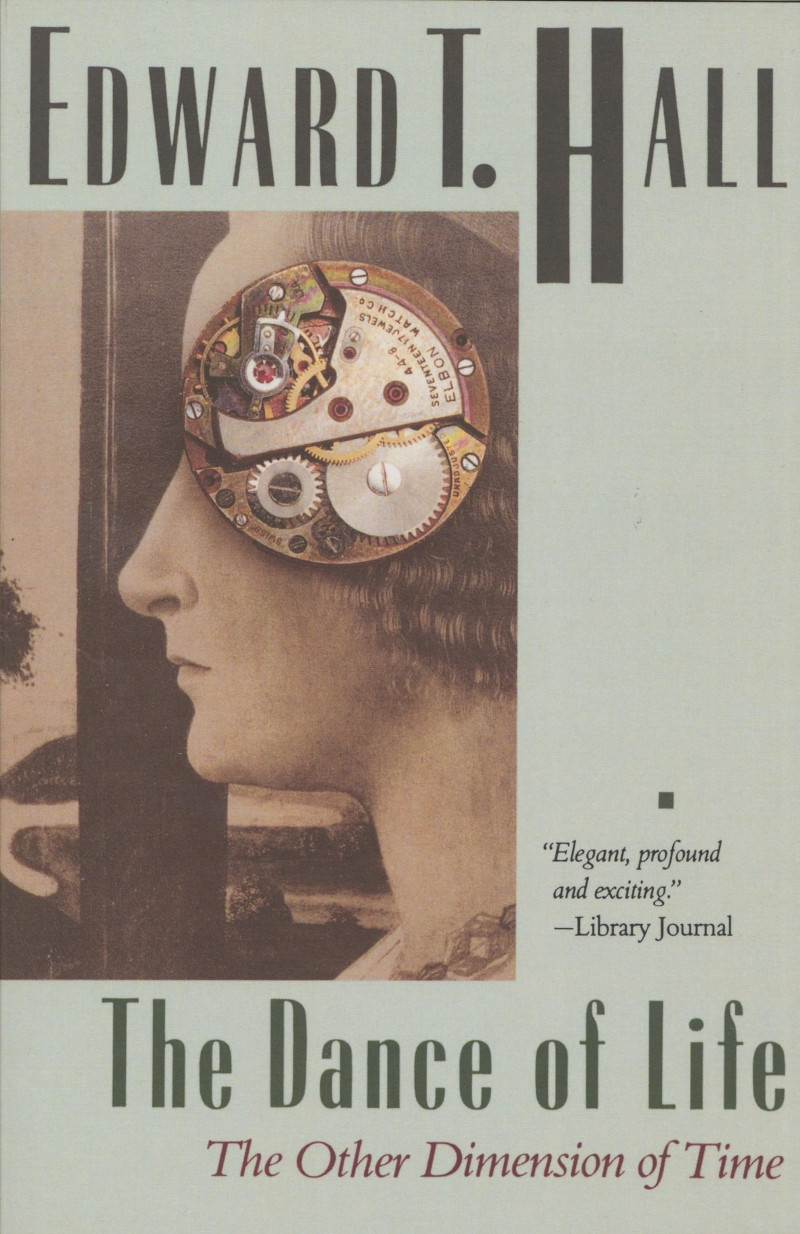
The Dance of Life: The Other Dimension of Time
Explores cultural perceptions and organization of time, contrasting monochronic and polychronic time systems and showing how temporal orientation influences work, relationships, and social structure.
- Published1983
- TypeBook
- GenreAnthropology, Time studies, Non-Fiction
- Languageen
About the Author

Edward T. Hall
Edward T. Hall, founder of proxemics, covering his work on space, context, and time, with notable quotes and publications.
View Profile- OccupationScientist
- FromUSA
-
Other Works
- The Silent Language (1959)
- The Hidden Dimension (1966)
- Beyond Culture (1976)
- Understanding Cultural Differences: Germans, French and Americans (1990)