
Book: The Gay Science
Overview
Published in 1882, The Gay Science turns philosophy into an art of joyful inquiry. Nietzsche reclaims “gay” in its older sense, sprightly, playful, linking knowledge to the troubadours’ “gaya scienza, ” where craft, wit, and song meet. Against ponderous metaphysics, he celebrates a cultivated cheerfulness that neither denies suffering nor hides from it, but transforms it into strength. The book gathers aphorisms, poems, and parables that sketch a new ethos for “free spirits”: experimental, self-critical, and attuned to the artistry of life.
Form and Style
The book’s aphoristic form is itself an argument. Short, varied pieces invite multiple angles rather than a single doctrine; tone shifts from satire to reverie; masks and personae loosen the reader’s expectations of philosophical solemnity. A cluster of songs rounds out the prose, underscoring the claim that thinking should learn from music and dance. The voice often provokes and withdraws at once, challenging the reader to finish the thought and to treat conviction as a temporary stance rather than a final resting place.
Death of God and Its Consequences
Its most famous scene is the parable of the madman who announces that God is dead and that we have killed him. Nietzsche does not mean a refutation of a theological thesis; he diagnoses a cultural event: the collapse of binding, transcendent guarantees for truth and morality. The result is a new, vertiginous freedom and a risk of nihilism. Without inherited absolutes, past values lose authority; yet this void also opens the task of creating values that spring from the needs and powers of living beings rather than from otherworldly dictates.
Knowledge, Perspectivism, and Critique of Truth
The Gay Science probes the drives behind “objectivity.” Knowing is not neutral; it is bound to life, to the instincts that seek power, health, and form. Truth is prized not because it mirrors a thing-in-itself but because certain fictions and clarifications prove beneficial or ennobling. Language itself seduces us into errors, substance, cause, free will, by freezing becoming into nouns and agents. Against ascetic ideals of disinterestedness, Nietzsche proposes a disciplined play: a many-eyed, many-toned approach that treats perspectives as instruments, compares them, and tests them for their capacity to enhance life.
Morality, Art, and Self-Overcoming
Moralities are human inventions that reflect the physiology and history of their makers. The book continues Nietzsche’s genealogical impulse: to show how “good” and “evil, ” pity and guilt, arise from contingent needs and power relations. Instead of lamenting this, he urges an aesthetic model of existence. Art provides a counter-school to moralism because it teaches selection, stylization, and affirmation. The exemplary thinker creates his character as a work, learning to transmute pain into insight and necessity into chosen fate.
Amor Fati and Eternal Recurrence
Two ethical touchstones crystallize here. Amor fati counsels loving one’s fate neither as resignation nor as optimism but as a proud yes to the whole weave of necessity. The thought of eternal recurrence, imagining one’s life returning endlessly, unchanged, tests the depth of that yes. Could one bless the repetition of every detail? The challenge is not a cosmology to be proven but an existential barometer: a standard for the strength and style of one’s affirmation.
Cheerfulness as Method
Cheerfulness is not frivolity; it is the hard-won mood of those who have faced the heaviest questions and learned to laugh without contempt. The Gay Science models such laughter: quick, exacting, and liberating. It recommends friendship, solitude, and seasonal renewal as practices for sustaining a playful seriousness. From this gaiety grows the courage to revalue values and to risk new ideals after the twilight of the old.
Citation Formats
APA Style (7th ed.)
The gay science. (2026, February 5). FixQuotes. https://fixquotes.com/works/the-gay-science/
Chicago Style
"The Gay Science." FixQuotes. February 5, 2026. https://fixquotes.com/works/the-gay-science/.
MLA Style (9th ed.)
"The Gay Science." FixQuotes, 5 Feb. 2026, https://fixquotes.com/works/the-gay-science/. Accessed 27 Mar. 2026.
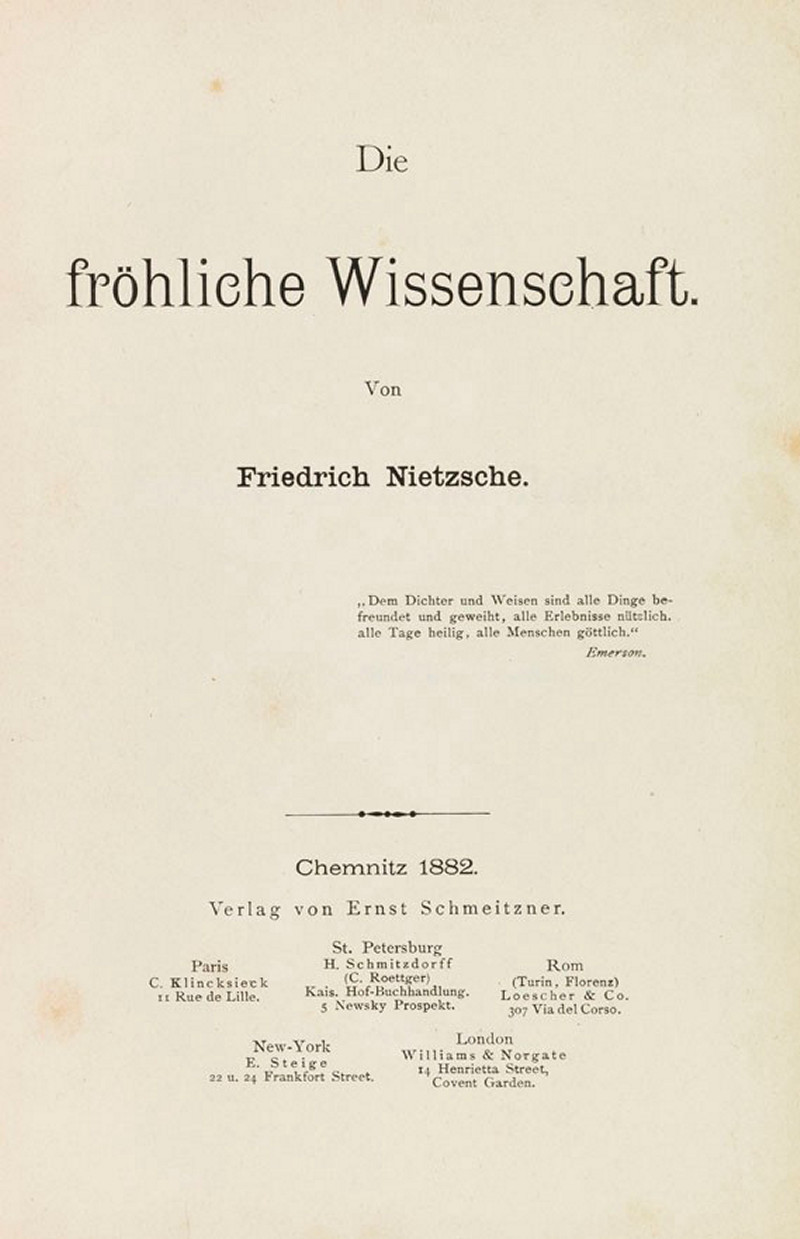
The Gay Science
Original: Die fröhliche Wissenschaft
An exploration of various philosophical ideas through a collection of short reflections on topics such as art, morality, religion, and the nature of human existence.
- Published1882
- TypeBook
- GenrePhilosophy
- LanguageGerman
About the Author

Friedrich Nietzsche
Friedrich Nietzsche, a profound influence in philosophy, focusing on morality, the Ubermensch, and cultural critique.
View Profile- OccupationPhilosopher
- FromGermany
-
Other Works
- The Birth of Tragedy (1872)
- Thus Spoke Zarathustra (1883)
- Beyond Good and Evil (1886)
- On the Genealogy of Morals (1887)
- Ecce Homo (1888)