
Book: The Hidden Dimension
Overview
Published in 1966, Edward T. Hall's The Hidden Dimension introduces the idea that human beings live in invisible spatial worlds that shape behavior, communication, and social order. Hall coins the term "proxemics" to describe the study of how people use space as a form of nonverbal communication. He argues that space is a culturally organized system as significant as language, and that variations in spatial behavior underlie many everyday misunderstandings and design failures.
Key Concepts
Proxemics divides interpersonal space into broadly recognizable zones, intimate, personal, social, and public distances, each governing different kinds of interaction. Intimate distance covers close physical contact and is reserved for lovers, family, and close friends; personal distance allows casual conversation; social distance suits acquaintances and formal exchanges; public distance supports speaking to groups and public performances. Hall links these distances to rhythm, tempo, and territory, proposing that people lay claim to spatial areas and defend them as part of a social grammar.
Cultural Patterns of Space
Hall emphasizes that spatial behavior is learned and varies considerably across cultures. Some societies are "contact" cultures where close physical proximity and touch are commonplace, while "noncontact" cultures maintain larger personal bubbles and reserve touch for intimate contexts. Differences in spatial norms affect eye contact, seating arrangements, queueing, and crowding perceptions. What feels comfortable or invasive in one culture may be rude or distant in another, making space a silent but powerful source of cross-cultural friction.
Architecture, Urban Design, and Everyday Life
Spatial patterns influence the design of homes, offices, streets, and public buildings. Hall contends that architecture and planning often ignore the invisible rules people use to move and meet, leading to designs that cause discomfort or social disorder. Residential layouts reflect ideas about privacy and family structure, while workplaces and classrooms reveal assumptions about authority, collaboration, and efficiency. Urban planners and architects can use proxemic insights to shape public spaces that encourage desired interactions or protect privacy.
Method and Evidence
Hall combines anthropological field observation, anecdotal examples, and cross-cultural comparisons rather than relying on controlled experiments. He draws on work with military and diplomatic communities, film studies, and everyday vignettes to illustrate spatial behavior. This qualitative, descriptive method seeks patterns in naturally occurring settings, foregrounding lived experience and contextual detail over statistical generalizations.
Legacy and Critique
The Hidden Dimension proved foundational for environmental psychology, intercultural communication, and design theory, popularizing spatial awareness in disciplines concerned with human behavior. At the same time, Hall's categories have been critiqued for overgeneralization, cultural stereotyping, and occasional lack of empirical rigor. Later researchers have refined proxemic theory, emphasizing variability within cultures, situational modifiers, and the interaction of space with gender, class, and technology. Despite critiques, Hall's central claim, that space is a communicative medium shaped by culture, remains a touchstone for studies of how environment and social life interconnect.
Citation Formats
APA Style (7th ed.)
The hidden dimension. (2026, February 4). FixQuotes. https://fixquotes.com/works/the-hidden-dimension/
Chicago Style
"The Hidden Dimension." FixQuotes. February 4, 2026. https://fixquotes.com/works/the-hidden-dimension/.
MLA Style (9th ed.)
"The Hidden Dimension." FixQuotes, 4 Feb. 2026, https://fixquotes.com/works/the-hidden-dimension/. Accessed 5 Mar. 2026.
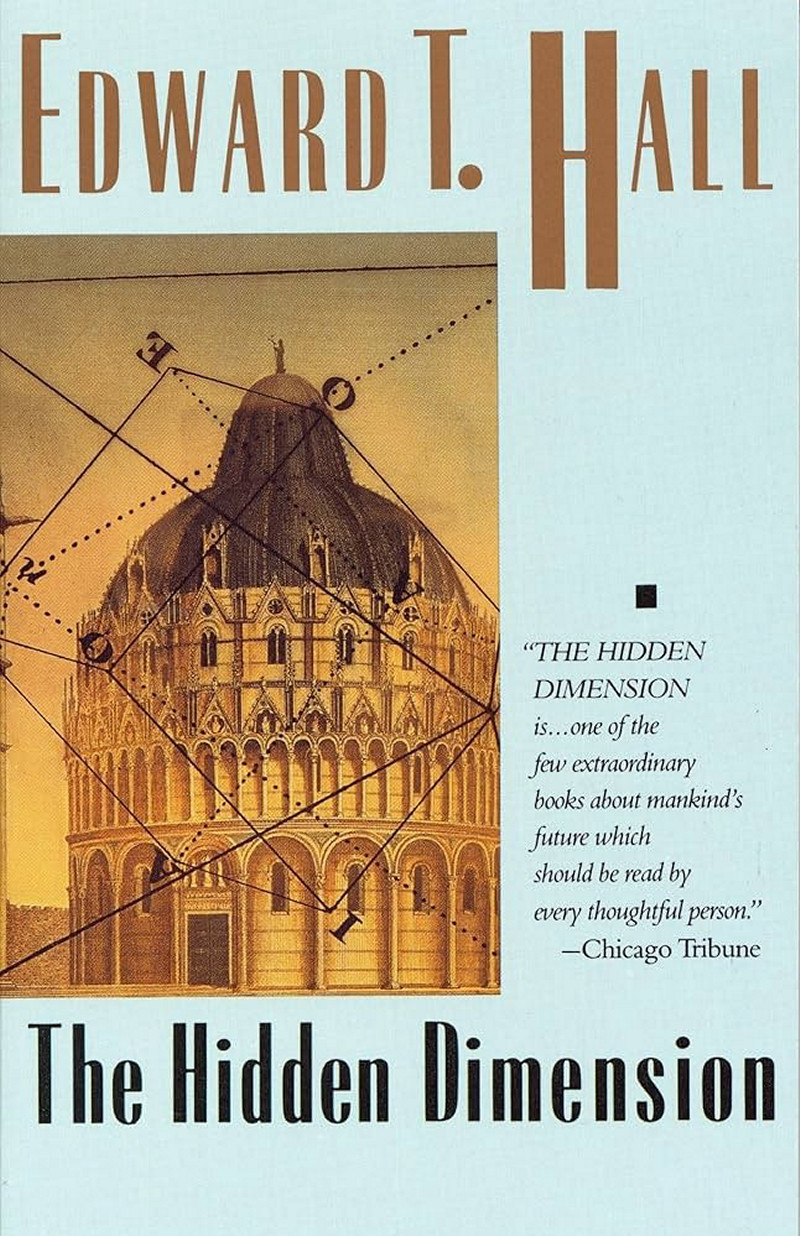
The Hidden Dimension
Original: The Hidden Dimension: Man's Use of Space in Public and Private
Develops the concept of proxemics, the study of human use of space, and analyzes how cultural differences in personal, social, and public distances affect behavior, architecture, urban design, and interpersonal relations.
- Published1966
- TypeBook
- GenreAnthropology, Environmental psychology, Non-Fiction
- Languageen
About the Author

Edward T. Hall
Edward T. Hall, founder of proxemics, covering his work on space, context, and time, with notable quotes and publications.
View Profile