
Book: The Silent Language
Overview
Edward T. Hall's The Silent Language argues that culture operates as an unspoken communication system that shapes perception, behavior, and social organization. Rather than treating culture as an assortment of customs or artifacts, Hall frames it as a set of invisible codes that govern how people use space, time, objects, and context to convey meaning. The book presents culture as a "language" learned largely outside conscious awareness, one that structures everyday interactions and underlies cross-cultural misunderstandings.
Hall draws on anthropology, psychology, and his own fieldwork to show how these nonverbal codes differ across societies and how those differences affect international relations, business, and personal encounters. He presents accessible examples, room arrangements, conversational distance, attitudes toward time, to reveal how deeply embedded and consequential these silent rules are.
Key Concepts
At the heart of the book is the idea that communication extends well beyond words. Hall introduces proxemics, the study of personal space and spatial organization, as a primary channel of nonverbal meaning. He examines how people claim, mark, and negotiate territory in interpersonal and public settings, and how personal distance varies by culture, relationship, and context.
Time receives comparable attention through Hall's distinctions between monochronic and polychronic orientations. Monochronic cultures treat time as linear, segmented, and scheduled, while polychronic cultures view time as fluid, with multiple activities overlapping. These temporal patterns influence punctuality, planning, and perceptions of respect or rudeness.
High-Context and Low-Context Cultures
One of Hall's most enduring contributions is the dichotomy of high-context and low-context communication. High-context cultures rely heavily on shared experience, implicit messages, and environmental cues; meaning is often embedded in relationships and settings rather than spelled out. Low-context cultures, by contrast, prioritize explicit, direct verbal messages and assume less shared background knowledge.
This framework clarifies why the same words or actions can carry different implications across cultures. It helps explain workplace friction, diplomatic blunders, and everyday misreadings where speakers assume a shared code that does not exist, or conversely, where explicit explanation is perceived as blunt or unnecessary.
Perception, Sensory Patterns, and Environment
Hall emphasizes that culture channels perception by privileging certain sensory modes and ways of organizing experience. He argues that societies develop characteristic "schedules" for using sensory information, what people attend to visually, aurally, or spatially, and that these patterns shape cognition and social order. Built environments, material objects, and patterns of movement all become carriers of cultural meaning.
This ecological approach links individual behavior with larger social structures, suggesting that architecture, urban planning, and design are not merely functional but deeply communicative. The arrangement of furniture, the layout of public space, and the ritualization of time are all part of the silent language through which a culture speaks.
Influence and Applications
The Silent Language proved foundational for fields as diverse as intercultural communication, organizational behavior, and design. Hall's concepts became practical tools for diplomats, international businesspeople, educators, and planners seeking to navigate cultural difference. His language, proxemics, high- and low-context, monochronic/polychronic, entered common use and shaped later research on nonverbal behavior and cross-cultural competence.
In applied settings, the book helps diagnose recurring misunderstandings and suggests that improving outcomes often requires attending to invisible rules rather than merely translating words.
Critiques and Continuing Relevance
Critics have noted that Hall sometimes simplifies complexity and risks stereotyping by attributing stable traits to whole cultures. Empirical validation of some claims has been uneven, and later scholars have emphasized variation within cultures and the fluidity of cultural codes. Nonetheless, the central insight, that much of culture is communicated silently and felt rather than articulated, remains influential.
The Silent Language endures because it shifts attention from words to the ambient structures that shape interaction. Its emphasis on context, space, and time continues to inform how people think about cultural difference, design human environments, and train for international engagement.
Citation Formats
APA Style (7th ed.)
The silent language. (2026, February 4). FixQuotes. https://fixquotes.com/works/the-silent-language/
Chicago Style
"The Silent Language." FixQuotes. February 4, 2026. https://fixquotes.com/works/the-silent-language/.
MLA Style (9th ed.)
"The Silent Language." FixQuotes, 4 Feb. 2026, https://fixquotes.com/works/the-silent-language/. Accessed 22 Mar. 2026.
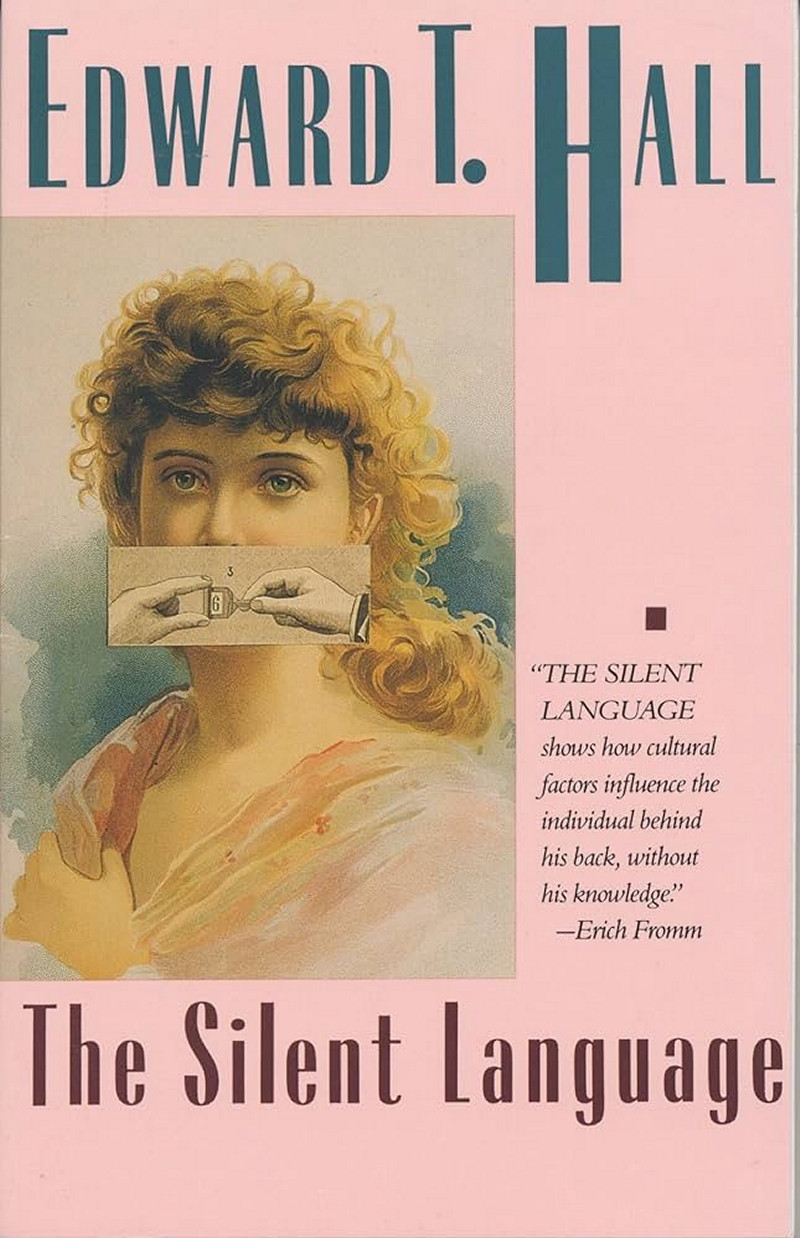
The Silent Language
Foundational work exploring nonverbal communication and the ways culture shapes perception, time, space, and context; introduces ideas about high-context and low-context cultures and how unseen cultural codes govern everyday interaction.
- Published1959
- TypeBook
- GenreAnthropology, Cross-cultural communication, Non-Fiction
- Languageen
About the Author

Edward T. Hall
Edward T. Hall, founder of proxemics, covering his work on space, context, and time, with notable quotes and publications.
View Profile