
One-act play: The Ugly Duckling
Introduction
A. A. Milne’s one-act play The Ugly Duckling (1941) is a light, gently satirical fairy-tale romance that recasts the familiar “swan from an ugly duckling” arc as a witty courtly charade. It deftly blends playful dialogue, mistaken identities, and an enchantment that turns conventional ideas of beauty upside down.
Setting and Premise
The action unfolds in a small, storybook kingdom ruled by a well-meaning, fussy King and Queen. Their daughter, a princess widely deemed plain, must be matched to a visiting prince. Long ago, a fairy’s christening charm ensured that the princess’s true beauty would be visible only to the person who loved her; to everyone else she appears awkward and unremarkable. The court plans a disguise.
Plot Summary
Before the prince arrives, the King and Queen resolve to substitute the radiant maid-of-honor for the princess, presenting the maid as the royal bride while the princess will pose as her attendant. Their plan puts polish ahead of truth, and the Chancellor fusses about protocol while urging caution. When the prince reaches court, a mirror plot twist emerges: he too has exchanged identities with his confident attendant. Each royal, uncertain of being judged on looks, prefers to be evaluated without the weight of rank or rumor.
The heart of the play is the private meeting between the supposed “servants.” Unaware of each other’s true status, they find ease in candid conversation, play at riddles and courtly small talk, and slowly reveal a shared dislike of pretense. As sympathy ripens into affection, the effect of the christening spell begins to work: the princess becomes beautiful in the prince’s eyes precisely because he has come to love her, and he, stripped of swagger, appears truly princely to her.
Meanwhile, the parallel masquerade with the showy maid and the blustering attendant founders in superficiality. Comic business accumulates as the King and Queen try to steer ceremonies, only to be confounded by crossed signals. At last the young couple admit who they are, and the double deception collapses cheerfully. With love proved, the enchantment is dispelled for them, and the court, mollified by a happy ending, blesses the match.
Characters
- The King and Queen: affectionate, image-conscious parents whose anxiety fuels the disguises.
- The Princess: shy, intelligent, and “plain” under the spell, she longs to be known rather than displayed.
- The Prince: modest and thoughtful beneath his borrowed livery.
- The Maid and the Attendant: foils who embody glitter without depth.
- Courtiers (especially the Chancellor): sources of protocol and punctilious humor.
Themes and Motifs
Milne emphasizes inner worth over appearances, the hazards of judging by surface, and the liberating power of play-acting to reveal truth. Doubling, disguise, and riddles dramatize perception versus reality, while the christening charm literalizes the idea that love and kindness “make” beauty visible.
Style and Tone
The play is brisk, amiable, and quotable, with courtly pastiche, light sarcasm, and a gentle mockery of pomp. Its one-act structure keeps tension lively and the reversal neat.
Conclusion
By marrying masquerade to moral, The Ugly Duckling turns a simple fairy tale into a sparkling, humane comedy about seeing truly.
Citation Formats
APA Style (7th ed.)
The ugly duckling. (2026, February 4). FixQuotes. https://fixquotes.com/works/the-ugly-duckling1/
Chicago Style
"The Ugly Duckling." FixQuotes. February 4, 2026. https://fixquotes.com/works/the-ugly-duckling1/.
MLA Style (9th ed.)
"The Ugly Duckling." FixQuotes, 4 Feb. 2026, https://fixquotes.com/works/the-ugly-duckling1/. Accessed 2 Apr. 2026.
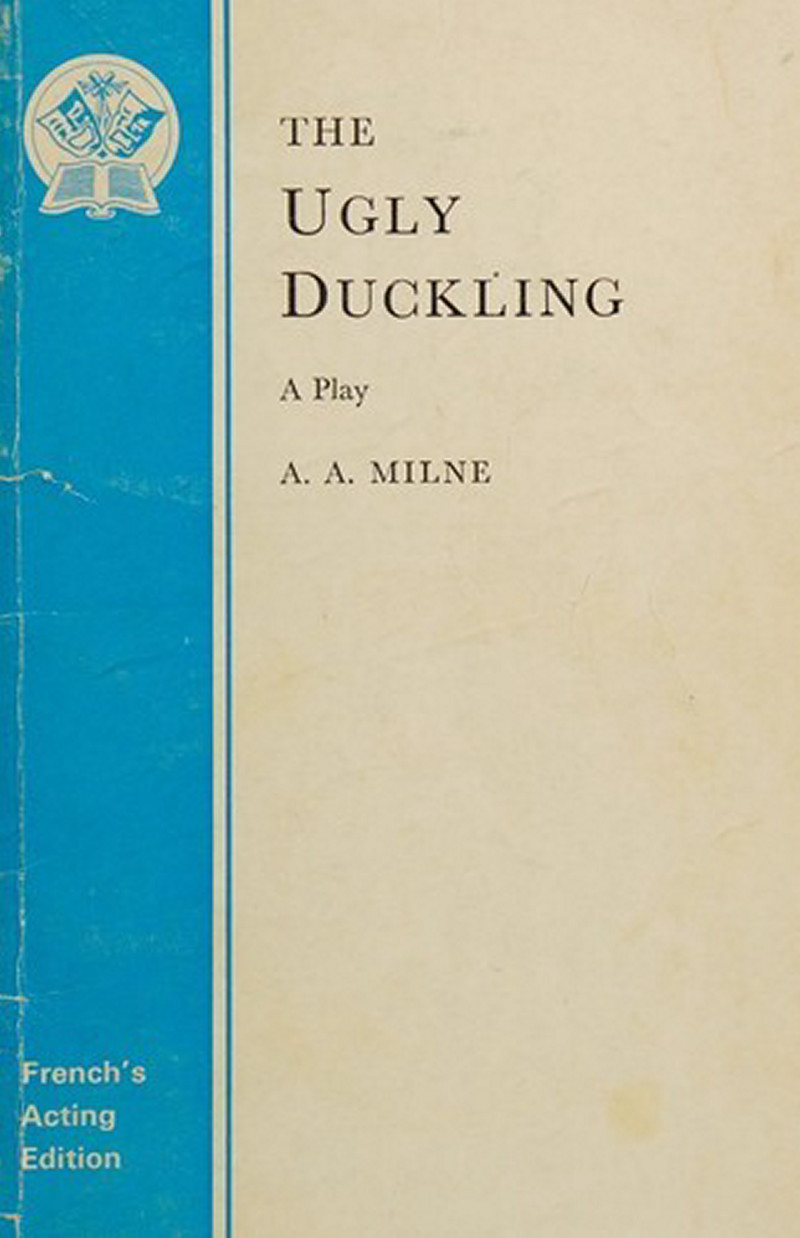
The Ugly Duckling
A fairy-tale comedy about a 'plain' princess and a prince whose true qualities come to light through a ruse.
- Published1941
- TypeOne-act play
- GenreComedy, Fairy tale
- LanguageEnglish
- CharactersPrincess, Prince, King, Queen
About the Author

A. A. Milne
A. A. Milne: early life, Punch career, war service, plays, and the creation and enduring legacy of Winnie-the-Pooh with E H Shepard.
View Profile- OccupationAuthor
- FromEngland
-
Other Works
- The Day's Play (1910)
- The Holiday Round (1912)
- Once a Week (1914)
- Wurzel-Flummery (1917)
- Once on a Time (1917)
- Belinda (1918)
- Not That It Matters (1919)
- Mr. Pim Passes By (1919)
- The Romantic Age (1920)
- If I May (1920)
- The Sunny Side (1921)
- The Truth About Blayds (1921)
- The Dover Road (1921)
- The Red House Mystery (1922)
- The Man in the Bowler Hat (1923)
- The Great Broxopp (1923)
- When We Were Very Young (1924)
- A Gallery of Children (1925)
- Winnie-the-Pooh (1926)
- Now We Are Six (1927)
- The House at Pooh Corner (1928)
- The Fourth Wall (1928)
- Toad of Toad Hall (1929)
- The Ivory Door (1929)
- By Way of Introduction (1929)
- Michael and Mary (1930)
- Two People (1931)
- Peace With Honour (1934)
- It's Too Late Now: The Autobiography of a Writer (1939)
- War With Honour (1940)
- Year In, Year Out (1952)