
Advertisement: Think Small
Overview
"Think Small" is a landmark Volkswagen print advertisement created at Doyle Dane Bernbach and associated with William Bernbach’s creative leadership, first appearing around 1959, 1960. It reintroduced the humble Volkswagen Beetle to an American audience awash in chrome, tailfins, and horsepower, and did so by reversing the period’s dominant car logic. Rather than promise more size, more flash, or more status, the ad asked readers to value modesty, thrift, and reliability. It became a defining expression of the creative revolution in advertising and a template for how wit, restraint, and candor could build a brand.
Visual Concept
The layout is almost shockingly spare. A vast field of white surrounds a tiny photograph of a Beetle, rendered so small that it seems to hover in negative space. Beneath it sits the understated, lowercase headline “Think small.” punctuated with a period, reinforcing finality and confidence without shouting. The body copy is set in clean, readable type and arranged with disciplined order, followed by a discreet Volkswagen logo and identification. The asymmetry, the ocean of white space, and the deliberate smallness force the reader to pause. The Beetle’s reduced scale is not a gimmick; it is the point.
Voice and Message
The copy speaks plainly, with dry humor and a self-aware tone that treats the audience as intelligent. It makes an argument that small is not a compromise but an advantage. A small car uses less fuel, costs less to maintain, and wastes less of everything, time, parts, money. The text suggests a product designed for utility, reliability, and longevity rather than for annual fashion cycles. There is an admission that the car will not impress those seeking flash or speed, which paradoxically strengthens credibility. The ad converts constraints, size, simplicity, into virtues by reframing them as thoughtful choices.
Context and Strategy
In the late 1950s American car advertising tended to be loud, cluttered, and hyperbolic, often selling aspiration as spectacle. Volkswagen, a foreign, compact, unadorned vehicle, was an improbable contender. The ad’s strategy was to confront that reality head-on and reposition “less” as the smarter alternative. The minimal design and candid tone announced a new brand personality: modest, modern, and a touch mischievous. Integrated art direction and copy, shaped under Bernbach’s philosophy and executed by a tight team, made the message inseparable from its form. The Beetle’s small image, the headline’s command, and the economical prose worked together to dramatize the same idea.
Cultural Effect
"Think Small" did more than sell cars; it shifted taste. It challenged the mid-century American equation of size with success and gave cultural permission to prize practicality and design honesty. Readers found the candor refreshing, and the wit made the brand likable. The ad helped establish a consistent voice for Volkswagen that continued in subsequent executions, creating a cohesive campaign that felt trustworthy and modern.
Legacy
Frequently ranked among the greatest advertisements of the 20th century, "Think Small" crystallized a new approach to persuasion: respect the audience, present a clear idea with visual economy, and embrace the truth of the product. It made the Beetle iconic, proved that understatement could outperform bluster, and influenced decades of advertising across categories. The ad’s enduring power lies in its elegant alignment of message, design, and product reality, an invitation to value what matters by simply thinking small.
Citation Formats
APA Style (7th ed.)
Think small. (2026, February 4). FixQuotes. https://fixquotes.com/works/think-small/
Chicago Style
"Think Small." FixQuotes. February 4, 2026. https://fixquotes.com/works/think-small/.
MLA Style (9th ed.)
"Think Small." FixQuotes, 4 Feb. 2026, https://fixquotes.com/works/think-small/. Accessed 28 Mar. 2026.
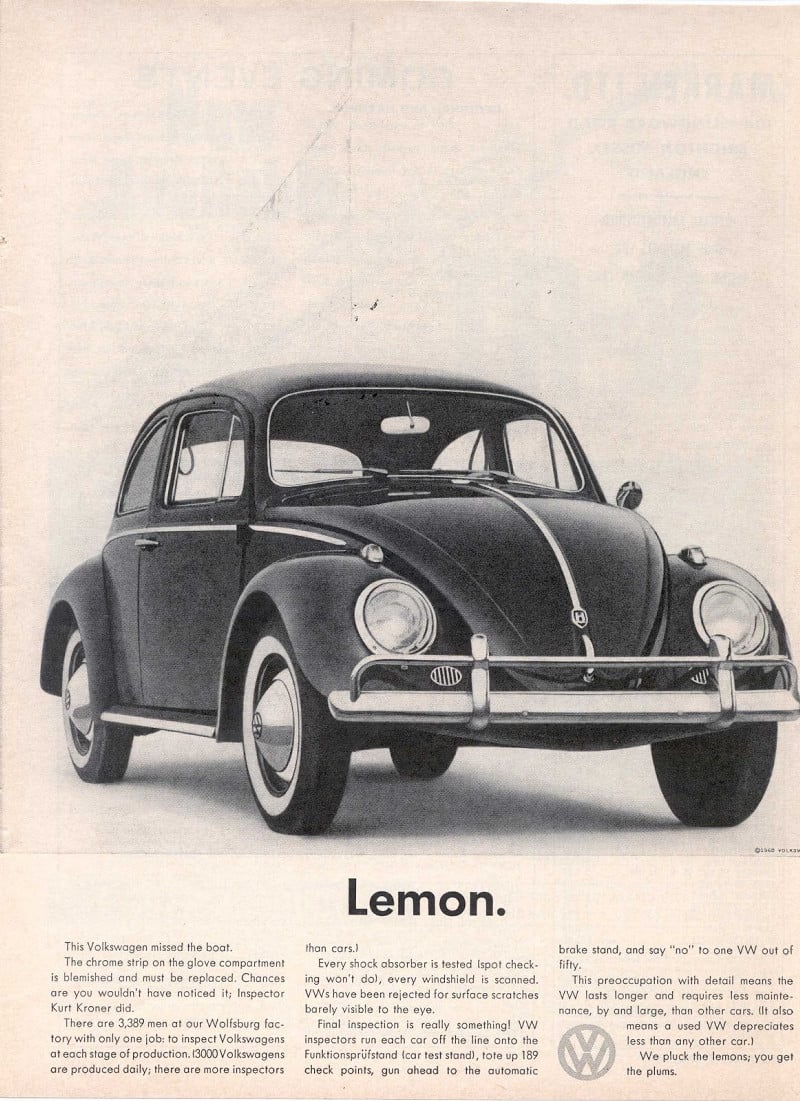
Think Small
Iconic print advertisement and integrated campaign for the Volkswagen Beetle produced by Doyle Dane Bernbach (DDB). Known for its spare layout, self-deprecating honesty and succinct copy that repositioned the small car as a virtue; widely credited with helping launch the modern creative revolution in advertising.
- Published1960
- TypeAdvertisement
- GenreAdvertising, Print ad, Campaign
- Languageen
About the Author

William Bernbach
William Bernbach, a revolutionary force in advertising, who co-founded DDB and championed creativity and empathy.
View Profile- OccupationBusinessman
- FromUSA
-
Other Works
- Lemon (Volkswagen) (1960)
- You Don’t Have to Be Jewish to Love Levy’s (1961)
- We Try Harder (Avis) (1962)