
Short Story: Worstward Ho
Overview
Samuel Beckett’s Worstward Ho is a late, radical prose piece that strips narrative to its skeletal minimum in order to test how little can be said while still saying. The title pivots from the Victorian adventure Westward Ho! to a voyage “worstward, ” exchanging expansion for contraction and discovery for depletion. Instead of plot, it offers a recursive drive to articulate and then erase, to conjure the faintest scene and pare it down further. The famous maxim “Ever tried. Ever failed. No matter. Try again. Fail again. Fail better.” crystallizes the method: progress as increasingly exact failure, language advancing by admission of its inadequacy.
Figures and Scene
Across a nearly bare expanse, gray, dim, without horizon, figures are proposed in the most tentative terms. An old man and a child are repeatedly set and reset: seated, facing, kneeling, head bowed, eyes down; their distance apart estimated then withdrawn, their postures revised, their very presence continually doubted. Sometimes one figure seems to be all there is; sometimes two; sometimes the thought of a third passes through, only to be dispelled. The space they inhabit is less a room than an inner theater, a skull-lit void with the least light possible to make out a contour before it too fades. Nothing like event occurs; the drama is the flicker of positing and canceling.
Method of Saying and Unsaying
The prose proceeds by injunctions, say a body, say a place, followed by qualifications that erode the assertion. Claims are touched, then withdrawn; numbers dwindle; measures are hazarded and unmade. The voice keeps pressing “on, ” then marks that there is “nohow on, ” yet goes on nonetheless, acknowledging each step as a botch while insisting on the next. Syntax mirrors the process: short, hammering units; repetitions, reversals, negations; a vocabulary narrowed to elemental words, say, seen, dim, least, gone. Where a conventional story builds, this one subtracts, seeking the minimum that still counts as saying, the least image that still flickers before it is extinguished.
Imagery and Motifs
Certain tokens recur as if at the edge of vision: the skull-like chamber; the weak, sourceless light; a hand lowered to a knee; a face tilted down; a child’s upturned head; the gray that thickens and thins. The human forms are schematic, their edges porous, their arrangement always provisional. Gesture replaces action, stillness replaces sequence. Counting and measuring fail, ten feet becomes less, then less again, until quantity itself seems suspect. Sight falters and hearing replaces it, then language tries to stand in for both, only to expose its own limits. The text circles the threshold where words cease to refer but still register, like breath fogging on glass before it clears.
Arc and Ending
The movement is not toward enlightenment but toward worst, toward the least remaining sayable. Each iteration drains more from the scene: figures shrink, distances blur, light ebbs, and words themselves wear thin. Even so, the compulsion to proceed never relaxes. The piece closes near a silence that cannot be fully had, a no-saying that cannot be fully said. What remains is a paradoxical persistence: a vowed fidelity to dwindling, a refusal to adorn failure with consolation, and a relentless articulation of its steps. Worstward Ho holds to the smallest ember of utterance, worrying it down until only the act of trying, stripped, stark, exact, still glows.
Citation Formats
APA Style (7th ed.)
Worstward ho. (2025, November 8). FixQuotes. https://fixquotes.com/works/worstward-ho/
Chicago Style
"Worstward Ho." FixQuotes. November 8, 2025. https://fixquotes.com/works/worstward-ho/.
MLA Style (9th ed.)
"Worstward Ho." FixQuotes, 8 Nov. 2025, https://fixquotes.com/works/worstward-ho/. Accessed 5 Mar. 2026.
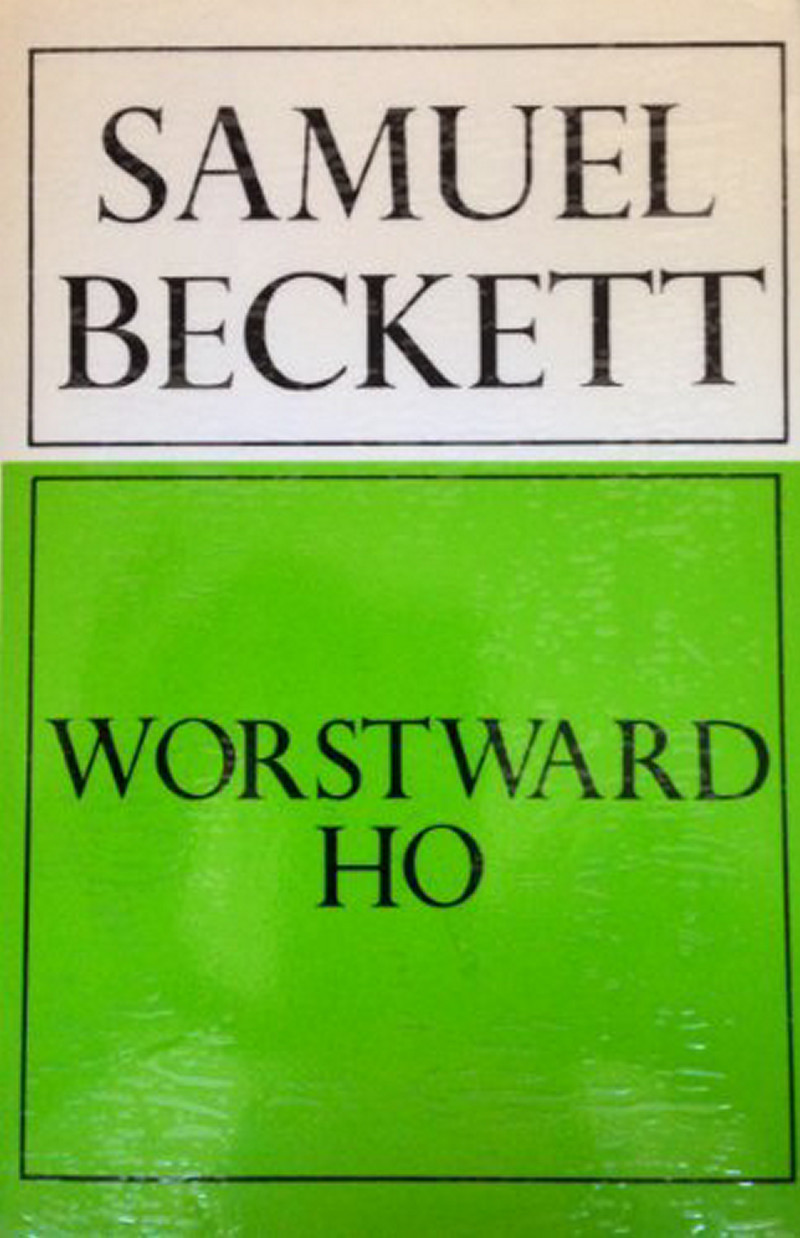
Worstward Ho
A terse, aphoristic prose piece famed for the line 'Ever tried. Ever failed. No matter. Try again. Fail again. Fail better.' It explores endurance, linguistic reduction and a relentless will to continue despite failure.
- Published1983
- TypeShort Story
- GenreProse, Experimental
- Languageen
- CharactersAn unnamed voice/narrator
About the Author

Samuel Beckett
Samuel Beckett covering life, major works, wartime years, bilingual writing, theater collaborations, Nobel Prize and quotes.
View Profile- OccupationPlaywright
- FromIreland
-
Other Works
- Murphy (1938)
- Eleutheria (1947)
- Malone Dies (1951)
- Molloy (1951)
- Watt (1953)
- Waiting for Godot (1953)
- The Unnamable (1953)
- Endgame (1957)
- Krapp's Last Tape (1958)
- Happy Days (1961)
- Cascando (1963)
- Play (1963)
- Come and Go (1965)
- Not I (1972)
- That Time (1976)
- Company (1980)
- Rockaby (1981)
- Ill Seen Ill Said (1981)
- Catastrophe (1982)